Puky
- 22
- 0
Hello, this is not really a homework question, but a question on a specific problem so I thought it belonged here rather than the General Physics subforum. This is a problem that was asked in our final exam, and I have doubts about it's "correct" solution. Here's a paint art to explain the problem.
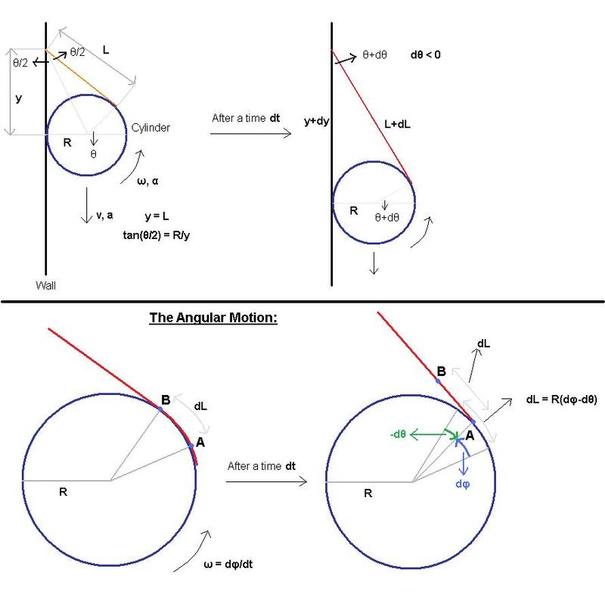
Here, a cylinder with a cord wrapped around it with one end fixed to the wall is released from rest, and it slides down as the cord unrolls. I have shown some variables on the diagram.
The question was to calculate the linear acceleration of the center of mass and the angular acceleration of the cylinder, given the needed constants like the radius and the coefficient of kinetic friction (it was small enough so that the cylinder could slide down). At the end it comes down to whether or not the magnitude of the linear acceleration [itex]a[/itex] is equal to the angular acceleration [itex]\alpha[/itex] times the radius [itex]R[/itex] (or [itex]a = \alpha R[/itex]).
Apparently, we were supposed to assume that this equation does hold, because the cord around the cylinder unrolls without slipping. It wasn't that easy to believe for me, because the direction in which the cord extends is not the same as the direction of the linear acceleration. So I did some calculation and found that the magnitude of the linear velocity [itex]v[/itex] is greater than angular speed times the radius ([itex]\omega R[/itex]), so [itex]a = \alpha R[/itex] cannot be true. But I need to be sure if my calculation was correct.
Here is what I did:
In the diagram on the upper left, it can be seen that [tex]\tan(\frac{\theta}{2})=\frac{R}{y}.[/tex]
Also, we have [tex]y=L.[/tex]
Now after a time [itex]dt[/itex], the angle [itex]\theta[/itex] will decrease, so [itex]d\theta[/itex] is negative.
Differentiating the equation [itex]\tan(\frac{\theta}{2}) = \frac{R}{y}[/itex] gives [tex]\frac{d\theta}{2\cos^2(\frac{\theta}{2})} = \frac{-R}{y^2}dy[/tex] rewriting [itex]2\cos^2(\frac{\theta}{2})[/itex] as [itex]1+\cos(\theta)[/itex] and rearranging [tex]d\theta=\frac{-R(1+\cos(\theta))}{y^2}dy.[/tex]Now let's consider only the rotational motion, with the diagrams shown in the lower part of the image. Pick two points A and B on the cord such that the cord will be tangent to the cylinder at B, and the length of the cord between these points will be [itex]dL[/itex] (or [itex]dy[/itex], since they are equal).
A time [itex]dt[/itex] after that picture, the cord will have extended by a length [itex]dL[/itex], so the cord will be tangent to the cylinder at A, but at a different angle [itex]\theta[/itex]. As shown in the image, the cylinder will rotate by an angle [itex]d\phi[/itex], and [itex]\theta[/itex] will decrease by [itex]-d\theta[/itex]. So these two differential angles added up will be equal to the angle between the two line segments connecting the center to A and B in the previous frame. So, [tex]dL=R(d\phi-d\theta).[/tex]
Plugging in the relationship between [itex]d\theta[/itex] and [itex]dy[/itex], using [itex]dL=dy[/itex] and rearranging gives:[tex](1-\frac{R^2(1+\cos(\theta))}{y^2})dy = R d\phi[/tex] dividing by dt: [tex](1-\frac{R^2(1+\cos(\theta))}{y^2})v = \omega R.[/tex]
According to this, [itex]v[/itex] is not equal to [itex]\omega R[/itex], but greater; and differentiating this last equation with respect to time doesn't give [itex]a=\alpha R[/itex].Thank you if you have bothered to read this far. Do you think everything I've done is correct? If anyone spots a mistake or can confirm that this is correct, I'd be glad if you could leave a reply. Thanks.
Here, a cylinder with a cord wrapped around it with one end fixed to the wall is released from rest, and it slides down as the cord unrolls. I have shown some variables on the diagram.
The question was to calculate the linear acceleration of the center of mass and the angular acceleration of the cylinder, given the needed constants like the radius and the coefficient of kinetic friction (it was small enough so that the cylinder could slide down). At the end it comes down to whether or not the magnitude of the linear acceleration [itex]a[/itex] is equal to the angular acceleration [itex]\alpha[/itex] times the radius [itex]R[/itex] (or [itex]a = \alpha R[/itex]).
Apparently, we were supposed to assume that this equation does hold, because the cord around the cylinder unrolls without slipping. It wasn't that easy to believe for me, because the direction in which the cord extends is not the same as the direction of the linear acceleration. So I did some calculation and found that the magnitude of the linear velocity [itex]v[/itex] is greater than angular speed times the radius ([itex]\omega R[/itex]), so [itex]a = \alpha R[/itex] cannot be true. But I need to be sure if my calculation was correct.
Here is what I did:
In the diagram on the upper left, it can be seen that [tex]\tan(\frac{\theta}{2})=\frac{R}{y}.[/tex]
Also, we have [tex]y=L.[/tex]
Now after a time [itex]dt[/itex], the angle [itex]\theta[/itex] will decrease, so [itex]d\theta[/itex] is negative.
Differentiating the equation [itex]\tan(\frac{\theta}{2}) = \frac{R}{y}[/itex] gives [tex]\frac{d\theta}{2\cos^2(\frac{\theta}{2})} = \frac{-R}{y^2}dy[/tex] rewriting [itex]2\cos^2(\frac{\theta}{2})[/itex] as [itex]1+\cos(\theta)[/itex] and rearranging [tex]d\theta=\frac{-R(1+\cos(\theta))}{y^2}dy.[/tex]Now let's consider only the rotational motion, with the diagrams shown in the lower part of the image. Pick two points A and B on the cord such that the cord will be tangent to the cylinder at B, and the length of the cord between these points will be [itex]dL[/itex] (or [itex]dy[/itex], since they are equal).
A time [itex]dt[/itex] after that picture, the cord will have extended by a length [itex]dL[/itex], so the cord will be tangent to the cylinder at A, but at a different angle [itex]\theta[/itex]. As shown in the image, the cylinder will rotate by an angle [itex]d\phi[/itex], and [itex]\theta[/itex] will decrease by [itex]-d\theta[/itex]. So these two differential angles added up will be equal to the angle between the two line segments connecting the center to A and B in the previous frame. So, [tex]dL=R(d\phi-d\theta).[/tex]
Plugging in the relationship between [itex]d\theta[/itex] and [itex]dy[/itex], using [itex]dL=dy[/itex] and rearranging gives:[tex](1-\frac{R^2(1+\cos(\theta))}{y^2})dy = R d\phi[/tex] dividing by dt: [tex](1-\frac{R^2(1+\cos(\theta))}{y^2})v = \omega R.[/tex]
According to this, [itex]v[/itex] is not equal to [itex]\omega R[/itex], but greater; and differentiating this last equation with respect to time doesn't give [itex]a=\alpha R[/itex].Thank you if you have bothered to read this far. Do you think everything I've done is correct? If anyone spots a mistake or can confirm that this is correct, I'd be glad if you could leave a reply. Thanks.
Last edited:

