Discussion Overview
The discussion revolves around identifying whether circuit elements are in series or parallel, particularly in the context of calculating total resistance in a circuit. Participants explore definitions, provide examples, and clarify concepts related to circuit analysis.
Discussion Character
- Exploratory
- Technical explanation
- Conceptual clarification
- Debate/contested
Main Points Raised
- One participant asserts that two elements are in parallel if they share two extraordinary nodes, while another participant agrees with this definition but questions its application in a specific example.
- Another participant suggests that to find the Thevenin equivalent, one must short-circuit the voltage source and redraw the circuit for clarity.
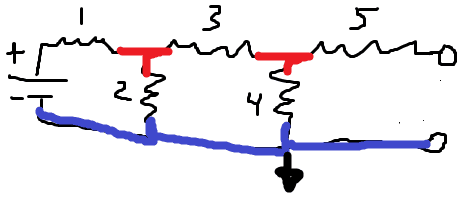
- There is a discussion about the configuration of resistors, with one participant stating that R3 is in series with (R1 || R2) because they do not share the same two extraordinary nodes.
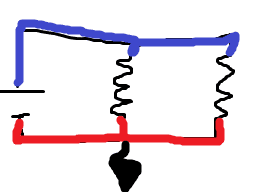
- A participant challenges a drawing that incorrectly shows R1 being shorted out, clarifying that shorting the voltage source involves replacing it with a wire.
- One participant provides a drawing to illustrate their understanding, stating that R3 is in series with (R1 || R4) and that the entire arrangement is parallel with R4, while R5 is in series with the whole setup.
- Another participant corrects the previous statement about the configuration, indicating that it should refer to (R1 || R2) instead of (R1 || R4).
- A participant provides a general definition of series and parallel connections, explaining that elements are in series if the current through them is the same and in parallel if they are connected at both ends, sharing the same voltage.
- One participant notes that the total resistance can differ based on the perspective of the circuit being analyzed, providing an example of how R1 and R2 appear in parallel when looking from the output, but the input resistance is calculated differently.
Areas of Agreement / Disagreement
Participants express both agreement and disagreement on various points, particularly regarding the configuration of resistors and the definitions of series and parallel connections. There is no consensus on the correct drawing or the total resistance calculations, indicating that multiple competing views remain.
Contextual Notes
Limitations include potential misunderstandings in circuit drawings and the dependence on specific definitions of series and parallel connections. The discussion also highlights the complexity of analyzing circuits from different perspectives, which may lead to different interpretations of the same configuration.