Calculate Minor Losses due to Flow Geometry Alone

Click For Summary

Discussion Overview

The discussion revolves around calculating minor losses in fluid flow due to geometry, specifically isolating these losses from major frictional losses. Participants explore the relationship between viscosity, flow geometry, and head loss, questioning the empirical nature of existing formulas and seeking a first principles approach.

Discussion Character

  • Exploratory
  • Technical explanation
  • Debate/contested
  • Mathematical reasoning

Main Points Raised

  • One participant seeks a formula to calculate minor losses solely based on area and velocity changes, separate from major frictional losses, and questions the empirical nature of existing K values.
  • Another participant asserts that head loss calculations are primarily empirical and raises a fundamental question about the existence of losses in the absence of viscosity.
  • A participant expresses confusion regarding the relationship between minor losses and fluid viscosity, noting that literature suggests local loss coefficients are not correlated with Reynolds number or roughness but rather with pipe size.
  • There is a discussion about the implications of inviscid flow, with one participant arguing that such flow would incur no losses and that pressure gradients in inviscid conditions are reversible, referencing Bernoulli's equation.
  • Another participant speculates that using a lower viscosity fluid might reduce both minor and major head losses due to easier flow direction changes.

Areas of Agreement / Disagreement

Participants express differing views on the relationship between viscosity and minor losses, with some suggesting that viscosity affects these losses while others argue that inviscid flow would not incur losses at all. The discussion remains unresolved regarding the calculation methods and the influence of viscosity on minor losses.

Contextual Notes

There are limitations in the assumptions made about the relationship between viscosity and head losses, as well as the applicability of existing empirical formulas. The discussion highlights the complexity of fluid dynamics and the need for clarity on definitions and conditions under which these calculations apply.

Timtam
Messages
40
Reaction score
0
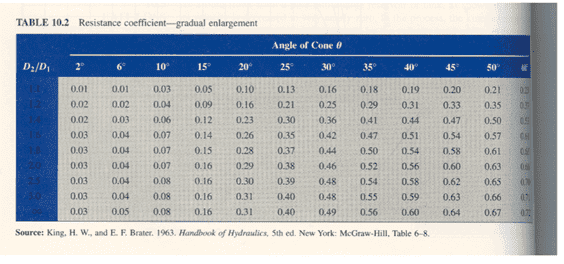
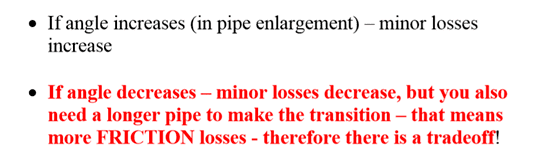
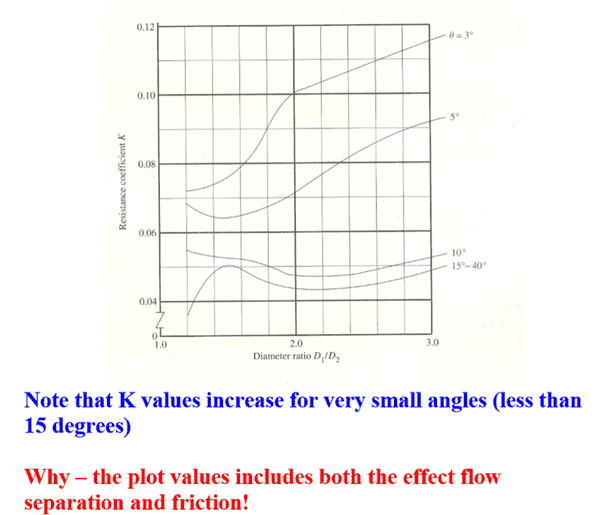
Hi does anyone know a way to calculate the Minor losses related just to flow Geometry isolated from Major frictional losses, all the k tables I can find combine the frictional losses with the geometry losses eg see below blurb from
upload_2016-5-16_10-29-10.png
upload_2016-5-16_10-29-30.png
upload_2016-5-16_10-29-40.png

but I was hoping to obtain a first principles formula that could equate these losses solely to area and velocity change

The reason being is I am assuming that major losses component of the K values must be based on particular viscosity fluid but I would like to calculate this for different viscosity fluids ?

Also for the Darcy Weisbach if I want to calculate just the frictional losses would I use the average diameter of a convergent or divergent section of pipe ?

If such a formula exists it ok to just plain add these two effects ?

Am I making life to difficult for myself is there an easier way ?
 
Science news on Phys.org
There's really nothing about these sorts of head loss calculations that comes from first principles. It is basically all empirical.

But here is a more fundamental issue: if there was no viscosity at all, what do you think would cause such losses to occur in these sorts of situations?
 
This is what confuses me. I always thought that minor losses are (like major head loss ) also proportional to the viscosity of the fluid but I am seeing statements like the below that suggest that it isn't.

where KL means (local) loss coefficient. Although KL is dimensionless, it is not correlated in the literature with the Reynolds number and roughness ratio but rather simply with the raw size of the pipe.

In an inviscid flow I was assuming that these Minor head losses come from the force required to change the Momentum of the flow or the orthogonal area the obstruction presents to the flow.

That said it makes sense to me that a lower viscosity fluid would find it easier to change direction and thus would incur smaller later flow separation

Is this correct ? could I also reduce my Minor head loss ( as well as my Major head loss) by using a lower viscosity fluid ?
 
The broader point I was trying to make is that an inviscid flow would incur no losses. Separation doesn't really make sense as a concept without viscosity. So, there is no source of dissipation to cause losses in an inviscid flow. Sure a force is required to accelerate the flow through a contraction, but that comes from a pressure gradient, and that pressure gradient is completely reversible in an inviscid flow. It's basically Bernoulli's equation.
 

Similar threads

  • · Replies 25 ·
Replies
25
Views
2K
Replies
8
Views
2K
  • · Replies 3 ·
Replies
3
Views
2K
  • · Replies 2 ·
Replies
2
Views
2K
  • · Replies 4 ·
Replies
4
Views
17K
  • · Replies 7 ·
Replies
7
Views
3K
  • · Replies 5 ·
Replies
5
Views
6K
  • · Replies 31 ·
2
Replies
31
Views
5K
  • · Replies 2 ·
Replies
2
Views
2K
  • · Replies 8 ·
Replies
8
Views
2K