Can You Solve This Infinite Grid of Resistors Problem?

Click For Summary

Discussion Overview

The discussion revolves around a problem involving an infinite grid of resistors, exploring the calculation of resistance in such a configuration. Participants reference both theoretical and practical aspects of the problem, including potential applications and related puzzles.

Discussion Character

  • Exploratory, Technical explanation, Debate/contested, Conceptual clarification

Main Points Raised

  • Some participants mention the problem as a well-known physics puzzle, indicating its popularity in academic circles.
  • One participant recalls a related scenario involving the calculation of resistance between two metal rods inserted into the ground, suggesting a continuous case of the problem.
  • Another participant highlights the importance of calculating total resistance by considering paths that are electrically parallel, emphasizing the condition of no current flow between those paths.
  • There is a mention of a resource that provides calculations related to the infinite grid of resistors, although no specific details about the calculations are provided.

Areas of Agreement / Disagreement

Participants express varying levels of familiarity with the problem, with some unable to solve it while others reference related concepts. No consensus on a solution is reached, and multiple viewpoints regarding the problem's complexity are evident.

Contextual Notes

Some assumptions about the configuration of the resistors and the conditions under which resistance is calculated are not fully explored. The discussion does not resolve the mathematical steps necessary for a complete solution.

Who May Find This Useful

This discussion may be of interest to those studying electrical engineering, physics, or anyone intrigued by theoretical problems involving circuits and resistance.

excrucio
Messages
3
Reaction score
0
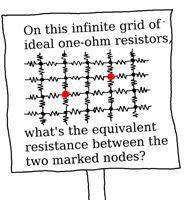
Could you solve this?
problem.JPG
 
Physics news on Phys.org
That's a famous physics "puzzle". Can you solve it?
 
I believe back in college I had to calculate the continuous case of this, e.g. you stick two metal rods into the ground a meter apart. What is the resistance between the rods given the resistivity of the ground.
(EDIT: Or maybe I just imagine having solved it. I definitely pondered it in the past)

The key insight in this problem is that you calculate the total resistance of it by calculating resistance along paths that are all electrically parallel with each other. More importantly, to be able to do so, you choose the paths so that there is no current flowing between those paths. That scenario happens when two neighboring paths have the same potential along their paths.

Sorry, that's all I recall :)
 
NO, I cannot solve it :(
 
Just FYI, there's a neat web page on the matter that calculates it.
 
Link?
 

Similar threads

  • · Replies 4 ·
Replies
4
Views
3K
  • · Replies 4 ·
Replies
4
Views
2K
  • · Replies 12 ·
Replies
12
Views
2K
  • · Replies 4 ·
Replies
4
Views
17K
  • · Replies 17 ·
Replies
17
Views
2K
  • · Replies 8 ·
Replies
8
Views
2K
  • · Replies 2 ·
Replies
2
Views
3K
  • · Replies 17 ·
Replies
17
Views
2K
Replies
9
Views
2K
  • · Replies 8 ·
Replies
8
Views
2K