Charges are Great Need more assistance

  • Thread starter Thread starter Saladsamurai
  • Start date Start date
  • Tags Tags
    Assistance Charges
Click For Summary

Homework Help Overview

The discussion revolves around a problem in electrostatics involving three charged particles. The original poster seeks to determine the ratio of charge q_3 to charge q, given specific conditions about the forces acting on the particles when they are held in place.

Discussion Character

  • Exploratory, Assumption checking, Problem interpretation

Approaches and Questions Raised

  • Participants explore the condition of zero net force on the particles and discuss the relationships between the forces acting on each charge. There are attempts to derive expressions for the forces and to understand the implications of these relationships.

Discussion Status

Participants are actively engaging with the problem, sharing insights and nudges towards understanding the relationships between the forces. Some guidance has been offered regarding the net force conditions, but there is still uncertainty about the correct application of these principles.

Contextual Notes

There is mention of confusion regarding the distances used in the force calculations, specifically the relationship between L and x, which may affect the setup of the problem. The original poster expresses frustration with the complexity of the problem and the need for further clarification.

Saladsamurai
Messages
3,009
Reaction score
7
[SOLVED] Charges are Great! Need more assistance!
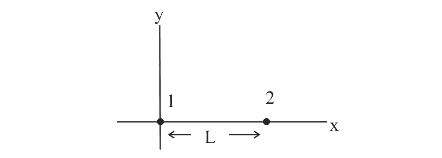
Homework Statement


Picture2-1.png


In the figure particle 1 of +q and particle 2 of charge +4q are held at a separation of L=.09 m If particle 3 of charge q_3 is to be placed such that the three particles remain in place when released, what must be (a) the ratio q_3/q and the (b) x and (c) y components?


Okay, I solved b and c easy enough. There is no y component and x=.03.

I am having trouble with a. Any hints? I know it must be a similar procedure, that is, I need to use the fact that there is NO NET force...but I can't seem to spot the correct relationship such that I am left with the desired variables (they don't cancel).

Word.
 
Physics news on Phys.org
Okay, I looked it up on Cramster (which I absolutely hate doing) and in their solution they assume that [itex]F_{31}=F_{21}[/itex] , but I cannot reason that out.

Any ideas?
 
Good Morning! Maybe I'll have some luck, now let's see here. . .:smile:
 
For your answer of b you used the fact that the net force on q3 must be 0. now use the fact that the net force on q1 and q2 must be 0.
 
kamerling said:
For your answer of b you used the fact that the net force on q3 must be 0. now use the fact that the net force on q1 and q2 must be 0.

Okay, I am kind of with you. So since the net force on all three particles is 0, then. . . crap I lost it.

Can someone give ne a little more of a nudge?
 
Saladsamurai said:
Okay, I am kind of with you. So since the net force on all three particles is 0, then. . . crap I lost it.

Can someone give ne a little more of a nudge?

Anyone? I know it may be obvious to some, but not to me.
 
What are the expressions for the total force on each charge? For each one just add the forces from each of the other two.
 
You mean like [itex]F_{1,net}=F_{12}+F_{13}[/itex]?
 
Sure, why not? Now, what are [tex]F_{12}[/tex] and [tex]F_{13}[/tex]?
 
  • #10
[tex]F_{12}=\frac{k|q||4q|}{L^2}[/tex]

and

[tex]F_{13}=\frac{k|q||q_3|}{(L-x)^2}[/tex]

Okay, I have values for L and X. What about the [itex]F_{1,net}[/itex] would that just be 0? It must be since the condition is that they stay in place, thus F_net-0.

Does this sound reasonable?
 
Last edited:
  • #11
I cannot get this to come out right! I am trying to solve for the ratio [itex]\frac{q_3}{q}[/itex]Using
[tex]F_{1,net}=F_{12}+F_{13}[/tex]

[tex]\Rightarrow F_{1,net}=\frac{k|q||4q|}{L^2}+\frac{k|q||q_3|}{(L-x)^2}[/tex]

I thought I could say that [itex]F_{1,net}=0[/itex] And then solve the above for

[tex]\frac{q_3}{q}[/tex]

But this is not working?
 
  • #12
Got IT! r_2 not equal to L-x. . . duh. It's just x!

Thanks everyone!
 

Similar threads

  • · Replies 6 ·
Replies
6
Views
3K
Replies
14
Views
3K
  • · Replies 25 ·
Replies
25
Views
2K
  • · Replies 3 ·
Replies
3
Views
2K
Replies
1
Views
1K
Replies
21
Views
2K
  • · Replies 11 ·
Replies
11
Views
2K
Replies
1
Views
910
  • · Replies 1 ·
Replies
1
Views
2K
  • · Replies 1 ·
Replies
1
Views
2K