Engineering Circuit input impedance with ground in an OP Amp circuit

Click For Summary
The discussion focuses on determining the input impedance and the impedance between the input terminal and ground in a specific operational amplifier (op-amp) circuit. Participants emphasize that the voltages at the op-amp's inverting and non-inverting terminals are ideally equal, but caution against assuming virtual grounds in this configuration. The approach to calculating input impedance involves using the relationship of input voltage to input current, specifically through resistor R3. There is a correction regarding the gain formula, highlighting that it must account for both negative and positive feedback in the circuit. Understanding the feedback dynamics is crucial for accurately calculating the circuit's behavior and impedance.
bobg123
Messages
1
Reaction score
0
Homework Statement
Find input impedance of the circuit shown. Calculate impedance between the input terminal and the ”ground”. Two resistors R1 have equal resistance.
Relevant Equations
V-=V+
V=IR
V_out=-R1/R3 Vin
V_out=R1/R2+1 Vin
I've been given the following circuit and have been asked to find the input impedance and the impedance between the input terminal and ground. I've never encountered an operational amplifier configured like this.
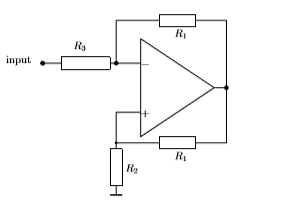
WwSBI.png

I know that the voltages at the - and + terminals of the op amp are ideally equal. In a normal inverting/non inverting op amp, I've been told the voltages at those points are zero. Is this still the case? If so, what is the output voltage? I'm having trouble conceptually understanding what this particular circuit does.

I'm not sure how to approach this problem, but I've tried separating the circuit into an inverting and non-inverting circuit. For the inverting circuit, I know V_out=-V_in*R1/R3. This gives me V(-)=V_in+V_in/R_3. For the noninverting, I know V_out=(R1/R2+1)V_in. The voltage at V(+) should be equal to V(-), giving V_in+V_in/R_3=V(R1)-V(R2)=R1/R2V_in+V_in-V(R2). Some rearrangement gives me V_in(1/R3-R1/R2)=-V(R2). Is this the right way of approaching the problem? Where do I go from here to calculate the impedance?
 
Physics news on Phys.org
bobg123 said:
I know that the voltages at the - and + terminals of the op amp are ideally equal.
That's one assumption you need to make, the other is that negligible current is drawn into those op-amp inputs. It would be wrong to think there are any virtual grounds here.

As always, input impedance = input voltage ÷ input current
and for this circuit, input current = the current in R3.
 
Calculate ther gain of the circuit.
Then, it will not be a problem to find the current through the chain R3..R1.
 
bobg123 said:
I've been given the following circuit and have been asked to find the input impedance and the impedance between the input terminal and ground. I've never encountered an operational amplifier configured like this.
View attachment 241071
I know that the voltages at the - and + terminals of the op amp are ideally equal. In a normal inverting/non inverting op amp, I've been told the voltages at those points are zero. Is this still the case? If so, what is the output voltage? I'm having trouble conceptually understanding what this particular circuit does.

I'm not sure how to approach this problem, but I've tried separating the circuit into an inverting and non-inverting circuit. For the inverting circuit, I know V_out=-V_in*R1/R3. This gives me V(-)=V_in+V_in/R_3. For the noninverting, I know V_out=(R1/R2+1)V_in. The voltage at V(+) should be equal to V(-), giving V_in+V_in/R_3=V(R1)-V(R2)=R1/R2V_in+V_in-V(R2). Some rearrangement gives me V_in(1/R3-R1/R2)=-V(R2). Is this the right way of approaching the problem? Where do I go from here to calculate the impedance?

Are you still working on this problem?

One problem I see is that in this:

V_in+V_in/R_3=V(R1)-V(R2)=R1/R2V_in+V_in-V(R2)

You are equating a sum of a voltage (red) and a current (blue) to a voltage (green). That's not permissible.
 
Quote: I know V_out=-V_in*R1/R3

No - that is not correct.
This simple expression is valid in case the feedback path contains these two resistors only (negative feedback).
However - in addition, we have positive feedback via R1 and R2.
Note, that the above simple gain expression results from a general formula for feedback circuits (and idealized open-loop gain): A=-Hf/Hr.
Both expressions Hf and Hr consist of simple voltage dividers and are defined as follows
(Vd=Diff. voltage at the opamps input):
* Forward damping: Hf=Vd/Vin for Vout=0
* Return damping (feedback factor): Hr=Vd/Vout for Vin=0.

This general formula is to be used also for the given circuit.
 

Similar threads

Replies
15
Views
2K
  • · Replies 2 ·
Replies
2
Views
1K
  • · Replies 1 ·
Replies
1
Views
2K
Replies
34
Views
4K
Replies
1
Views
2K
  • · Replies 2 ·
Replies
2
Views
3K
  • · Replies 13 ·
Replies
13
Views
2K
  • · Replies 12 ·
Replies
12
Views
2K
  • · Replies 8 ·
Replies
8
Views
2K
  • · Replies 12 ·
Replies
12
Views
4K