Dirac's Gamma Matrices: What Are They & Do They Have Many Forms?

Click For Summary

Discussion Overview

The discussion centers around Dirac's gamma matrices, exploring their definitions, forms, and representations within the context of the Dirac equation. The scope includes theoretical aspects and potential applications in high energy and non-relativistic physics.

Discussion Character

  • Exploratory, Technical explanation, Debate/contested

Main Points Raised

  • Some participants inquire about the nature and various forms of Dirac's gamma matrices.
  • It is noted that there are different ways to define the gamma matrices, which can lead to variations in the Dirac equation's appearance depending on the representation used.
  • One participant expresses a preference for the Weyl or chiral basis, suggesting it is particularly useful for studying relativistic particles.
  • Another participant contrasts the Weyl basis with the Dirac basis, indicating that the latter is more suitable for non-relativistic particle studies, with the definitions of "relativistic" and "non-relativistic" being context-dependent.

Areas of Agreement / Disagreement

Participants express differing preferences for the Weyl and Dirac bases, indicating a lack of consensus on which representation is superior for various applications.

Contextual Notes

The discussion does not resolve the implications of using different bases or the specific contexts in which each might be preferred, leaving these aspects open for further exploration.

pallab
Messages
43
Reaction score
4
what are Dirac's gamma matrices
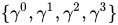
\{\gamma ^{0},\gamma ^{1},\gamma ^{2},\gamma ^{3}\}
. especially ,
\gamma ^{0}
does it have many forms?
 
Physics news on Phys.org
pallab said:
what are Dirac's gamma matrices
\{\gamma ^{0},\gamma ^{1},\gamma ^{2},\gamma ^{3}\}
. especially ,
\gamma ^{0}
does it have many forms?

There are some different ways to define them. The Dirac equation, in which a matrix with differential operators as its entries is acting on the spinor field, looks a bit different depending on the representation (assuming you write it explicitly in matrix-spinor form).
 
Michael Price said:
Of the choices, I find the Weyl or chiral basis the best one to use..

Generally speaking, the Weyl basis (in which ##\gamma^5## is diagonal) is most useful for studying relativistic particles, such as in high energy physics experiments, while the Dirac basis (in which ##\gamma^0## is diagonal) is most useful for studying non-relativistic particles. (Here "relativistic" and "non-relativistic" is relative to the lab frame in which the measuring equipment is assumed to be at rest.)
 
  • Like
Likes   Reactions: vanhees71 and Michael Price

Similar threads

  • · Replies 22 ·
Replies
22
Views
2K
  • · Replies 1 ·
Replies
1
Views
4K
  • · Replies 1 ·
Replies
1
Views
2K
  • · Replies 3 ·
Replies
3
Views
3K
  • · Replies 71 ·
3
Replies
71
Views
12K
  • · Replies 4 ·
Replies
4
Views
4K
Replies
7
Views
4K
  • · Replies 4 ·
Replies
4
Views
3K
  • · Replies 3 ·
Replies
3
Views
2K
  • · Replies 5 ·
Replies
5
Views
3K