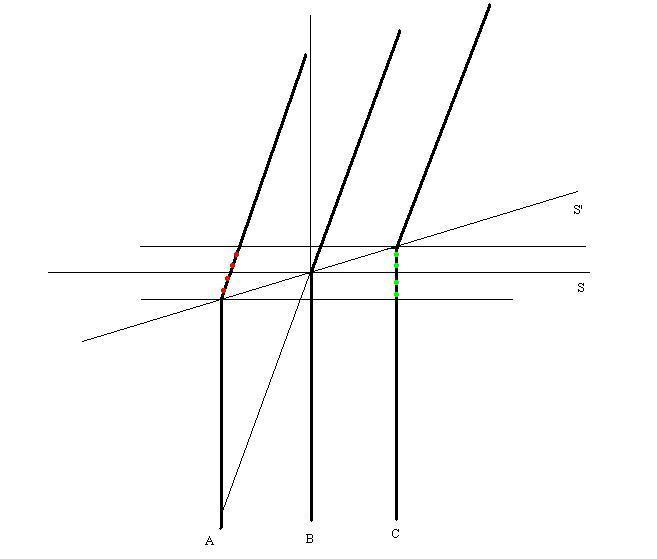
mananvpanchal said:
Please, try to understand. I have defined some events in diagram (red events and green events). A can define red events in its S' frame and C can define the same events in its S frame. Same for green events, A can define green events in its S' frame and C can define the same events in its S frame. The all events is defined by two co-ordinate system for A and C.
The issue here is not to define the events in any frame or transforming to one frame to another.
First off, let me point out that your scenario has nothing to do with the fact that A, B and C are clocks--they could just as easily be rocks. You haven't asked about the times on the clocks.
mananvpanchal said:
The issue is:
at t1: LoS is horzontal for all three clock.
In frame S, LoS is horizontal
all the time for all events. You don't have to narrow it down to any specific time.
mananvpanchal said:
at t2: A changes its frame and LoS of its become skewed.
A didn't change its frame. A has always been in frame S
and in frame S'. In frame S', LoS is skewed
all the time for all events. You don't have to narrow it down to any specific time.
However, the event at which A changes its speed has two different sets of co-ordinates, one set for frame S and another set for frame S'. You just can't say at t2, something happened to A without also saying which frame t2 applies to.
mananvpanchal said:
A misses all green events on C.
This statement reveals that you don't have any idea what an event is. The green events occur in both frames, just with different co-ordinates. Why do you think that A misses any events? This just doesn't make any sense at all.
mananvpanchal said:
at t3: B changes its frame.
B changes its speed, not its frame, and you need to say which frame t3 applies to. B is always in both frames, just at rest prior to a certain time in frame S and after a different certain time is S'. You need to do a Lorentz Transform to determine those two times in both frames, you cannot just say that t3 applies to both frames.
mananvpanchal said:
at t4: C changes its frame.
Likewise for C and t4.
mananvpanchal said:
between t2 and t4: C is in S frame, and all red events occur for C.
At all times, C is in both frames. Each red event has two different sets of co-ordinates, one for frame S and one for frame S'.
mananvpanchal said:
we take t4 of S=t'1 of S'
You cannot compare times in frame S with times in S'. It is meaningless to say that the time co-ordinate in one frame is equal to the time co-ordinate in a different frame (except, of course, for the origins). What you can do is say that t'4=t'1 (if it is, who knows?).
mananvpanchal said:
so, after t'1: LoS of C become skewed.
LoS applies to frames, not to rocks or clocks. LoS is skewed in your drawing for frame S' all the time, not just for the one example you drew. LoS is horizontal in your drawing for frame S all the time, not just for the three examples you drew.
mananvpanchal said:
The all red events seems eligible to re-occur for C.
This last statement reveals that you have no idea what an event is.
Really, this is a trivial issue. As long as you continue to ignore what I'm telling you and insist that I don't understand, then you will continue to struggle with this very simple issue.