Finding the perpendicular distance in this moments question

Click For Summary

Homework Help Overview

The discussion revolves around a moments question involving the calculation of a perpendicular distance related to forces in a diagram. Participants are exploring the geometry of the setup, particularly focusing on the relationship between various lines and angles in the context of moments.

Discussion Character

  • Exploratory, Assumption checking, Problem interpretation

Approaches and Questions Raised

  • Participants discuss the setup of the problem, questioning the correctness of their diagrams and the identification of the required distances. There are attempts to clarify the relationship between different lines and angles, with some suggesting the use of geometric properties to find the necessary distances.

Discussion Status

The discussion is active, with participants providing guidance on how to approach the problem. Some have indicated that there is sufficient information available, while others express uncertainty about the adequacy of their diagrams and the relationships between the elements involved.

Contextual Notes

Participants note potential missing information and express concerns about the clarity of the problem setup. There is a mention of specific angles and distances that may influence the calculations, as well as the need for a clearer understanding of the relationships between the lines in the diagram.

Bolter
Messages
262
Reaction score
31
Homework Statement
See below
Relevant Equations
moment = force x perp dist
I have tried this question but can't get my head around to doing part b)
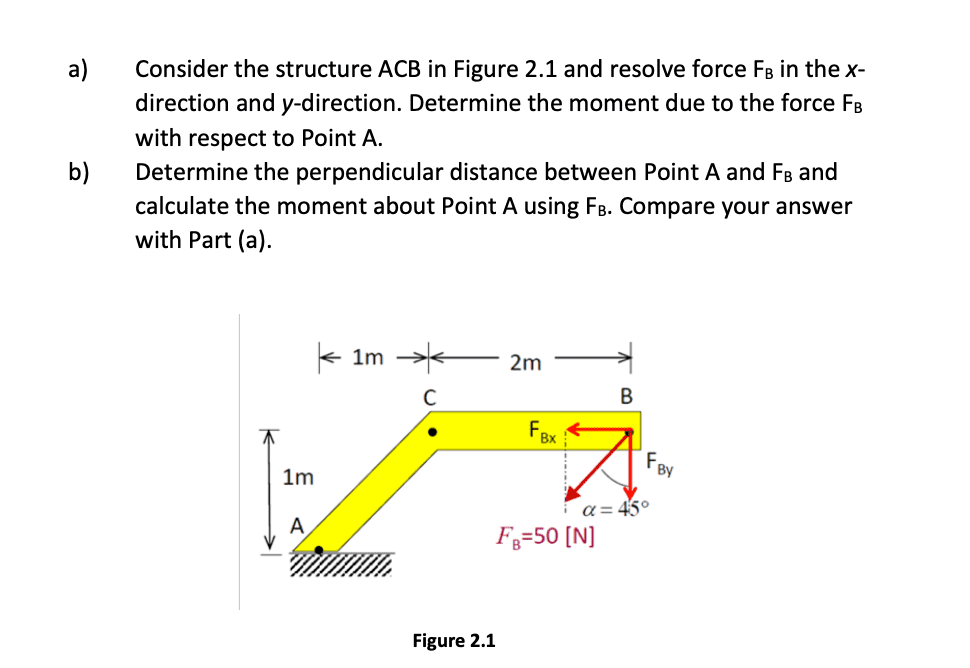
Screenshot 2020-10-18 at 15.30.36.png


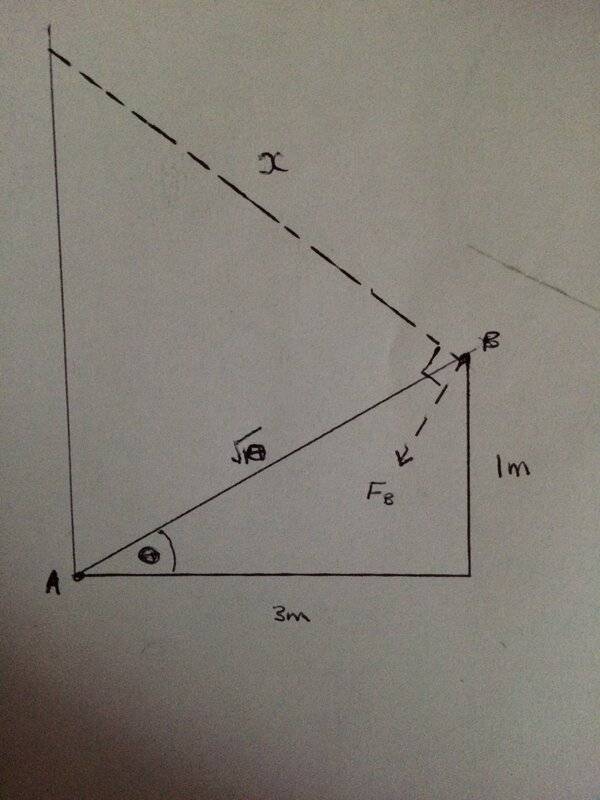
This is the sketch I have drawn and I'm guessing 'x' is the distance that I have to fine that's perpendicular to force Fb, though I'm not sure if I have set it up correctly?
IMG_5380.JPG


Any help would be appreciated! Thanks
 
Physics news on Phys.org
Extend the dotted line of FB down and to the left. Drop a normal to this line starting at point A. Determine the length of this normal line.
 
Distance "x" of your drawing is not the one required to find.

Also, note that the angles of section AC and force Fb are the same.
A 45-degree inclined distance of 2 m separates both lines.
A perpendicular distance between those lines would be...
 
  • Like
Likes   Reactions: Bolter
Chestermiller said:
Extend the dotted line of FB down and to the left. Drop a normal to this line starting at point A. Determine the length of this normal line.
Lnewqban said:
Distance "x" of your drawing is not the one required to find.

Also, note that the angles of section AC and force Fb are the same.
A 45-degree inclined distance of 2 m separates both lines.
A perpendicular distance between those lines would be...

I redrew the diagram and and labelled the new perpendicular distance I have to find, however I don't think I have enough info in the question to be able to work out this distance unless I'm missing something?

IMG_5382.JPG
 
Bolter said:
I redrew the diagram and and labelled the new perpendicular distance I have to find, however I don't think I have enough info in the question to be able to work out this distance unless I'm missing something?

View attachment 271134
There is enough info. It might be more obvious if you show point C and consider the relationship between the line AC and the line of action of the force.
 
haruspex said:
There is enough info. It might be more obvious if you show point C and consider the relationship between the line AC and the line of action of the force.

I tried including line AC in my diagram but I don't see how it'd help me find any angles or lengths.
I thought I could somehow use Pythagoras theorem to the right angle triangle ABF (in my diagram) where I know AB is sqrt(10) but I still have 2 unknown sides so that won't work

IMG_5383.JPG
 
Bolter said:
I tried including line AC in my diagram but I don't see how it'd help me find any angles or lengths.
I thought I could somehow use Pythagoras theorem to the right angle triangle ABF (in my diagram) where I know AB is sqrt(10) but I still have 2 unknown sides so that won't work

View attachment 271140
What is the distance from C to BF? This is what @Lnewqban was hinting at in post #3.
 
haruspex said:
What is the distance from C to BF? This is what @Lnewqban was hinting at in post #3.

By that do you mean the perpendicular distance from C to BF which is equivalent to length AF as they are parallel to each other?

EDIT: Ok I got distance from C to BF to be 1.414m and assuming that's equal to AF then AF = 1.414m
hence moment is 1.414m * 50N = 70.7Nm
 
Last edited:
Bolter said:
By that do you mean the perpendicular distance from C to BF which is equivalent to length AF as they are parallel to each other?

EDIT: Ok I got distance from C to BF to be 1.414m and assuming that's equal to AF then AF = 1.414m
hence moment is 1.414m * 50N = 70.7Nm
Right.
 
  • Like
Likes   Reactions: Bolter

Similar threads

  • · Replies 7 ·
Replies
7
Views
1K
  • · Replies 2 ·
Replies
2
Views
642
Replies
26
Views
2K
  • · Replies 1 ·
Replies
1
Views
3K
  • · Replies 15 ·
Replies
15
Views
6K
  • · Replies 6 ·
Replies
6
Views
3K
Replies
17
Views
3K
Replies
12
Views
2K
  • · Replies 21 ·
Replies
21
Views
3K
  • · Replies 13 ·
Replies
13
Views
3K