Finding time required via force equation

Click For Summary

Homework Help Overview

The problem involves calculating the time required for a planetary motion scenario, specifically relating to an elongated elliptical orbit and its connection to Kepler's Third Law. Participants are discussing the relevant equations and interpretations of velocity calculations in the context of definite integrals.

Discussion Character

  • Exploratory, Conceptual clarification, Mathematical reasoning, Assumption checking

Approaches and Questions Raised

  • Participants are attempting to clarify the source of certain terms in their equations, such as π and the factor (1/4)1/2. There is a focus on understanding the implications of velocity calculations at the origin and the nature of the integral used. Questions arise regarding the behavior of the velocity as it approaches the origin and the application of bounds in integrals.

Discussion Status

The discussion is ongoing, with participants providing feedback on each other's calculations and interpretations. Some guidance has been offered regarding the use of Kepler's Third Law and the relationship between elliptical and circular orbits, but there is no explicit consensus on the velocity calculations or the implications of the integrals discussed.

Contextual Notes

Participants are navigating potential misunderstandings related to definite integrals and their limits, particularly concerning the behavior at the origin, which is noted to be undefined. The problem context includes assumptions about planetary motion and the characteristics of elliptical orbits.

shanepitts
Messages
84
Reaction score
1
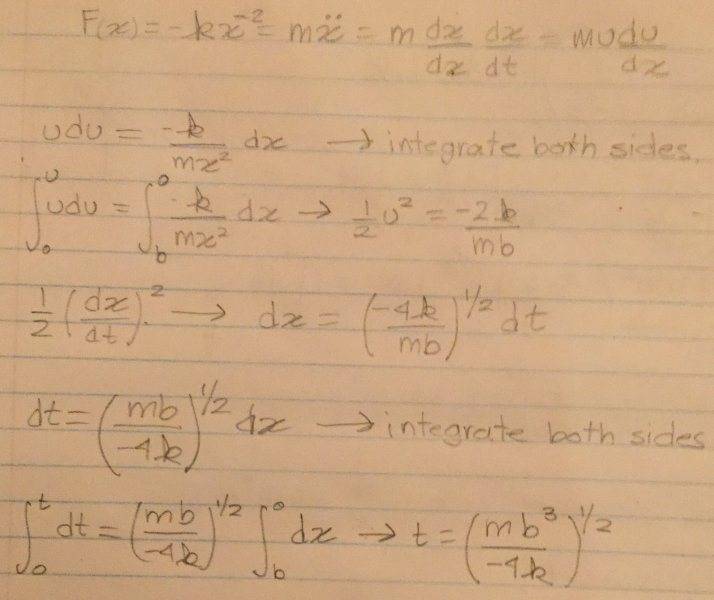
The problem, relevant equations, and my attempt at a solution are all shown on both attached images.
Not sure where the π and and extra (1/4)1/2 is coming from.
Also, I noticed that my final result, in the attemp at a solution should be t=(mb3/4k)1/2, no negative sign.
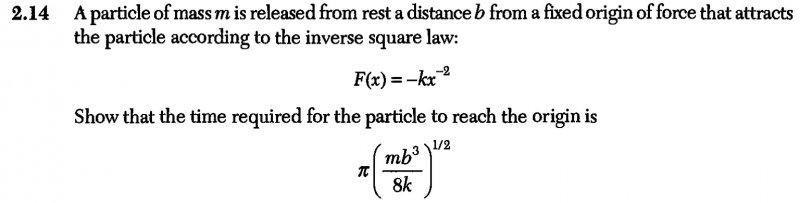
image.jpg
image.jpg
 
Last edited:
Physics news on Phys.org
Your velocity calculation is wrong. That definite integral will give the velocity at the origin (which will be infinite), but for the next step you need the velocity at an arbitrary distance x.
 
  • Like
Likes   Reactions: shanepitts
haruspex said:
Your velocity calculation is wrong. That definite integral will give the velocity at the origin (which will be infinite), but for the next step you need the velocity at an arbitrary distance x.

Thanks for the quick reply, but not to seem to ignorant in relation to using definite integrals, why would the velocity be infinite at origin?
 
shanepitts said:
Thanks for the quick reply, but not to seem to ignorant in relation to using definite integrals, why would the velocity be infinite at origin?
What did the indefinite integral look like? What happened when you applied the x=0 bound?
 
  • Like
Likes   Reactions: shanepitts
haruspex said:
What did the indefinite integral look like? What happened when you applied the x=0 bound?

so obvious, it gets divided by zero; it Is undefined.

Thanks again
 
shanepitts said:

Such problem can be solved by using Kepler's Third Law. This is planetary motion, only the ellipse is very-very elongated. Still, the time of revolution is the same as along an equivalent circle, with radius equal to the semi-mayor axis of this orbit.
From the definition of ellipse, the sum of the distances between the planet and the foci is equal to the mayor axis, 2a. And it is the same as ##2\sqrt{f^2+b^2} where b is half of the minor axis.
If you make the ellipse narrower and narrower, at the limit of b=0, you get that a=f. The semi-mayor axis is equal to the distance of a focus from the centre. The planet starts from one focus and arrives to the Sun at the other focus in half of the time period.
According to Newton's Third Law, the time period is the same as that on a circle, with the same radius as the semi-mayor axis of the distorted ellipse.
The initial distance between planet and Sun is d = 2a. What is the time period along a circular orbit with radius d/2?
fallingtime.JPG
 

Similar threads

  • · Replies 11 ·
Replies
11
Views
2K
  • · Replies 24 ·
Replies
24
Views
1K
Replies
4
Views
2K
Replies
4
Views
2K
Replies
14
Views
2K
Replies
9
Views
1K
  • · Replies 2 ·
Replies
2
Views
2K
  • · Replies 2 ·
Replies
2
Views
1K
  • · Replies 9 ·
Replies
9
Views
1K
  • · Replies 9 ·
Replies
9
Views
2K