Altan Tok
- 1
- 0
So I was studying on transformer calculations and understand it all pretty well until coming across these questions that I don't really understand. There's about 6 of them but if someone could work out 2 for me so I can understand it and finish it off it would be much appreciated.
Thanks
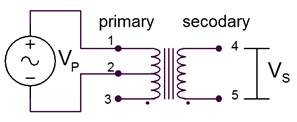
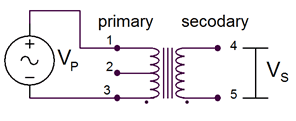
Electrical Specifications: Impedance at 1 kHz
1 - 2 150 W
2 - 3 150 W
1 - 3 600 W
4 - 5 10 kW
DC Resistance
1 - 3 23 W
4 - 5 400 W
Rated Power 2 W
-->This transformer is designed to match impedances 600 W (pins 1-3) to 10 kW (pins 4-5) or 150 W (pins 1-2 or 2-3) to 10 kW (pins 4-5).
-->Note that you can reverse primary and secondary to match 10 kW (pins 4-5) to either 150 W (pins 1-2 or 2-3) or 600 W (pins 1-3).
For each of the configurations in Figure 11, calculate the turns ratio NS/NP. Use Equation (6) and the transformer specifications on page 6 to calculate the turns ratios for each combination and provide a formula that gives VS as a function of VP. Enter your results in the table below.
NS/NP:
VS = f(VP):
Step-up / Step-down:
My attempt:
so I'm trying to figure out the turns ratio of each of them and I think you use the formula Rl/Rp=(Ns/Np)^2 where n is the amount of turns and R is the impedance. would the impedance be 600 ohms and 10 k ohms? do I have to consider each part as 1-2, 1-3 and 4-5?
Thanks
Electrical Specifications: Impedance at 1 kHz
1 - 2 150 W
2 - 3 150 W
1 - 3 600 W
4 - 5 10 kW
DC Resistance
1 - 3 23 W
4 - 5 400 W
Rated Power 2 W
-->This transformer is designed to match impedances 600 W (pins 1-3) to 10 kW (pins 4-5) or 150 W (pins 1-2 or 2-3) to 10 kW (pins 4-5).
-->Note that you can reverse primary and secondary to match 10 kW (pins 4-5) to either 150 W (pins 1-2 or 2-3) or 600 W (pins 1-3).
For each of the configurations in Figure 11, calculate the turns ratio NS/NP. Use Equation (6) and the transformer specifications on page 6 to calculate the turns ratios for each combination and provide a formula that gives VS as a function of VP. Enter your results in the table below.
NS/NP:
VS = f(VP):
Step-up / Step-down:
My attempt:
so I'm trying to figure out the turns ratio of each of them and I think you use the formula Rl/Rp=(Ns/Np)^2 where n is the amount of turns and R is the impedance. would the impedance be 600 ohms and 10 k ohms? do I have to consider each part as 1-2, 1-3 and 4-5?
Last edited: