Fundamentals of Electrical Engineering Circuit Basics Question

Click For Summary

Discussion Overview

The discussion revolves around a homework problem related to electrical engineering, specifically focusing on calculating power values (p1, p2, p3, p4) in a circuit. Participants are exploring the relationships between current, voltage, and power in the context of a circuit diagram, which includes a controlled voltage source.

Discussion Character

  • Homework-related
  • Mathematical reasoning
  • Technical explanation

Main Points Raised

  • One participant calculates p1, p2, and p4 but expresses uncertainty about determining the voltage for p3, stating they prefer not to use the conservation of energy principle.
  • Another participant asserts that the current I is 5A, leading to the conclusion that the voltage across the controlled source should be 3V, calculated as 5A multiplied by 0.6.
  • A subsequent reply reiterates the current through the controlled source is 4A, but emphasizes that the voltage for p3 is defined as 0.6 times the current I, which is stated to be 5A.

Areas of Agreement / Disagreement

There is some agreement on the value of the current I being 5A, but there is a lack of consensus on the correct voltage for p3 and how to approach its calculation, indicating unresolved aspects of the problem.

Contextual Notes

Participants reference a circuit diagram that is not provided, which may contain critical information influencing their calculations. The discussion also highlights potential confusion regarding the definitions and relationships of current and voltage in the context of dependent sources.

Varro
Messages
2
Reaction score
0
"Fundamentals of Electrical Engineering" Circuit Basics Question
Homework Statement


07ELr.jpg

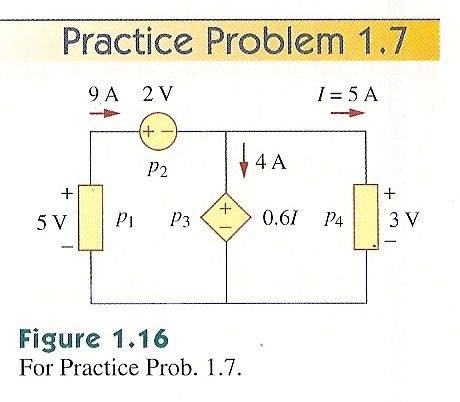
I am asked to find p1, p2, p3, p4.

Homework Equations


p=vi
ƩP=0

The Attempt at a Solution


p1=(5)(-9)
=-45
p2=(2)(9)
=18
p4=(3)(5)
=15

p3=v(.6i)
=v(.6(4))
=v(2.4)
I know that v=5 and p3=12, but I don't know why v=5.

I do perfectly fine finding p1, p2, and p4, but I am having difficulty figuring out how to find the voltage on p3 to get the power. I am trying to refrain from using the law of the conservation of energy (ƩP=0), since a previous example I tried to figure out before gave me the same problem.
 
Physics news on Phys.org


The diagram shows I = 5A. So the voltage on the controlled source should be 5*0.6 = 3V.


gneill said:
The diagram shows I = 5A. So the voltage on the controlled source should be 5*0.6 = 3V.

I am talking about the dependent voltage source, p3. The current is labeled as 4A.


Varro said:
I am talking about the dependent voltage source, p3. The current is labeled as 4A.

Yes, the current through the controlled source is labelled as 4A. But the controlled source voltage is stated to be 0.6I, and I = 5A.
 

Similar threads

  • · Replies 178 ·
6
Replies
178
Views
10K
  • · Replies 32 ·
2
Replies
32
Views
5K
  • · Replies 6 ·
Replies
6
Views
8K
  • · Replies 1 ·
Replies
1
Views
2K
  • · Replies 1 ·
Replies
1
Views
2K
  • · Replies 2 ·
Replies
2
Views
3K
  • · Replies 1 ·
Replies
1
Views
2K
  • · Replies 26 ·
Replies
26
Views
3K
  • · Replies 5 ·
Replies
5
Views
3K
Replies
0
Views
2K