Gas Compression in a Closed System: Non-Linear vs. Horizontal P-V Diagrams

Click For Summary

Discussion Overview

The discussion revolves around the characteristics of pressure-volume (P-V) diagrams for gas compression in a closed system, particularly focusing on whether the graph must always be non-linear and the implications of different temperature conditions on the shape of the curve.

Discussion Character

  • Exploratory, Technical explanation, Debate/contested

Main Points Raised

  • One participant questions whether the P-V graph must always be non-linear during gas compression, particularly under isothermal conditions, and raises the possibility of a horizontal graph if temperature decreases.
  • Another participant suggests that the Ideal Gas Law (PV = NRT) should be assumed unless a different equation is specified, which could help in expressing P as a function of V and calculating work done.
  • A repeated point emphasizes the need to focus on the shape of the curve rather than just the calculation of work done.
  • One participant proposes that the compression process may be polytropic, introducing the equation PV^n = C, which adds to the confusion regarding the curve's shape.

Areas of Agreement / Disagreement

Participants express differing views on the shape of the P-V curve during gas compression, with no consensus reached on whether it must always be non-linear or if horizontal graphs are possible under certain conditions.

Contextual Notes

Participants have not resolved the implications of temperature changes on the P-V diagram shape, and there is ambiguity regarding the application of the Ideal Gas Law versus polytropic processes.

mech-eng
Messages
826
Reaction score
13
When a gas in a closed system is compressed, should the graph always be non-linear? If T is constant ie if the process isothermal it is clear that it should be so but I am not very sure that if the graph can be horizontal. If T decreases might not it be horizontal?
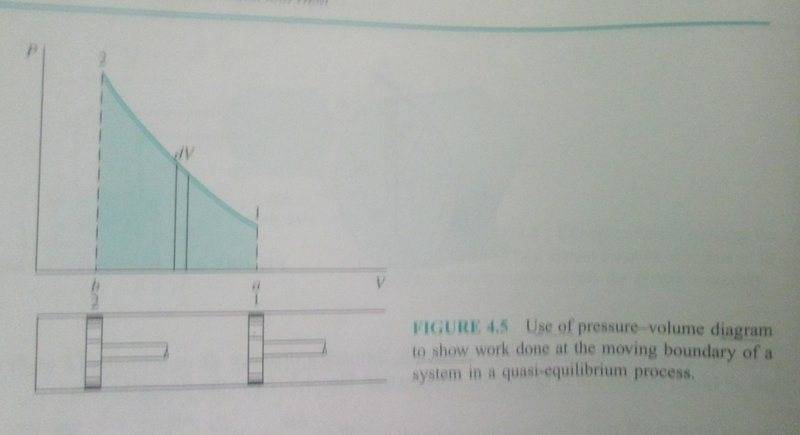
upload_2017-4-26_19-17-48.jpeg


Thank you.
 
Engineering news on Phys.org
Unless some other constitutive equation is specified, I'd be inclined to assume that the Idea Gas Law applies. Thus,
P * V = N * R * T
This will enable you to express P(V) and thus calculate the work done.
 
Dr.D said:
Unless some other constitutive equation is specified, I'd be inclined to assume that the Idea Gas Law applies. Thus,
P * V = N * R * T
This will enable you to express P(V) and thus calculate the work done.
Yes we can calculate the work done but I especially ask for the shape of the curve.

Thank you.
 
Solve the equation for P and you have the shape of the curve.
 
Dr.D said:
Solve the equation for P and you have the shape of the curve.

But such a compression process is polytropic so the equation is also might be PVn=C and this is where I am confused.

Thank you.
 

Similar threads

  • · Replies 5 ·
Replies
5
Views
3K
  • · Replies 3 ·
Replies
3
Views
3K
Replies
25
Views
5K
  • · Replies 45 ·
2
Replies
45
Views
7K
  • · Replies 20 ·
Replies
20
Views
3K
  • · Replies 2 ·
Replies
2
Views
2K
  • · Replies 5 ·
Replies
5
Views
2K
  • · Replies 33 ·
2
Replies
33
Views
3K
  • · Replies 1 ·
Replies
1
Views
2K
  • · Replies 11 ·
Replies
11
Views
3K