Help Understanding Simultaneity Diagram

  • Context: Graduate 
  • Thread starter Thread starter xDk
  • Start date Start date
  • Tags Tags
    Diagram Simultaneity
Click For Summary

Discussion Overview

The discussion revolves around understanding a simultaneity diagram related to special relativity, specifically focusing on the ordering of events as perceived by two different observers, A and B. Participants explore the implications of light signals emitted from events and how they affect the perception of simultaneity and event ordering in different reference frames.

Discussion Character

  • Exploratory
  • Technical explanation
  • Conceptual clarification
  • Debate/contested

Main Points Raised

  • One participant expresses confusion about why light ray RQ is sent out before SP, suggesting that this order is necessary for both observers to illuminate events Q and P.
  • Another participant explains that the order of events for observer B is determined by the intersections of light rays on observer A's worldline, indicating that Q occurs before O and P for B.
  • It is noted that observer A perceives events P and Q as simultaneous, while observer B sees them in a different order due to the light cone intersections.
  • Some participants discuss the significance of the midpoint events on B's worldline and how they relate to the timing of events Q, O, and P.
  • There is a question about whether an observer needs to see the receiving light ray to determine the order of events, leading to further clarification about the timing of event O relative to Q and P.
  • One participant suggests that transforming the diagram to B's rest frame could clarify the event ordering, but there is uncertainty about how this transformation would work.
  • Another participant describes how the transformed diagram would represent the events and their order, emphasizing that event O remains the pivot point in both frames.

Areas of Agreement / Disagreement

Participants express varying levels of understanding regarding the simultaneity diagram, with some agreeing on the ordering of events for observer B while others remain uncertain or confused about specific aspects, particularly regarding the timing of event O and the implications of light ray intersections.

Contextual Notes

Some participants indicate a lack of clarity about the definitions of certain events and their relationships, particularly regarding the timing of event O and how it is perceived by observer B. The discussion also highlights the complexity of transforming reference frames and the interpretation of light cones.

xDk
Messages
8
Reaction score
0
Hello, I am having a bit of trouble understanding this diagram.
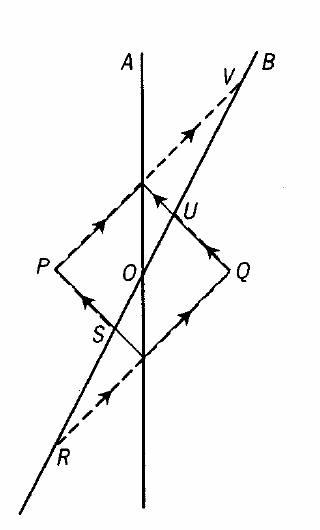
cjOQ0Wb.png


I can accept the example of the moving train with an observer beside the train and an observer on the train, then two lights emit from both ends of the train when the train pass the observer. But this diagram is a little confusing to me.

The description of the diagram reads: B sends out light rays RQU and SPV to illuminate the events P and Q. RU=SV and so these events are equidistant according to B. The signal RQ was sent out before the signal SP so B concludes event Q took place well before P.
The order of events for B is Q, then O, and then P.

My first issue is why is RQ sent out before SP.
Second issue is why are the events in the order Q then O then P for B.
 
Physics news on Phys.org
xDk said:
why is RQ sent out before SP.

Because it has to be in order for both observers, A and B, to illuminate events Q and P. Your diagram has two key points unlabeled: the point where the light ray RQ intersects A's worldline, and the point where the light ray PV intersects A's worldline. Call those two points X and Y, respectively. Then what determines event S (i.e., the event when B sends out its light ray to illuminate event P) is this: B sends out a light ray at event R, which will illuminate event Q; that light ray reaches A at event X, and A sends out a light ray in the opposite direction at that event; when that light ray from A reaches B, at event S, B sends out a second light ray, which will illuminate event P.

In other words, the light rays that illuminate events P and Q intersect on A's worldline, at event X. Similarly, the light rays emitted from events P and Q intersect on A's worldline, at event Y. The fact that both pairs of light rays intersect on A's worldline, but not on B's (each pair intersects B's worldline at two different events--R and S, and U and V, respectively), is the key fact to recognize in this scenario.

xDk said:
why are the events in the order Q then O then P for B.

Because of the key fact I just mentioned above. Notice that P and Q happen at the same time as event O for observer A; this is also due to the key fact I mentioned above. The intersection of the light rays to and from events P and Q is what picks out observer A's worldline as the one for which P and Q happen at the same time; and the fact that the light rays to and from events P and Q do not intersect on B's worldline--that light to and from Q intersects B's worldline before light to and from P--is what determines the ordering of events for B.
 
This elaborates on @PeterDonis's reply.

Given an inertial observer's worldline and a set of events,
you can quickly determine the time-ordering of those events according to that observer (based on radar methods).

Consider observer-B and event Q.
Q's lightcone intersects B's worldline at R and U. Observer-B says that " 'the midpoint-event of segment R and U' (call it Q_B) is simultaneous with Q ".
That's clearly before event O on B's worldline. (By the way, O's lightcone intersects B's worldline at O and O, with midpoint-event at O.)
Similarly, P_B is after O on B's worldline.
So, observer-B says "Q happens, then O, then P".

Since P's lightcone-intersections with A's worldline coincide with Q's lightcone-intersections with A's worldline, observer-A says that "P and Q are simultaneous."
For observer-A, its appears events P_A and Q_A coincide with O... so, observer-A would say "P, Q, and O are simultaneous".
 
robphy said:
This elaborates on @PeterDonis's reply.
Consider observer-B and event Q.
Q's lightcone intersects B's worldline at R and U. Observer-B says that " 'the midpoint-event of segment R and U' (call it Q_B) is simultaneous with Q ".
That's clearly before event O on B's worldline. (By the way, O's lightcone intersects B's worldline at O and O, with midpoint-event at O.)
Similarly, P_B is after O on B's worldline.
So, observer-B says "Q happens, then O, then P".
When you say Q is clearly before O because of its light cone I don't quite get that. Because I see an intersection at R from Q then S from P then O.
Does the observer need to see the receiving light ray to say the event happened? Because then I see O then U from Q then V from P.
I think maybe I am not clear on the O event, and when B sees it.
 
In a radar measurement, the observer receives that light-signal-echo that he sent to the distant event.
So, "B"ob sent a signal at R to meet Q, and he receives the echo at U. (RQ and QU are segments on Q's past and future lightcones, respectively.)

Call the midpoint of segment RU [on Bob's worldline] "Q_B".
From the diagram, can you see that on Bob's worldline, Q_B occurs before O?
Since Bob regards Q_B as simultaneous with Q, it follows that Bob regards Q occurring before O.

(Bob assigns a time-coordinate to event Q as the average of the clock-readings from R and U
and a spatial-separation to event Q as half the difference (t_R-t_U) of those clock readings.)
 
xDk said:
I think maybe I am not clear on the O event, and when B sees it.

The O event is on B's worldline, so he "sees" it when he is at it. He is at it after R and S, and before U and V.
 
robphy said:
In a radar measurement, the observer receives that light-signal-echo that he sent to the distant event.
So, "B"ob sent a signal at R to meet Q, and he receives the echo at U. (RQ and QU are segments on Q's past and future lightcones, respectively.)

Call the midpoint of segment RU [on Bob's worldline] "Q_B".
From the diagram, can you see that on Bob's worldline, Q_B occurs before O?
Since Bob regards Q_B as simultaneous with Q, it follows that Bob regards Q occurring before O.

(Bob assigns a time-coordinate to event Q as the average of the clock-readings from R and U
and a spatial-separation to event Q as half the difference (t_R-t_U) of those clock readings.)
I think I get it now. Without doing any calculation though, could I say since B's world line has a different slope to A you would have to transform his "plane/graph" then you could run a line that is horizontal in his transformed "plane/graph" in the positive time direction and then the line would hit Q then O then P?
 
PeterDonis said:
The O event is on B's worldline, so he "sees" it when he is at it. He is at it after R and S, and before U and V.
With that said, how does he see it between Q and S? Because the rays coming back from Q and S (U and V) happen after O on B's worldline.
 
xDk said:
could I say since B's world line has a different slope to A you would have to transform his "plane/graph"

Do you mean, transform the graph from A's rest frame (in which it is currently drawn) to B's rest frame? Yes, you can do that, but it doesn't work the way you apparently think it does. See below.

xDk said:
then you could run a line that is horizontal in his transformed "plane/graph" in the positive time direction and then the line would hit Q then O then P?

I'm not even sure what "horizontal in the positive time direction" means, so I can't answer this. However, I can try to describe what the transformed diagram will look like.

In the transformed diagram, B's worldline will be a vertical line (like A's is in the original diagram), and A's worldline will be moving up and to the left (the reflection through the vertical axis of what B's worldline looks like in the original diagram). Event O will still be at the intersection of the two worldlines (this event is the "pivot", the spacetime origin of both frames, so it doesn't move in the transformation). Event P will be to the left of O, but also somewhat above it; and event Q will be to the right of O, but also somewhat below it. This reflects the fact that, in B's frame, Q happens before O, which happens before P--events that happen at the same time in B's frame lie along perfectly horizontal lines in the transformed diagram.

The light rays in the transformed diagram are still 45 degree lines, so you can still construct the rest of the events by drawing them and seeing where they intersect the worldlines of A and B.
 
  • #10
This is sort of what I meant
sLWPs7r.png

PeterDonis said:
Do you mean, transform the graph from A's rest frame (in which it is currently drawn) to B's rest frame? Yes, you can do that, but it doesn't work the way you apparently think it does. See below.
I'm not even sure what "horizontal in the positive time direction" means, so I can't answer this. However, I can try to describe what the transformed diagram will look like.

In the transformed diagram, B's worldline will be a vertical line (like A's is in the original diagram), and A's worldline will be moving up and to the left (the reflection through the vertical axis of what B's worldline looks like in the original diagram). Event O will still be at the intersection of the two worldlines (this event is the "pivot", the spacetime origin of both frames, so it doesn't move in the transformation). Event P will be to the left of O, but also somewhat above it; and event Q will be to the right of O, but also somewhat below it. This reflects the fact that, in B's frame, Q happens before O, which happens before P--events that happen at the same time in B's frame lie along perfectly horizontal lines in the transformed diagram.

The light rays in the transformed diagram are still 45 degree lines, so you can still construct the rest of the events by drawing them and seeing where they intersect the worldlines of A and B.
This is very new to me. I appreciate all the help. From the description you just explained, it makes more sense. Ill just think about it a bit more then get back to you :D
 
  • #11
Note that Bob's spatial-axes are parallel to the lines joining Q to Q_B (the midpoint of RU).
In fact, in Minkowski spacetime geometry, the segment Q_B-to-Q is "Minkowski-perpendicular" to RU (along Bob's worldline).
 

Similar threads

  • · Replies 6 ·
Replies
6
Views
2K
  • · Replies 9 ·
Replies
9
Views
1K
  • · Replies 20 ·
Replies
20
Views
3K
  • · Replies 221 ·
8
Replies
221
Views
17K
  • · Replies 13 ·
Replies
13
Views
3K
  • · Replies 51 ·
2
Replies
51
Views
5K
  • · Replies 26 ·
Replies
26
Views
5K
  • · Replies 17 ·
Replies
17
Views
2K
  • · Replies 6 ·
Replies
6
Views
2K
  • · Replies 16 ·
Replies
16
Views
3K