How many positive integers x satisfy this logarithmic inequality?

Join the discussion
Registration is free. Ask a follow-up in this thread, or start your own.
3 replies · 4K views
Mr X
Messages
42
Reaction score
13
Homework Statement
How many positive integers x satisfy ##\log_{\frac x 8} (\frac{x^2} 4) < 7 + \log_2(\frac 8 x)##
Relevant Equations
Basic logarithamic rules
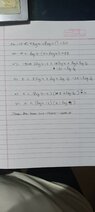
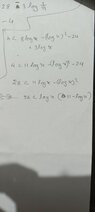
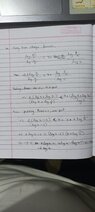
The whole solution is a bit long, which I'll attach but the part I'm stuck at is, assuming everything else above it is correct, is
4 < (log x - 3)(8-log x)

Note ; inequalities aren't technically taught yet in the course, so please try to make the solution not go too deep into that. If that isn't possible there's a high chance I've gone wrong before that step, hence I've uploaded the entire solution.
 

Attachments
  • IMG20230808094713.jpg
    IMG20230808094713.jpg
    24.8 KB · Views: 150
  • IMG20230808094717.jpg
    IMG20230808094717.jpg
    19.7 KB · Views: 165
  • IMG20230808101736.jpg
    IMG20230808101736.jpg
    12.4 KB · Views: 164
Physics news on Phys.org
Mr X said:
Homework Statement: How many positive integers x satisfy ##\log_{\frac x 8} (\frac{x^2} 4) < 7 + \log_2(\frac 8 x)##
Relevant Equations: Basic logarithamic rules

The whole solution is a bit long, which I'll attach but the part I'm stuck at is, assuming everything else above it is correct, is
4 < (log x - 3)(8-log x)

Assuming your logs are to base 2 then this is one of the possible solutions. It is convenient to use logs to base 2; then the left hand side is [tex] \log_{x/8}(x^2/4) = 2\frac{ \log_2(x/4)}{\log_2(x/8)} = \frac{2 (\log_2 x - 1)}{\log_2 x - 3}[/tex] and the right hand side is [tex]7 + \log_2(8/x) = 10 - \log_2 x[/tex] so that if [itex]y = \log_2 x[/itex] then [tex] \frac{2(y-1)}{y-3} < 10 - y.[/tex]

To solve this, we must multiply both sides by [itex]y - 3[/itex]. But this only preserves the inequality if [itex]y - 3 > 0[/itex], and in that case [tex] y^2 - 11y + 28 < 0[/tex] which is as far as you got, but you then did not factorise this as [tex] (y - 4)(y - 7) < 0.[/tex]

Alternatively, if [itex]y < 3[/itex] then we must reverse the inequality when multiplying both sides by [itex]y - 3[/itex], which leads to [tex](y - 4)(y - 7) > 0.[/tex]
 
Reply
  • Like
Likes   Reactions: Mr X and nuuskur
pasmith said:
Assuming your logs are to base 2 then this is one of the possible solutions. It is convenient to use logs to base 2; then the left hand side is [tex] \log_{x/8}(x^2/4) = 2\frac{ \log_2(x/4)}{\log_2(x/8)} = \frac{2 (\log_2 x - 1)}{\log_2 x - 3}[/tex] and the right hand side is [tex]7 + \log_2(8/x) = 10 - \log_2 x[/tex] so that if [itex]y = \log_2 x[/itex] then [tex] \frac{2(y-1)}{y-3} < 10 - y.[/tex]

To solve this, we must multiply both sides by [itex]y - 3[/itex]. But this only preserves the inequality if [itex]y - 3 > 0[/itex], and in that case [tex] y^2 - 11y + 28 < 0[/tex] which is as far as you got, but you then did not factorise this as [tex] (y - 4)(y - 7) < 0.[/tex]

Alternatively, if [itex]y < 3[/itex] then we must reverse the inequality when multiplying both sides by [itex]y - 3[/itex], which leads to [tex](y - 4)(y - 7) > 0.[/tex]
sorry I didn't reply after, but got it, thankyou.