How to measure the air pressure of a pipe without having water resistance

Click For Summary
SUMMARY

This discussion focuses on measuring air pressure in a pipe system that alternates between water and compressed air without using water-resistant sensors. Participants suggest using a diaphragm of impermeable film to protect the sensor from water, while also considering a protection chamber with shut-off valves to manage water drainage. The proposed solution involves careful installation to ensure that residual water does not damage the sensor. The conversation highlights the challenges of using non-water-resistant sensors and the necessity of a robust design to maintain accurate pressure readings.

PREREQUISITES
  • Understanding of fluid mechanics principles
  • Familiarity with pressure sensors and their specifications
  • Knowledge of diaphragm technology in pressure measurement
  • Experience with plumbing and valve systems for fluid control
NEXT STEPS
  • Research the design and implementation of pressure protection chambers
  • Explore diaphragm materials suitable for pressure sensors
  • Investigate the use of strain gauges for pressure measurement
  • Learn about the Bernoulli effect and its impact on pressure readings
USEFUL FOR

Engineers, fluid mechanics specialists, and technicians involved in pressure measurement and system design who seek to optimize sensor performance in variable fluid environments.

Pir4t3x
Messages
9
Reaction score
0
Hello,

I'm having a question regarding the sensors and the techniques in fluid mechanics. Since my skills are amazing in this field, here I'm asking

you questions xD

I want to measure the air pressure of this tube/pipe (P1,P2,P3). This pipe will be flushed with water and then with compressed air.
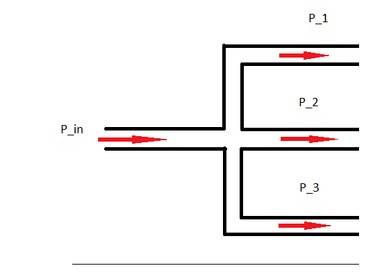
kRySFc.jpg


In principle, it should be just pressure sensor in each pipe and problem solved!

The question is that if I want to use a pressure sensor which doesn't have water resistantce. I'll measure the air pressure only when the

compressed air is flushed. How can I protect the sensor from water during the water flushing step?

Note: I was thinking of adding valve to protect the pressure sensor (close it when the water is flusing) but the idea would be not practical. As

any drop of water left in the pipe would damage the sensor (if there is blockage for example).

I have been thinking about this for too long and it seems impossible not to use water resistant sensor. Is there any chance to do it?

I hope that I can find my answer here.
 
Engineering news on Phys.org
Welcome to PF.

If you place an diaphragm of impermeable film between the sensor and the pipe you will protect the sensor from the water. If you then fill the sensor side with an inert oil there will be very little movement of the diaphragm as the pipe pressure changes.
 
Baluncore said:
Welcome to PF.

If you place an diaphragm of impermeable film between the sensor and the pipe you will protect the sensor from the water. If you then fill the sensor side with an inert oil there will be very little movement of the diaphragm as the pipe pressure changes.
Thank you for replying. The thing is that I didn't find any provider which sells diaphragm. They sell the pressure sensor with the diaphragm.
I thought that maybe there is a way to measure the pressure without the diaphragm technique.

Thank you thou
 
What kind of sensor are you using?
 
MRFMengineer said:
What kind of sensor are you using?
I'm not using any right now. I want to use one without " water resistant " and I'm trying to choose one.

Sorry for the late response.Just saw your reply.
 
Two valves , intermediate pipe section , blowdown .
 
Nidum said:
Two valves , intermediate pipe section , blowdown .

Can you please be more specific .. As i understood nothing :(
 
There is a protection chamber fitted between the air/water pipework and the gauge .

Chamber has shut off valves at pipe work end and at gauge end . A drain cock is also fitted .

Chamber remains nominally dry but in use it may get to contain small amounts of water .

Before pipework system is filled with water the two shut off valves are set to closed position .

When water in pipework is stopped and air flow is started the initial air flow blows all the residual water out of the pipework .

After a sufficient time the pipework end valve to the gauge protection chamber is opened together with the drain cock .

Air flow now blows any water in the chamber out through the drain cock .

After a sufficient time gauge end valve is opened and drain cock closed .

nb:

Protection chamber can be an actual vessel but often it is just a short length of pipe or a plain block with the valves built in .

Practical installation requires some thought about orientation of chamber and exact positions of valves so that water can drain freely .

There are self acting and powered variants of the basic system .
 
Last edited:
  • Like
Likes   Reactions: Pir4t3x
Nidum said:
There is a protection chamber fitted between the air/water pipework and the gauge .

Chamber has shut off valves at pipe work end and at gauge end . A drain cock is also fitted .

Chamber remains nominally dry but in use it may get to contain small amounts of water .

Before pipework system is filled with water the two shut off valves are set to closed position .

When water in pipework is stopped and air flow is started the initial air flow blows all the residual water out of the pipework .

After a sufficient time the pipework end valve to the gauge protection chamber is opened together with the drain cock .

Air flow now blows any water in the chamber out through the drain cock .

After a sufficient time gauge end valve is opened and drain cock closed .

nb:

Protection chamber can be an actual vessel but often it is just a short length of pipe or a plain block with the valves built in .

Practical installation requires some thought about orientation of chamber and exact positions of valves so that water can drain freely .

There are self acting and powered variants of the basic system .
First of all, I want to thank you for giving me a detailed answer!

but I'm afraid taht I have a couple of questions on your answer:

1- When you said between air/water pipe , did you mean two different pipes? becasue in my case I would prefer having one pipe for water/air.
2- I don't understand the positioning of the pressure gauge and chamber in the pipe? is the pressure gauge going to be in the Chamber? or T junction with the tube?
3- Just for simplification, let's say I'll do this system on one pipe ( not the 3 pipe system above). Can you draw it, plesae? As to undetstnad your answer completely.

I'm sorry to ask many questions, but it's critical for me to fully understand the solution.
I hope you can undetstand.

Wish you a nice weekend!
 
  • #10
ok . May have to be next Monday now though .
 
  • #11
Nidum said:
ok . May have to be next Monday now though .

Take your time. Thank you for letting me know thou!
 
  • #12
Gauge protector.jpg


Multiple variants and they can be made quite small size .
 
  • #13
Nidum said:
View attachment 204479

Multiple variants and they can be made quite small size .

Thank you so much. I really appreciate all the help and thanks a million!

Regarding the design, by the connection to the pipe, you mean to Pin or to each channel? where is the water supply (pump)?

I was givin this idea but I don't think that it will work on pressure of 1-2 bar. The idea is to add a T-junction to the tube with a loop in it and a pressure sensor (non water resistant). The water will choose the horizantal tube and won't go up (vertically). but in 1-2 bar, I think the water will go to the vertical tube as well.

the drowback of this idea is that if there is blockage, the sensor is damaged!

http://3.1m.yt/Ld6rQAc.png

What do you think?

Again, thank you.
 
  • #14
Pir4t3x said:
by the connection to the pipe, you mean to Pin or to each channel?

Depends on why and where you want to measure the pressure . You could have a gauge at one location or gauges at several locations .

With the looped pipe idea you may still get stray water in the gauge even if it is just condensation . Real problem is that if air or water are moving at any significant velocity you will get a false pressure reading due to Bernoulli effect .

Could you explain more completely the purpose of this work ? If we had more information we might be able to think of other ways of solving your gauging problem .
 
  • #15
Nidum said:
Depends on why and where you want to measure the pressure . You could have a gauge at one location or gauges at several locations .

With the looped pipe idea you may still get stray water in the gauge even if it is just condensation . Real problem is that if air or water are moving at any significant velocity you will get a false pressure reading due to Bernoulli effect .

Could you explain more completely the purpose of this work ? If we had more information we might be able to think of other ways of solving your gauging problem .

The idea is that I want to measure the air pressure to check if there is disconnection or blockage at the ending of the tube. ( the tube at the end is connected to

another tube). If there is disconnection the pressure will decrease and if there is blockage, the pressure will increase.

Basically, I want to check the condition of the tube using the air pressure since it gives accurate results.

I want to measure the pressure in each tube so I don't have to add a valve for each tube as it will take more time and it will give me inaccurate results.
 
  • #16
Have you considered using a strain gauge? How much pressure are you encountering?
 
  • #17
RogueOne said:
Have you considered using a strain gauge? How much pressure are you encountering?
0-1 bar " compressed air "
 
  • #18
Pir4t3x said:
I'm not using any right now. I want to use one without " water resistant " and I'm trying to choose one...

Why the preference for a sensor unable to tolerate water?

A 0-30 PSI (2 bar), 4-20 milliamp, thin film strain gauge-based transmitter with 303S22 stainless steel diaphragm at the "wetted" side costs about $110 USD. A protection chamber would be the way to go if the sensor must remain dry, but if the reasoning is the 'dry' sensor costs less, it probably won't be once valves and additional plumbing are included.
 

Similar threads

  • · Replies 14 ·
Replies
14
Views
2K
  • · Replies 20 ·
Replies
20
Views
11K
  • · Replies 5 ·
Replies
5
Views
3K
  • · Replies 45 ·
2
Replies
45
Views
6K
  • · Replies 31 ·
2
Replies
31
Views
5K
Replies
4
Views
3K
Replies
13
Views
4K
  • · Replies 4 ·
Replies
4
Views
2K
Replies
3
Views
2K
Replies
0
Views
2K