Large Amplitude Pendulum Equation

11 replies · 7K views · last reply
StevenJacobs990
Messages
16
Reaction score
0
The equation for large-angle pendulum can be infinitely long. What is the pattern with the latter numbers in "..."?
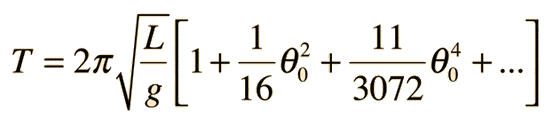
Series expansion for the period of a large-amplitude pendulum: T = 2π√(L/g) [1 + (1/16)θ₀² + (11/3072)θ₀⁴ + ...]
 
sophiecentaur said:
Does this link help?
Yeah, but what's the pattern that comes after 11/3072 (theta)^4?
 
There is no pattern. That's why you need the elliptic integrals.
 
StevenJacobs990 said:
Yeah, but what's the pattern that comes after 11/3072 (theta)^4?
AS I said before, your attachment is not readable.
 
Here is a graphic I made.
Look at equation 3.
Three series expansions for pendulum period T = 2*PI*sqrt(L/g) times a large-amplitude correction, ending with T = 2*PI*sqrt(L/g)*(1/CE) where CE = AGM(1, cos(Θ/2)). Equation 3 is circled in red.
 
pendulum.png
StevenJacobs990
I don't know the equation for generating those numbers in the formula but here is the large amplitude formula carried out to theta 20:
 
Honestly, I wouldn't be surprised if this a Taylor expansion of some sort.
 
rumborak said:
Honestly, I wouldn't be surprised if this a Taylor expansion of some sort.
. . . .or something else. There are (my Mathematician friends tell me) many equations that can only be solved using a series - Taylor or not so well known ones.
 
I originally was writing a pendulum calculator and while researching the Internet, I came across this topic. Anyway, I finished the calculator and it is online: http://www.1728.org/pendulum.htm
It can calculate pendulum periods up to theta 14 and uses the arithmetic mean to calculate exact pendulum periods.
Try it out if you like.