Lorentz force and work done: where is the glitch?

Click For Summary

Discussion Overview

The discussion revolves around the Lorentz force acting on a free electron moving in a magnetic field, specifically addressing the implications of this force on the electron's velocity and kinetic energy. Participants explore the relationship between the magnetic force, work done, and the resultant motion of the electron, with a focus on vector addition and the conditions under which the magnetic force can do work.

Discussion Character

  • Debate/contested
  • Mathematical reasoning
  • Technical explanation

Main Points Raised

  • One participant asserts that an electron moving along the x-axis gains speed in the y-direction due to the Lorentz force without losing speed in the x-direction, questioning whether this is a glitch or valid.
  • Another participant counters that any increase in velocity in the y-direction must result in a corresponding decrease in the x-direction velocity, maintaining a constant speed overall.
  • Several participants discuss the mathematical expression for work done by the magnetic force, noting that it evaluates to zero due to the orthogonality of the force and velocity vectors.
  • One participant emphasizes the need to specify axes and directions when discussing the vectors involved in the Lorentz force and work done.
  • There is a contention regarding the interpretation of vector addition, with one participant providing an example to illustrate how adding velocity components can increase the overall speed.
  • Another participant insists that the magnetic force cannot do work on a point charge, reiterating that the force and velocity vectors are always orthogonal.
  • Disagreement arises over the interpretation of the Lorentz force's effect on the electron's trajectory and speed, with participants challenging each other's understanding of basic mechanics and vector relationships.

Areas of Agreement / Disagreement

Participants express differing views on the effects of the Lorentz force on the electron's velocity and the conditions under which work is done. There is no consensus on whether the initial claims regarding the electron's motion are valid or flawed, and the discussion remains unresolved.

Contextual Notes

Participants highlight the importance of specifying directions and axes in vector calculations, and there are references to basic mechanics principles that may not be universally understood among participants. The discussion also touches on the implications of the magnetic force in various contexts, including Ampère's force law.

pleco
Messages
46
Reaction score
1
Where is the glitch?

1. Let a single free electron move along x-axis with constant speed Vx. It encounters magnetic field on its right side, so the Lorentz force accelerates it along y-axis and it gains speed Vy.
--- Glitch or pass?

2. The electron does not slow down in x direction when it starts accelerating in y direction, but instead this new gained speed in y direction adds up to its Vx velocity vector, increases its speed and kinetic energy along with changing its trajectory.
--- Glitch or pass?
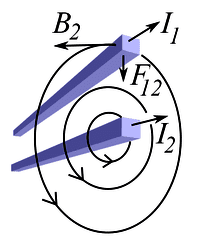

220px-MagneticWireAttraction-2nd.png


x direction of wire1 electrons drift
y direction of wire2 B field
z direction of Lorentz force acting on wire1 electrons

Direction of wire1 electrons displacement due to Lorentz force is in z direction downwards, the same direction Lorentz force is pointing to.
--- Glitch or pass?


milesyoung said:
Here I use only the definition of work and the expression for the magnetic force:
<br /> W = \int_{t_1}^{t_2} \mathbf{F_\mathbf{mag}} \cdot \mathbf{v} \, \mathrm{d}t = \int_{t_1}^{t_2} \left( q \mathbf{v} \times \mathbf{B} \right) \cdot \mathbf{v} \, \mathrm{d}t = \int_{t_1}^{t_2} 0 \, \mathrm{d}t = 0<br />
It's a very simple equation. You're saying this is somehow wrong?

Please mark your axis and be specific about your directions. That vdt is wrong velocity vector, electrons drift vector. That is not the displacement in the direction of the force. Acceleration, velocity and the displacement due to Lorentz force are all vectors pointing where the Lorentz force is pointing itself, that's given by F= ma.

{0,0,1} dot {1,0,0} = 0 <- drift velocity vector = wrong displacement vector

{0,0,1} dot {0,0,1} = 1 <- acceleration/displacement vector = correct vector
 
Last edited:
Physics news on Phys.org
There is a glitch in 1 and 2. The electron will gain velocity in y but lose velocity in x such that it's speed will be constant.

I can post the math later.
 
pleco said:
1. Let a single free electron move along x-axis with constant speed Vx. It encounters magnetic field on its right side, so the Lorentz force accelerates it along y-axis and it gains speed Vy.
--- Glitch or pass?

2. The electron does not slow down in x direction when it starts accelerating in y direction, but instead this new gained speed in y direction adds up to its Vx velocity vector, increases its speed and kinetic energy along with changing its trajectory.
--- Glitch or pass?
Both are false, any change in velocity in the y-direction will come with a change in the velocity in the x-direction such that the magnitude of the velocity vector of the electron stays constant.

If the net force on an object and its velocity vector are always orthogonal then THE OBJECT WILL NOT CHANGE ITS SPEED. This is basic mechanics.

With regards to Ampère's force law - you bring it up every time, but to understand why it's NOT a counterexample, you first have to understand why the magnetic force can't do any work on a point charge. Now please, just show me where the math is wrong here:

We have an electron traveling in some magnetic field \mathbf{B} (which doesn't have to be uniform) with the instantaneous velocity \mathbf{v}. This electron is not one of the many free electrons in a conductor. This electron is simply traveling in space, unconstrained but affected by the magnetic field.

So let's calculate the work done by the magnetic force on the electron from some time t_1 to t_2:
<br /> W = \int_{t_1}^{t_2} \mathbf{F_\mathbf{mag}} \cdot \mathbf{v} \, \mathrm{d}t = \int_{t_1}^{t_2} \left( q \mathbf{v} \times \mathbf{B} \right) \cdot \mathbf{v} \, \mathrm{d}t = \int_{t_1}^{t_2} 0 \, \mathrm{d}t = 0<br />
Now, please don't bring up Ampère's force law yet again - it's not a counterexample even though you think it is. Just stick to the magnetic force component of the Lorentz force law for now. As you say, it's always right.
 
milesyoung said:
Both are false, any change in velocity in the y-direction will come with a change in the velocity in the x-direction such that the magnitude of the velocity vector of the electron stays constant.

I don't think that's how vector addition works. Let electron move with 10m/s along x-axis, then add 5m/s along y-axis: {10,0,0} + {0,5,0} = {10,5,0}. Vector magnitude increases from 10m/s to 11.18m/s.


Now please, just show me where the math is wrong here:

We have an electron traveling in some magnetic field \mathbf{B} (which doesn't have to be uniform) with the instantaneous velocity \mathbf{v}. This electron is not one of the many free electrons in a conductor. This electron is simply traveling in space, unconstrained but affected by the magnetic field.

So let's calculate the work done by the magnetic force on the electron from some time t_1 to t_2:
<br /> W = \int_{t_1}^{t_2} \mathbf{F_\mathbf{mag}} \cdot \mathbf{v} \, \mathrm{d}t = \int_{t_1}^{t_2} \left( q \mathbf{v} \times \mathbf{B} \right) \cdot \mathbf{v} \, \mathrm{d}t = \int_{t_1}^{t_2} 0 \, \mathrm{d}t = 0<br />

You didn't mark axis or specify any directions. Please point at which step do you disagree, look:

Electron velocity along x-axis {1, 0, 0}
B_field vector along y-axis {0, 1, 0}
Force_vector = {1, 0, 0} cross {0, 1, 0} = {0, 0, 1}

So it means, the force vector is along z-axis, perpendicular to both the electron's initial velocity vector and B field vector. The electron feels this acceleration from Lorentz force and increases its z-axis velocity component. Thus, displacement vector = {0, 0, 1}, and therefore:

F dot v = {0, 0, 1} dot {0, 0, 1} = 1.

It's zero only if the two vectors are perpendicular, it is not zero if they are in the same direction, as they are in the this case with Lorentz force. Ok?
 
pleco said:
Please mark your axis and be specific about your directions.

##\left( q \mathbf{v} \times \mathbf{B} \right) \cdot \mathbf{v}=0## for any vectors ##v## and ##B## and any value of ##q## no matter what axes and directions you choose.
 
pleco said:
I don't think that's how vector addition works. Let electron move with 10m/s along x-axis, then add 5m/s along y-axis: {10,0,0} + {0,5,0} = {10,5,0}. Vector magnitude increases from 10m/s to 11.18m/s.
You assume the velocity in the x-direction stays constant. It does not. The fact that you don't know this from whatever course you've had in introductory mechanics makes me think we should be talking about something much more basic.

pleco said:
You didn't mark axis or specify any directions.
Regardless of how you set it up, the magnetic force on the electron and its velocity vector will always be orthogonal. So as shown, the magnetic force can't do any work.

pleco said:
Electron velocity along x-axis {1, 0, 0}
B_field vector along y-axis {0, 1, 0}
Force_vector = {1, 0, 0} cross {0, 1, 0} = {0, 0, 1}
This is fine.

So it means, the force vector is along z-axis, perpendicular to both the electron's initial velocity vector and B field vector. The electron feels this acceleration from Lorentz force and increases its z-axis velocity component. Thus, displacement vector = {0, 0, 1}, and therefore:

F dot v = {0, 0, 1} dot {0, 0, 1} = 1.
No, you don't get to just arbitrarily choose what you substitute into \mathbf{F_\mathbf{mag}} \cdot \mathbf{v}. You use the instantaneous magnetic force \mathbf{F_\mathbf{mag}} and the instantaneous velocity \mathbf{v}:

F dot v = {0, 0, 1} dot {1, 0, 0} = 0

You need to brush up on your basic mechanics, e.g.:
pleco said:
Acceleration, velocity and the displacement due to Lorentz force are all vectors pointing where the Lorentz force is pointing itself, that's given by F= ma.
This is just plain wrong. Like haruspex suggested, look up how uniform circular motion works.

If you want to discuss mechanics, then we can do that, but we're not going to have a discussion about EM fields etc.

Now I really have to get some sleep.
 
Nugatory said:
##\left( q \mathbf{v} \times \mathbf{B} \right) \cdot \mathbf{v}=0## for any vectors ##v## and ##B## and any value of ##q## no matter what axes and directions you choose.

220px-MagneticWireAttraction-2nd.png


drift direction X-axis: {1, 0, 0}
field vector Y-axis: {0, 1, 0}
displacement Z-axis: {0, 0, 1}

({1, 0, 0} cross {0, 1, 0}) dot {0, 0, 1} = 1
 
I don't get why you think that ##(q\vec{v}\times\vec{B})\cdot\vec{v} \neq 0##, but here is an elementary proof that it is indeed ##=0##:

$$\vec{v} = \begin{pmatrix}v_x \\ v_y \\ v_z \end{pmatrix} \qquad\vec{B} = \begin{pmatrix}B_x \\ B_y \\ B_z \end{pmatrix}$$
$$\vec{F} = q\, \vec{v}\times\vec{B} = q\,\begin{pmatrix}v_x \\ v_y \\ v_z \end{pmatrix}\times\begin{pmatrix}B_x \\ B_y \\ B_z \end{pmatrix} = q\, \begin{pmatrix}v_y B_z - v_z B_y \\ v_z B_x - v_x B_z \\ v_x B_y - v_y B_x \end{pmatrix}$$
$$\vec{F}\cdot\vec{v} = q \, \begin{pmatrix}v_y B_z - v_z B_y \\ v_z B_x - v_x B_z \\ v_x B_y - v_y B_x \end{pmatrix} \cdot \begin{pmatrix}v_x \\ v_y \\ v_z \end{pmatrix} = q\,(v_y B_z - v_z B_y) v_x + q\,(v_z B_x - v_x B_z) v_y + q\,(v_x B_y - v_y B_x) v_z = 0$$
(Every positive term has a corresponding negative term, so everything cancels.)
 
Here is the math I promised earlier

The force is ##\mathbf{F}=q\mathbf{v}\times \mathbf{B} = m \mathbf{a} = m \frac{d}{dt}\mathbf{v}##. So the differential equation we are solving is:

##\frac{d}{dt}\mathbf{v}=\frac{q}{m}\mathbf{v}\times \mathbf{B} ##

If you plug in ##\mathbf{B}=(0,0,B)## and the initial condition ##\mathbf{v}(0)=(v_0,0,0)## and you solve that differential equation then you get:

##\mathbf{v}=(v_0 \cos(\frac{q}{m} B t), -v_0 \sin(\frac{q}{m} B t),0)##

pleco said:
I don't think that's how vector addition works. Let electron move with 10m/s along x-axis, then add 5m/s along y-axis: {10,0,0} + {0,5,0} = {10,5,0}. Vector magnitude increases from 10m/s to 11.18m/s.
That is true, but not relevant. This problem is a vector differential equation, not a vector addition problem.
 
Last edited:
  • #10
milesyoung said:
You assume the velocity in the x-direction stays constant. It does not.

Please provide some reference for that.
Regardless of how you set it up, the magnetic force on the electron and its velocity vector will always be orthogonal. So as shown, the magnetic force can't do any work.

220px-MagneticWireAttraction-2nd.png


I drift direction X-axis: {1, 0, 0}
B field vector Y-axis: {0, 1, 0}
F force vector Z-axis: {0, 0, 1}

1. Lorentz force acts along Z-axis?

2. Lorentz force accelerate electrons along Z-axis?
No, you don't get to just arbitrarily choose what you substitute into \mathbf{F_\mathbf{mag}} \cdot \mathbf{v}. You use the instantaneous magnetic force \mathbf{F_\mathbf{mag}} and the instantaneous velocity \mathbf{v}:

F dot v = {0, 0, 1} dot {1, 0, 0} = 0

It's not arbitrary, I chose Lorentz force and wire displacement direction. Why do you choose electrons drift direction as "displacement vector"? That's not the direction of wires displacement nor of Lorentz force. Are you not supposed to find out if there is any displacement in the direction of the force?
 
Last edited:
  • #11
rubi said:
I don't get why you think that ##(q\vec{v}\times\vec{B})\cdot\vec{v} \neq 0##, but here is an elementary proof that it is indeed ##=0##:

Because that second velocity vector is supposed to be in the direction of the force and/or wire displacement. Why would you calculate work done relative to the direction of the current when neither the force nor wire displacement is in that direction? That equation works for electric force, but magnetic force is different and so we have to be more careful about what is it we are actually trying to calculate and chose appropriate vectors.
 
  • #12
pleco said:
Because that second velocity vector is supposed to be in the direction of the force and/or wire displacement. Why would you calculate work done relative to the direction of the current when neither the force nor wire displacement is in that direction? That equation works for electric force, but magnetic force is different and so we have to be more careful about what is it we are actually trying to calculate and chose appropriate vectors.
No, you can't randomly replace the quantities in the formula by other quantities. The formula for the work at an instant of time is ##\mathrm d W=\vec{F}\cdot\mathrm d\vec{x}##, where ##\vec{F} = q\,\vec{v}\times\vec{B}## is the Lorentz force at that instant of time and ##\mathrm d\vec{x}=\vec{v}\,\mathrm d t## is the displacement at that instant of time. In your example, ##\vec{F}## clearly points in ##z## direction and ##\mathrm d\vec{x}## clearly points in ##x## direction at that instant of time (the electrons move along the wire). Only in the next instant of time, the direction of ##\mathrm d\vec{x}## would have changed, but then the direction of ##\vec{F}## would have changed as well. What you are trying to do is to multiply the Lorentz force at an instant of time with the displacement at a different instant of time, which is wrong.

The equation is ##\mathrm d W=\vec{F}\cdot\mathrm d\vec{x}## and not ##\mathrm d W=\vec{F}\cdot\mathrm d\vec{a}##.
 
  • #13
Pleco, you are welcome here to learn, not to argue. This is not a debate and it is against the forum rules to make assertions that are contrary to mainstream physics.
 
  • #14
pleco said:
Because that second velocity vector is supposed to be in the direction of the force and/or wire displacement.
No. Both v vectors are the velocity of the charge. Therefore the triple product always gives 0. The math is crystal clear.
 
  • #15
DaleSpam said:
Pleco, you are welcome here to learn, not to argue. This is not a debate and it is against the forum rules to make assertions that are contrary to mainstream physics.

I'm not making any assertions, please ask for reference if you are not familiar with something I said.

This is from Wikipedia:

19cce42727e34c9ede59788ca5373494.png


http://en.wikipedia.org/wiki/Work_(physics)#Mathematical_calculation


That equation will produce correct results. You can use dx instead of ds only if x stands for "curve" and not x-axis. If you disagree, then please explain your opinion.
 
  • #16
pleco said:
I'm not making any assertions, please ask for reference if you are not familiar with something I said.

This is from Wikipedia:

19cce42727e34c9ede59788ca5373494.png


http://en.wikipedia.org/wiki/Work_(physics)#Mathematical_calculationThat equation will produce correct results.
##W=\int F \mathrm d s## is exactly the same as ##W = \int \vec{F}\mathrm d\vec{x}##, where ##F(s):=\vec{F}(s)\cdot\vec{v}(s)\frac{\mathrm d t}{\mathrm d s}##, reparametrized in terms of the arclength, so both integrals give you the same number. The second equality ##\int F\mathrm d s = F\int \mathrm d s## is only true if ##F(s) = F## doesn't depend on the arclength at all, which is of course false in your example due to the inhomogeneous magnetic field.

Computing the work using ##W=\int \vec{F}\mathrm d\vec{x}## is completely valid. It is the most general definition of work and all other formulas that you will find are just a special case of it.

You can use dx instead of ds only if x stands for "curve" and not x-axis.
The ##\vec{x}## doesn't stand for ##x##-axis. It is just the vector ##\vec{x} = \begin{pmatrix} x\\y\\z \end{pmatrix}##.
 
  • #17
rubi said:
##W=\int F \mathrm d s## is exactly the same as ##W = \int \vec{F}\mathrm d\vec{x}##, where ##F(s):=\vec{F}(s)\cdot\vec{v}(s)\frac{\mathrm d t}{\mathrm d s}##, reparametrized in terms of the arclength, so both integrals give you the same number. The second equality ##\int F\mathrm d s = F\int \mathrm d s## is only true if ##F(s) = F## doesn't depend on the arclength at all, which is of course false in your example due to the inhomogeneous magnetic field.

Computing the work using ##W=\int \vec{F}\mathrm d\vec{x}## is completely valid. It is the most general definition of work and all other formulas that you will find are just a special case of it.


The ##\vec{x}## doesn't stand for ##x##-axis. It is just the vector ##\vec{x} = \begin{pmatrix} x\\y\\z \end{pmatrix}##.

I'm not sure if we completely understand each other. It can not be a line integral, it must not be limited to change in just one direction. It has to be arbitrary path or curve integral, so electrons may, if they are compelled to do so, move in lateral direction to their initial velocity vector.
 
  • #18
Work is always a line integral. There is no exception. A particle defines a path ##C_{t_0}^{t_1} = \{\vec{x}(t) : t_0 \leq t \leq t_1\} \subseteq \mathbb R^3## in space and a force field is a function that assigns a vector ##\vec{F}(\vec{x})## to each point of space. The work along the path ##C_{t_0}^{t_1}## is defined to be the integral ##W = \int_{C_{t_0}^{t_1}} \vec{F}(\vec{x})\,\mathrm d \vec{x}##. This definition captures all occurrences of work in physics. If you want to compute that integral, you must choose some parametrization ##\vec{x}(s)## of the path and compute ##\int_{s_0}^{s_1} \vec{F}(\vec{x}(s)) \frac{\mathrm d\vec{x}}{\mathrm d s} \mathrm d s##, but this is not relevant for our discussion, because we can just derive ##W=0## directly from the definition ##W=\int \vec{F}\mathrm d\vec{x}## of work, so let's please stick to that definition.

All of this is completely irrelevant. The only thing we need to know is that the magnetic part of the Lorentz force is always perpendicular to the displacement, so ##\vec{F}\cdot\mathrm d \vec{x} = 0## and thus ##W = 0##.

Line_integral_of_vector_field.gif
 
Last edited:
  • #19
pleco said:
Please provide some reference for that.
DaleSpam just showed you (in post #9) the solution of the trajectory of the electron in your example. As you can see, the velocity in the x-direction isn't constant, but the magnitude of \mathbf{v} is, i.e. the speed of the electron is constant.

pleco said:
220px-MagneticWireAttraction-2nd.png


I drift direction X-axis: {1, 0, 0}
B field vector Y-axis: {0, 1, 0}
F force vector Z-axis: {0, 0, 1}

1. Lorentz force acts along Z-axis?

2. Lorentz force accelerate electrons along Z-axis?
If you single out an electron that has that velocity at some instant in time, then yes (for the magnetic component of the Lorentz force), but it's not the magnetic component of the Lorentz force that does work on the conductor, and no matter how many times you show that image it still won't be a counterexample, and you won't understand why until you get the basics sorted.

And just to be absolutely clear - we're not talking about any conductors. We're just looking at an electron traveling in space.

pleco said:
It's not arbitrary, I chose Lorentz force and wire displacement direction. Why do you choose electrons drift direction as "displacement vector"? That's not the direction of wires displacement nor of Lorentz force. Are you not supposed to find out if there is any displacement in the direction of the force?
In this expression:
<br /> W = \int_{t_1}^{t_2} \mathbf{F_\mathbf{mag}} \cdot \mathbf{v} \, \mathrm{d}t<br />
Displacement is not a factor. It uses the definition of work as the integration of the power \mathbf{F_\mathbf{mag}} \cdot \mathbf{v} over the trajectory of the point of application of \mathbf{F_\mathbf{mag}}.

Indeed, that's exactly how many define it:
http://en.wikipedia.org/wiki/Work_(physics)#Work_and_potential_energy

The scalar product of a force F and the velocity v of its point of application defines the power input to a system at an instant of time. Integration of this power over the trajectory of the point of application, C=x(t), defines the work input to the system by the force.

You don't even have to muck around with integrals. If the power \mathbf{F_\mathbf{mag}} \cdot \mathbf{v} is always zero, then clearly the magnetic force can't have done any work on the particle. As DaleSpam showed, \mathbf{F_\mathbf{mag}} \cdot \mathbf{v} = 0 is indeed always true.

If you insist on talking about displacement (and I've tried to avoid it because you seem to think that displacement is something that must happen in the direction of whatever force is applied):
W = F s
This is only valid for a constant force that acts in the direction of displacement. Notice that F and s are scalars.

I wonder if this is where you took a wrong turn somewhere. You do realize that the applied force and the displacement don't have to be in the same direction?

This is the general expression:
<br /> W = \int_{C} \mathbf{F} \cdot \mathrm{d}\mathbf{s}<br />
where C is the trajectory of the point of application of \mathbf{F} and \mathbf{F} can vary along C.

But since:
<br /> W = \int_{C} \mathbf{F} \cdot \mathrm{d}\mathbf{s} = \int_{t_1}^{t_2} \mathbf{F} \cdot \frac{\mathrm{d}\mathbf{s}}{\mathrm{d}t} \, \mathrm{d}t = \int_{t_1}^{t_2} \mathbf{F} \cdot \mathbf{v} \, \mathrm{d}t<br />
It changes absolutely nothing.

So to reiterate: You don't get to choose what you substitute into \mathbf{F_\mathbf{mag}} \cdot \mathbf{v}. You use the instantaneous magnetic force \mathbf{F_\mathbf{mag}} and the instantaneous velocity \mathbf{v}. Period.

Now, this is going to be my last post on this matter. If you want to set up a problem in basic mechanics, like, for instance, uniform circular motion, then I'm all for discussing that instead.
 
Last edited:
  • #20
pleco said:
I'm not making any assertions, please ask for reference if you are not familiar with something I said.
Yes, you are. Besides the post I have deleted you have made several flat out wrong assertions as well as several irrelevant assertions:
pleco said:
I don't think that's how vector addition works. Let electron move with 10m/s along x-axis, then add 5m/s along y-axis: {10,0,0} + {0,5,0} = {10,5,0}. Vector magnitude increases from 10m/s to 11.18m/s.
Irrelevant assertion.

pleco said:
Electron velocity along x-axis {1, 0, 0}
B_field vector along y-axis {0, 1, 0}
Force_vector = {1, 0, 0} cross {0, 1, 0} = {0, 0, 1}

So it means, the force vector is along z-axis, perpendicular to both the electron's initial velocity vector and B field vector. The electron feels this acceleration from Lorentz force and increases its z-axis velocity component. Thus, displacement vector = {0, 0, 1}, and therefore:

F dot v = {0, 0, 1} dot {0, 0, 1} = 1.
Wrong assertion. F.v = (0,0,1).(1,0,0) = 0

pleco said:
It's zero only if the two vectors are perpendicular, it is not zero if they are in the same direction, as they are in the this case with Lorentz force. Ok?
Wrong assertion, they are never in the same direction with the Lorentz force.
pleco said:
Because that second velocity vector is supposed to be in the direction of the force and/or wire displacement.
Wrong. The v in both cases is the velocity of the charge.
pleco said:
It can not be a line integral,
Wrong assertion. Work is always a line integral.

pleco said:
it must not be limited to change in just one direction. It has to be arbitrary path or curve integral, so electrons may, if they are compelled to do so, move in lateral direction to their initial velocity vector.
Irrelevant assertion. Nobody but you is limiting the change to just one direction. Line integrals can be calculated on curved lines and in directions lateral to the initial velocity vector, as I showed earlier in the differential equation.

pleco said:
This is from Wikipedia:

19cce42727e34c9ede59788ca5373494.png


http://en.wikipedia.org/wiki/Work_(physics)#Mathematical_calculationThat equation will produce correct results.
Irrelevant assertion. If you read the derivation you would see that it is only valid for constant F, which is not the case here.

You need to stop making assertions and start listening to the good advice that you are getting. We want to help you learn, but to do that you need to put forth some effort to understand what is being explained and look to see the many places that your current understanding is flat out wrong.
 
Last edited:
  • #21
pleco said:
This is from Wikipedia:

19cce42727e34c9ede59788ca5373494.png


http://en.wikipedia.org/wiki/Work_(physics)#Mathematical_calculationThat equation will produce correct results. You can use dx instead of ds only if x stands for "curve" and not x-axis. If you disagree, then please explain your opinion.
The same Wikipedia article explains in the derivation that the simplified formula you are using applies only "If the force is always directed along this line" (where "this line" is "the trajectory of the particle") and only "If F is constant".

The Lorentz force is never directed along the line and it is not constant in this problem. The simplified equation does not apply because the simplifying assumptions used to derive it are not valid for this scenario.

The equation that does apply is the one immediately above the simplifying assumptions that are not valid. Specifically:
$$W = \int_{t_1}^{t_2} \mathbf{F}\cdot\mathbf{v} dt$$
You have already been shown how that immediately simplifies to 0 for the Lorentz force. Since for the Lorentz force ##\mathbf{F} \cdot \mathbf{v} = (q\mathbf{v}\times\mathbf{B})\cdot\mathbf{v}=0##
 
  • #22
Just to add: It is important to note that this definition of the work applies always, not only to conservative forces. If you have an arbitrary force \vec{F}(t,\vec{x},\vec{v}), Newton's law reads
m \ddot{\vec{v}}=\vec{F}.
Now if \vec{x}(t) is a solution of this equation of motion (one of its trajectories), you have
m \dot{\vec{x}} \cdot \ddot{\vec{x}}=\dot{\vec{x}} \cdot \vec{F}.
Integration gives
\frac{m}{2} [\dot{\vec{x}}^2(t_2)-\dot{\vec{x}}^2(t_1)]=\int_{t_1}^{t_2} \mathrm{d} t \dot{\vec{x}} \cdot \vec{F}.
The left-hand side is the difference of the kinetic energies at the two times considered and the right-handside the work of the particle done when running along its trajectory. As the deriviation shows, this work-energy relation always holds true, no matter what kind of forces you consider.

If in addition the force is conservative, i.e., if it is a time-independent gradient field (which is also independent of the velocity!), you have
\vec{F}=\vec{F}(\vec{x})=-\vec{\nabla} U.
Then, the work along the trajectory is nothing special anymore, because no matter, how you choose the integration path, the integral only depends on the initial and final point of this path. Then the energy-conservation law holds in its most simple form:
\frac{m}{2} \dot{\vec{x}}+U(\vec{x})=E=\text{const}.

In electrodynamics, of course the energy-conservation law also holds true, but you have to take into account the energy of the fields and the charges.
 
  • #23
rubi said:
Work is always a line integral. There is no exception. A particle defines a path ##C_{t_0}^{t_1} = \{\vec{x}(t) : t_0 \leq t \leq t_1\} \subseteq \mathbb R^3## in space and a force field is a function that assigns a vector ##\vec{F}(\vec{x})## to each point of space. The work along the path ##C_{t_0}^{t_1}## is defined to be the integral ##W = \int_{C_{t_0}^{t_1}} \vec{F}(\vec{x})\,\mathrm d \vec{x}##. This definition captures all occurrences of work in physics. If you want to compute that integral, you must choose some parametrization ##\vec{x}(s)## of the path and compute ##\int_{s_0}^{s_1} \vec{F}(\vec{x}(s)) \frac{\mathrm d\vec{x}}{\mathrm d s} \mathrm d s##, but this is not relevant for our discussion, because we can just derive ##W=0## directly from the definition ##W=\int \vec{F}\mathrm d\vec{x}## of work, so let's please stick to that definition.

Yes, it's always line segments. The important thing is that those line segments are not constrained to a single direction and can describe curved paths.


[PLAIN]https://upload.wikimedia.org/wikipedia/commons/b/b0/Line_integral_of_vector_field.gif[/QUOTE]

That's it, now we're talking.

elect.jpg


Electron is entering static magnetic field B from the left. We can see it in five successive points in time during one seconds. For each segment of the integral: blue vectors are initial velocity, black are Lorentz acceleration vectors, green vectors are B field, and red vectors are final velocity.

There is definitively displacement, but is it in the direction of any force - what force is doing the work in this scenario and how? How would you actually evaluate the integral if these initial conditions are given:

electron initial position = {2,7,0}
electron initial velocity = {4,0,0}
B field initial vector = {0,0,-5}
B field source location {0,0,0}

What is electron's final location and velocity after one seconds?
 
Last edited by a moderator:
  • #24
pleco said:
Yes, it's always line segments. The important thing is that those line segments are not constrained to a single direction and can describe curved paths.
Nobody denied this. The formula ##W=\int_C\vec{F}\,\mathrm d\vec{x}## automatically takes care of everything, so there is no need to worry.

How would you actually evaluate the integral if these initial conditions are given:

electron initial position = {2,7,0}
electron initial velocity = {4,0,0}
B field initial vector = {0,0,-5}
B field source location {0,0,0}

What is electron's final location and velocity after one seconds?
You haven't specified enough information to be able to calculate the integral. You need a formula ##\vec{x}(t) = \ldots## and a magnetic field ##\vec{B}(\vec{x}) = \ldots## in order to to carry out the calculation.

However, no matter, what ##\vec{x}(t)## and what ##\vec{B}(\vec{x})## you hand us, the integral will always take the form ##W=\int_{t_0}^{t_1} q\,(\dot{\vec{x}}(t)\times\vec{B}(\vec{x}(t)))\cdot\dot{\vec{x}}(t) \,\mathrm d t##, so the result is automatically ##0##. A value different from ##0## is impossible (this has been proven to you several times in this thread).
 
  • #25
pleco said:
There is definitively displacement, but is it in the direction of any force
No, this is another flat out wrong assertion. Instantneous displacement is always, always in the direction of velocity. It is only ever in the direction of the force if the force happens to be in the direction of the velocity.

I am willing to work out the problem you posed above if you are OK with making the B field uniform instead of having a (dipole?) source at the origin.
 
  • #26
pleco said:
How would you actually evaluate the integral if these initial conditions are given:

electron initial position = {2,7,0}
electron initial velocity = {4,0,0}
B field initial vector = {0,0,-5}
B field source location {0,0,0}

What is electron's final location and velocity after one seconds?
Actually, this was easier than I thought. I used the formula from Wikipedia for the magnetic dipole field: https://en.wikipedia.org/wiki/Magne...ic_field_produced_by_a_magnetic_dipole_moment

That gives me B. Then F=qv x B and F=ma gives me a differential equation ma=qv x B. Plugging that into Mathematica using the initial conditions specified (assuming you meant all of the above to be in SI values) then solving for the position of the electron as a function of time. Evaluating that at t=1 gives the electron final position = (2.011,6.961). Evaluating the work done on the electron gives 0, which is confirmed by the fact that the final speed is still 4.
 
  • #27
If the speed was 4m/s, distance traveled in one second should be 4m. With your result the electron barely moved from its initial position.
 
  • #28
johana said:
If the speed was 4m/s, distance traveled in one second should be 4m. With your result the electron barely moved from its initial position.

It's not moving in a straight line, so can move at 4m/s for a second yet not end up very far from its starting point.
 
  • #29
johana said:
If the speed was 4m/s, distance traveled in one second should be 4m. With your result the electron barely moved from its initial position.
The length of the path is:

$$\int_0^1 |v(t)| dt = 4$$

So the path is indeed 4 m traveled at a constant speed of 4 m/s.

Here is an image of the path.
 

Attachments

  • ElectronPath.jpg
    ElectronPath.jpg
    16.6 KB · Views: 486
Last edited:
  • #30
DaleSpam said:
Actually, this was easier than I thought. I used the formula from Wikipedia for the magnetic dipole field: https://en.wikipedia.org/wiki/Magne...ic_field_produced_by_a_magnetic_dipole_moment

That gives me B. Then F=qv x B and F=ma gives me a differential equation ma=qv x B. Plugging that into Mathematica using the initial conditions specified (assuming you meant all of the above to be in SI values) then solving for the position of the electron as a function of time. Evaluating that at t=1 gives the electron final position = (2.011,6.961). Evaluating the work done on the electron gives 0, which is confirmed by the fact that the final speed is still 4.

Can you please post your Mathematica code?
 

Similar threads

  • · Replies 36 ·
2
Replies
36
Views
5K
  • · Replies 14 ·
Replies
14
Views
2K
  • · Replies 6 ·
Replies
6
Views
938
  • · Replies 6 ·
Replies
6
Views
2K
  • · Replies 2 ·
Replies
2
Views
2K
  • · Replies 19 ·
Replies
19
Views
1K
  • · Replies 2 ·
Replies
2
Views
2K
Replies
7
Views
2K
  • · Replies 1 ·
Replies
1
Views
4K
  • · Replies 9 ·
Replies
9
Views
2K