Magnetic Field of Current loop around the Core

Click For Summary
SUMMARY

The discussion focuses on calculating the magnetic field generated by a current loop around an iron core, emphasizing the qualitative changes introduced by the core's material properties. The Bio-Savart-Laplace law is applicable for the current loop alone, while the presence of the iron core complicates the calculation due to the need for numerical methods. Key equations mentioned include Ampere's law and the relationship between magnetic field strength in the iron and airgap. The use of vector potential for complex geometries is suggested as a potential solution for accurate calculations.

PREREQUISITES
  • Understanding of Ampere's law and its applications
  • Familiarity with the Bio-Savart-Laplace law
  • Knowledge of magnetic permeability (μ) and relative permeability (μr)
  • Basic principles of vector potential in electromagnetism
NEXT STEPS
  • Research numerical methods for magnetic field calculations in complex geometries
  • Explore the application of vector potential (B = curl(A)) in electromagnetic problems
  • Study the effects of different materials on magnetic field strength and distribution
  • Learn about high precision Biot-Savart calculations and their implementation
USEFUL FOR

Physicists, electrical engineers, and anyone involved in electromagnetic field calculations, particularly those working with magnetic materials and complex geometries.

FelixTheWhale
Messages
4
Reaction score
0
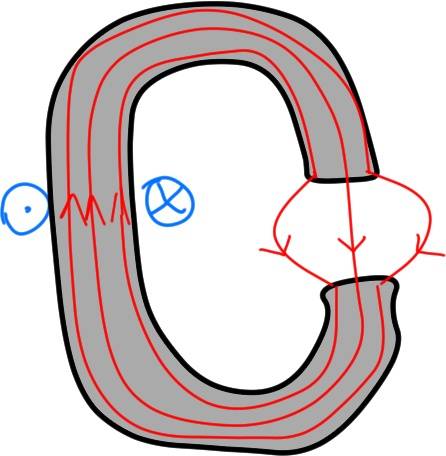
Hello friends, I am trying to find how calculate the magnetic field created by current loop considering that there is a some geometry of material that can enhance the magnetic field. I thought it can be solved by multipling by permeability μ but realized that the iron core changes the picture of magnetic qualitatively.

To illustrate this i attached image for: only coil (1) and coil around the iron bar (2).

For the first picture, it is easy to integrate by Bio-Savart-Laplace law, but..
How to find he field for any point at the second picture?
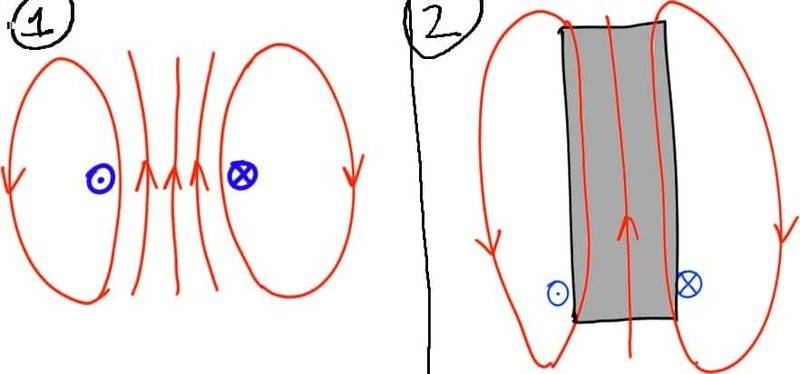
image.jpg


Or, more complicated case:
mm2.jpg
 
Last edited:
Physics news on Phys.org
The latter case is easy if the width of the airgap is small ( the magnetic field in the airgap is almost homogenous ).

From Ampere's law you know that
∫ H⋅ds = N*I ( complete circular path )
Also you know that Hiron = μr,iron * Hair

In case of the rod/solenoid, you don't quite know the path of the magnetic field. Some numeric calculation will be needed. ( See my avatar ).
 
  • Like
Likes   Reactions: FelixTheWhale
Nice image! What can you advise to make a numeric calculation? Is it possible to apply a vector potential (B=curl (A)) to have the solution for complex geometry?
 
FelixTheWhale said:
What can you advise to make a numeric calculation?
I have used high precision Biot-Savart calculation. Just use a 3D compass and follow the field direction from some point, until the field bites its own tail.
 
  • Like
Likes   Reactions: FelixTheWhale

Similar threads

  • · Replies 43 ·
2
Replies
43
Views
7K
  • · Replies 4 ·
Replies
4
Views
2K
  • · Replies 42 ·
2
Replies
42
Views
3K
  • · Replies 7 ·
Replies
7
Views
5K
  • · Replies 22 ·
Replies
22
Views
2K
  • · Replies 5 ·
Replies
5
Views
2K
  • · Replies 2 ·
Replies
2
Views
2K
  • · Replies 3 ·
Replies
3
Views
1K
  • · Replies 2 ·
Replies
2
Views
16K
  • · Replies 2 ·
Replies
2
Views
7K