Newton's Law's Problem (Contact Force)

  • Thread starter Thread starter certainlynot5
  • Start date Start date
  • Tags Tags
    Contact force Force
Click For Summary

Homework Help Overview

The discussion revolves around a physics problem involving three boxes with given masses and an applied force. The participants are exploring how to calculate the contact forces between the boxes using Newton's laws of motion.

Discussion Character

  • Exploratory, Conceptual clarification, Mathematical reasoning

Approaches and Questions Raised

  • The original poster attempts to calculate the contact forces using a specific equation based on the total applied force and the combined masses of the boxes. Some participants suggest finding the acceleration of the entire system first and then analyzing each block with free body diagrams. There is a question about the correct formula for acceleration and whether the blocks accelerate at the same rate.

Discussion Status

The discussion is active, with participants providing different approaches to the problem. Some guidance has been offered regarding the need to consider the entire system's acceleration before analyzing individual blocks. There is ongoing exploration of the correct method to find acceleration and contact forces.

Contextual Notes

Participants are working under the constraints of a homework problem, which may limit the information available and the methods they can use. There is some confusion regarding the application of formulas and the relationships between the blocks.

certainlynot5
Messages
3
Reaction score
0
Basically 3 boxes, somehting like this;
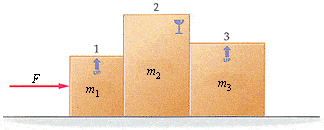
05-19alt.gif

Masses are as followed: M1= 28 kg, M2= 18.7 kg, M3= 28.7 kg. The applied force on the box is 644 N

Part A) What is the magnitude of the contact force between M1 and M2
Part B) What is the magnitude of the contact force between M2 and M3


To find the contace force between M1 and M2, i used this equation; 644/(28 + 18.7) for Part A, and 644/(18.7 + 28.7) for Part B. The anwers are; Part A, 13.79, and for Part B, 13.58.

Is this the correct method? If not, what can be done to achieve the correct answer?
 

Attachments

  • 05-19alt.gif
    05-19alt.gif
    6.4 KB · Views: 549
Physics news on Phys.org
Start by finding the acceleration of the total system of three blocks. Then take each block apart in a free body diagram, identify all forces acting on each block, and apply Newton's laws.
 
and to find acceleration, i would use the formula, F/mg which is 644/28, 644/18.8, 644/28.7?
 
certainlynot5 said:
and to find acceleration, i would use the formula, F/mg which is 644/28, 644/18.8, 644/28.7?
No, each block is in contact with each other, so they must each accelertae at the same rate. What is the acceleration of the total system of the 3 blocks together (as if they were one big mass)?
 
the the entire mass is 75.4
 
certainlynot5 said:
the the entire mass is 75.4
Yes, in kg. So what's the acceleration of the entire mass?
 

Similar threads

  • · Replies 17 ·
Replies
17
Views
2K
  • · Replies 5 ·
Replies
5
Views
2K
  • · Replies 5 ·
Replies
5
Views
8K
  • · Replies 14 ·
Replies
14
Views
3K
  • · Replies 1 ·
Replies
1
Views
5K
Replies
6
Views
3K
  • · Replies 17 ·
Replies
17
Views
2K
Replies
17
Views
2K
  • · Replies 10 ·
Replies
10
Views
3K
  • · Replies 5 ·
Replies
5
Views
2K