kasha
- 7
- 0
This may be a little of a stupid question.
But I was looking at a diagram describing Bragg's Law of Diffraction.
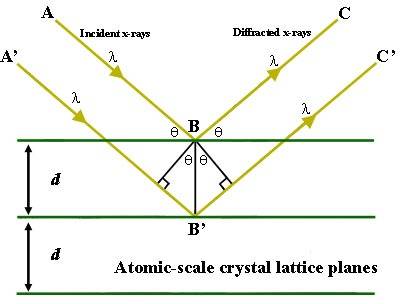
and I was like...how can an interference happen if wave beam C and wave beam C' are hitting different points on the detector screen?! they are not hitting the same point on the detector.
Per Wikipedia: The two separate waves will arrive at a point with the same phase, and hence undergo constructive interference, if and only if this path difference is equal to any integer value of the wavelength...but how would they arrive at the same point? I think the graph is very confusing.
Any help to clear things up would be very appreciated...
But I was looking at a diagram describing Bragg's Law of Diffraction.
and I was like...how can an interference happen if wave beam C and wave beam C' are hitting different points on the detector screen?! they are not hitting the same point on the detector.
Per Wikipedia: The two separate waves will arrive at a point with the same phase, and hence undergo constructive interference, if and only if this path difference is equal to any integer value of the wavelength...but how would they arrive at the same point? I think the graph is very confusing.
Any help to clear things up would be very appreciated...