Power supply and power dissipated in a circuit

Click For Summary

Discussion Overview

The discussion revolves around the relationship between power supply and power dissipation in an electrical circuit, specifically examining a scenario involving multiple voltage sources and resistors. Participants explore concepts related to Thévenin's theorem and conservation of energy, while addressing a specific problem that raises questions about power calculations.

Discussion Character

  • Technical explanation
  • Mathematical reasoning
  • Debate/contested

Main Points Raised

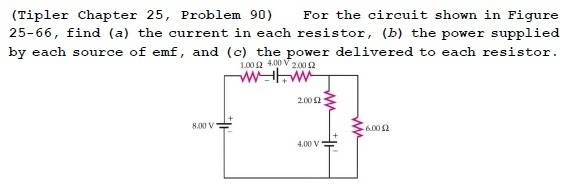
  • One participant questions whether the power supply can be smaller than the power dissipated, citing a specific problem involving three cells.
  • Another participant asserts that power supplied cannot be smaller than power dissipated due to conservation of energy, suggesting a reevaluation of the problem without a specific resistor.
  • A different participant introduces a Thévenin equivalent circuit, proposing that it would yield a specific voltage and resistance, leading to a balanced power dissipation calculation.
  • Further contributions suggest alternative approaches to calculating the Thévenin equivalent and the implications of voltage drops across resistors in the circuit.
  • One participant expresses confusion about their calculations and acknowledges a mistake in their approach to determining the Thévenin equivalent voltage.
  • Another participant describes a method involving Kirchhoff's laws to find the potential and currents in the circuit, challenging the assumption that power from the two 4V sources cancels out.
  • A final participant indicates that they have gained clarity on the topic after engaging in the discussion.

Areas of Agreement / Disagreement

Participants express differing views on the calculations and interpretations of power supply and dissipation, with no consensus reached on the initial question regarding whether power supply can be less than power dissipated. Multiple competing models and approaches are presented throughout the discussion.

Contextual Notes

Participants reference specific circuit configurations and calculations that depend on assumptions about voltage sources and resistances, with some unresolved mathematical steps and interpretations of Thévenin's theorem. The discussion highlights the complexity of power calculations in circuits with multiple sources.

athrun200
Messages
275
Reaction score
0
Can Power supply be smaller than power dissipated?
Because I saw this in one question
attachment.php?attachmentid=44488&stc=1&d=1330433350.jpg

attachment.php?attachmentid=44487&stc=1&d=1330433350.jpg

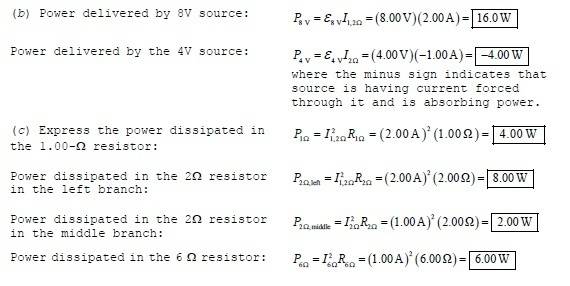
There are 3 cells, the power supply of the two 4V cells cancel each other. (one is -4W and another one is 4W)
So the total power supply should be 16W

But in part c, the power dissipated is 4+8+2+6=20W

Power supply < power dissipated?
 

Attachments

  • a1.jpg
    a1.jpg
    26.3 KB · Views: 968
  • q1.jpg
    q1.jpg
    13.5 KB · Views: 1,240
Physics news on Phys.org
Can Power [supplied] be smaller than power dissipated?
No. Conservation of energy and all that.
the power supply of the two 4V cells cancel each other
Not exactly - try the problem again, only this time remove the part with the 6ohm resistor.

24W is supplied, but 4W is the rate work is being done against the current - leaving 20W of energy for the current to carry. 20W is dissipated. It balances.
If you built this you'd notice that the "-4W" supply gets hot like all the others.

You can think of this circuit as three PSUs with internal resistances driving a 6ohm load.
 
Note: treating the bit without the 6Ohm resister as the supply, the Thévenin equivalent would have a voltage of 8V and resistance 2Ohms.

You'll see this still gives 6W dissipated in the 6Ohm resister, and 2W in the Thévenin resister, while 8W is supplied. Again - everything balances.
 
It seems the Thévenin equivalent should have 7.2V with 1.2 ohm resistance.
attachment.php?attachmentid=44514&stc=1&d=1330494095.jpg
 

Attachments

  • 1111.jpg
    1111.jpg
    15.5 KB · Views: 845
Using Thevenin equivalents isn't the easiest way here.

What I did was.

1. replace the 8v and 4v source by a 12 v source, and the 1ohm and 2ohm resistance that are in series with a 3 ohm resistance

2. assume the potential at the bottom is 0, and the potential at the top right is U.

3. work out the currents in the 3 branches: (V-12)/3, (V-4)/2, V/6 (all pointed downwards)

4. the sum of the currents must be 0 (kirchhof)

so U/3+U/2+U/6 - 12/3 - 4/2 = 0, so U=6 volt.

then it's easy to work out the currents with the equations already given.

The answer sheet is entirely correct, but it doesn't give the power in the top 4V source.
This power is not equal to 4W, and it doesn't cancel the power of the other 4V source.
I have no idea why you should think that.

The same current is going through it as through the 8V source, so the power must be half the power of the 8V source.
 
Thanks everyone, I understand it now.
 

Similar threads

  • · Replies 8 ·
Replies
8
Views
3K
  • · Replies 11 ·
Replies
11
Views
3K
Replies
22
Views
4K
  • · Replies 19 ·
Replies
19
Views
3K
Replies
13
Views
4K
  • · Replies 31 ·
2
Replies
31
Views
14K
  • · Replies 36 ·
2
Replies
36
Views
5K
  • · Replies 1 ·
Replies
1
Views
2K
Replies
7
Views
4K
Replies
4
Views
5K