Question about flow rate in the source flow

Join the discussion
Ask a follow-up here, or get your own question answered by working scientists, mathematicians and engineers — people, not an autocomplete.
Real named experts · corrections over time · the nuance an AI answer skips
10 replies · 2K views
tracker890 Source h
Messages
90
Reaction score
11
Homework Statement
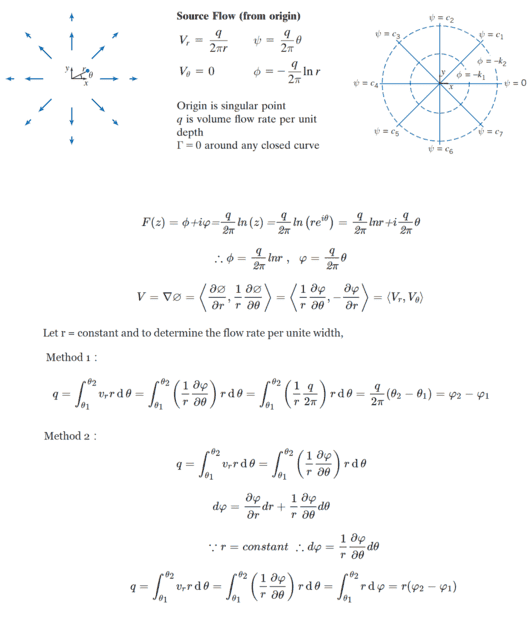
Determine flow rate per unite width in the source flow
Relevant Equations
flow rate equation
Please help me to understand what wrong with method 2.
ref.Flowrate Between Streamlines
(Thank you for your time and consideration.)
1670568334521.png
 
Last edited:
Physics news on Phys.org
In the third line from the end where you have an equation for ##d\varphi##, the last term should not have a factor of ##\frac 1 r##. Note how the factor of ##\frac 1 r## makes the term have the wrong dimensions.
 
TSny said:
In the third line from the end where you have an equation for ##d\varphi ##, the last term should not have a factor of ##\frac 1 r##. Note how the factor of ##\frac 1 r## makes the term have the wrong dimensions.
But about the gradent in cylindrical coordinates is ##\nabla\mathrm\psi=\frac{\partial\mathrm\psi}{\partial r}{\textbf{e}}_r+\frac1r\frac{\partial\mathrm\psi}{\partial\mathrm\theta}{\textbf{e}}_\theta+\frac{\partial\mathrm\psi}{\partial z}{\textbf{e}}_z##, so ##d\mathrm\psi=\frac{\partial\mathrm\psi}{\partial r}dr+\frac1r\frac{\partial\mathrm\psi}{\partial\mathrm\theta}d\theta+\frac{\partial\mathrm\psi}{\partial z}dz##.
Is the above thinking wrong?
 
tracker890 Source h said:
But about the gradent in cylindrical coordinates is ##\nabla\mathrm\psi=\frac{\partial\mathrm\psi}{\partial r}{\textbf{e}}_r+\frac1r\frac{\partial\mathrm\psi}{\partial\mathrm\theta}{\textbf{e}}_\theta+\frac{\partial\mathrm\psi}{\partial z}{\textbf{e}}_z##, so ##d\mathrm\psi=\frac{\partial\mathrm\psi}{\partial r}dr+\frac1r\frac{\partial\mathrm\psi}{\partial\mathrm\theta}d\theta+\frac{\partial\mathrm\psi}{\partial z}dz##.
Is the above thinking wrong?
Isn't ##{\textbf{e}}_\theta=rd\theta##?
 
haruspex said:
Isn't ##{\textbf{e}}_\theta=rd\theta##?
Different:
##{\textbf{e}}_\theta## is vector
##rd\theta## is scalar
 
tracker890 Source h said:
$$d\psi=\frac{\partial\psi}{\partial r}dr+\frac{\partial\psi}{\partial\theta}d\theta$$
reference as follows:
he Gradient in Polar Coordinates and other Orthogonal Coordinate Systems
Yes, for the case of constant z; so?
Compare that with what you wrote in post #3. You have a 1/r factor on the second term which should not be there. It appears in your version because you wrongly replaced eθ with dθ instead of with rdθ. Check the dimensionality of each.
 
tracker890 Source h said:
But about the gradent in cylindrical coordinates is ##\nabla\mathrm\psi=\frac{\partial\mathrm\psi}{\partial r}{\textbf{e}}_r+\frac1r\frac{\partial\mathrm\psi}{\partial\mathrm\theta}{\textbf{e}}_\theta+\frac{\partial\mathrm\psi}{\partial z}{\textbf{e}}_z##, so ##d\mathrm\psi=\frac{\partial\mathrm\psi}{\partial r}dr+\frac1r\frac{\partial\mathrm\psi}{\partial\mathrm\theta}d\theta+\frac{\partial\mathrm\psi}{\partial z}dz##.
Is the above thinking wrong?
-----------------
##\nabla\mathrm\psi=\frac{\partial\mathrm\psi}{\partial r}{\textbf{e}}_r+\frac1r\frac{\partial\mathrm\psi}{\partial\mathrm\theta}{\textbf{e}}_\theta+\frac{\partial\mathrm\psi}{\partial z}{\textbf{e}}_z##

This equation is correct. It expresses the gradient of ##\psi##. The gradient of ##\psi## is a vector quantity. The dimensions of the gradient of ##\psi## are the dimensions of ##\psi## divided by distance. You can check that each term on the right of the equation has these dimensions.
------------------

##d\mathrm\psi=\frac{\partial\mathrm\psi}{\partial r}dr+\frac1r\frac{\partial\mathrm\psi}{\partial\mathrm\theta}d\theta+\frac{\partial\mathrm\psi}{\partial z}dz##

This equation is not correct. ##d \psi## is the differential of psi. This is a scalar quantity that represents a small change in ##\psi## when the variables ##r, \theta## and ##z## are varied by ##dr##, ##d\theta##, and ##dz## respectively. The dimensions of ##d \psi## are the same as the dimensions of ##\psi##. Each term on the right side of the equation should have dimensions of ##\psi##. But the second term on the right side of your equation has dimensions of ##\psi## divided by distance (##r##).

For an arbitrary function ##f## of three variables ##u, v, w##, the differential of ##f(u, v, w)## is $$df = \frac{\partial f}{\partial u} du + \frac{\partial f}{\partial v}dv + \frac{\partial f}{\partial w}dw $$ So ##d \psi## is $$d\mathrm\psi=\frac{\partial\mathrm\psi}{\partial r}dr+\frac{\partial\mathrm\psi}{\partial\mathrm\theta}d\theta+\frac{\partial\mathrm\psi}{\partial z}dz$$
 
TSny said:
-----------------
##\nabla\mathrm\psi=\frac{\partial\mathrm\psi}{\partial r}{\textbf{e}}_r+\frac1r\frac{\partial\mathrm\psi}{\partial\mathrm\theta}{\textbf{e}}_\theta+\frac{\partial\mathrm\psi}{\partial z}{\textbf{e}}_z##

This equation is correct. It expresses the gradient of ##\psi##. The gradient of ##\psi## is a vector quantity. The dimensions of the gradient of ##\psi## are the dimensions of ##\psi## divided by distance. You can check that each term on the right of the equation has these dimensions.
------------------

##d\mathrm\psi=\frac{\partial\mathrm\psi}{\partial r}dr+\frac1r\frac{\partial\mathrm\psi}{\partial\mathrm\theta}d\theta+\frac{\partial\mathrm\psi}{\partial z}dz##

This equation is not correct. ##d \psi## is the differential of psi. This is a scalar quantity that represents a small change in ##\psi## when the variables ##r, \theta## and ##z## are varied by ##dr##, ##d\theta##, and ##dz## respectively. The dimensions of ##d \psi## are the same as the dimensions of ##\psi##. Each term on the right side of the equation should have dimensions of ##\psi##. But the second term on the right side of your equation has dimensions of ##\psi## divided by distance (##r##).

For an arbitrary function ##f## of three variables ##u, v, w##, the differential of ##f(u, v, w)## is $$df = \frac{\partial f}{\partial u} du + \frac{\partial f}{\partial v}dv + \frac{\partial f}{\partial w}dw $$ So ##d \psi## is $$d\mathrm\psi=\frac{\partial\mathrm\psi}{\partial r}dr+\frac{\partial\mathrm\psi}{\partial\mathrm\theta}d\theta+\frac{\partial\mathrm\psi}{\partial z}dz$$
Thank you for your clear answer, so ##d\psi## is
$$d\psi=\frac{\partial\psi}{\partial r}dr+\frac{\partial\psi}{\partial\theta}d\theta+\frac{\partial\psi}{\partial z}dz$$
$$ \because r\;and\;z=constant\;\;\;\therefore d\psi=\frac{\partial\psi}{\partial\theta}d\theta $$
 
tracker890 Source h said:
$$d\psi=\frac{\partial\psi}{\partial r}dr+\frac{\partial\psi}{\partial\theta}d\theta+\frac{\partial\psi}{\partial z}dz$$
$$ \because r\;and\;z=constant\;\;\;\therefore d\psi=\frac{\partial\psi}{\partial\theta}d\theta $$
Yes
 
Reply
  • Like
Likes   Reactions: tracker890 Source h