Relationship between E-field and Probability Amplitude of Waves

Click For Summary

Discussion Overview

The discussion centers on the relationship between the electric field of electromagnetic waves and the probability amplitude associated with photons. It explores theoretical aspects of wave descriptions in quantum mechanics and classical electromagnetism, as well as the implications of these relationships in the context of photon behavior.

Discussion Character

  • Exploratory
  • Technical explanation
  • Debate/contested

Main Points Raised

  • Some participants propose that electromagnetic waves can be described by Maxwell's equations, while photons are described by probability waves, raising questions about their relationship.
  • One participant notes that intensity is proportional to the square of both the electric field amplitude and the probability amplitude.
  • Several participants express that the question regarding the relationship between the electric field and probability amplitude is commonly asked, suggesting a broader interest in the topic.
  • Another participant emphasizes that photons cannot be described by the non-relativistic Schrödinger equation, indicating that their quantum behavior differs from that of non-relativistic particles.
  • A later reply discusses the concept of photon states being described by Fock states and the relationship of the electric field to these states through field operators.
  • One participant questions the meaning of the bold p in the Schrödinger equation for photons, suggesting it may represent momentum.

Areas of Agreement / Disagreement

Participants express differing views on the relationship between the electric field and probability amplitude, with no consensus reached on whether they are directly proportional or how they relate given their different natures (vector vs. scalar).

Contextual Notes

The discussion highlights limitations in understanding the relationship due to the differing frameworks of classical electromagnetism and quantum mechanics, as well as the absence of a spatial wavefunction for photons in the traditional sense.

tade
Messages
720
Reaction score
26
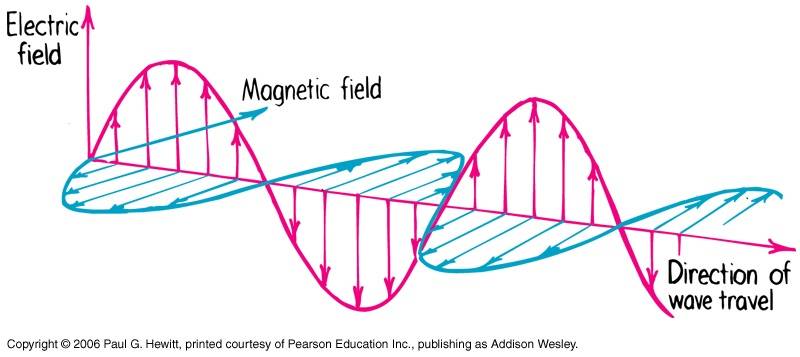
Electromagnetic waves can be classically described by Maxwell's equations.
26-02Figure_FIG.jpg


Photons can be described by probability waves.In this case, what is the relationship between the electric field and the probability amplitude?

Are they directly proportional to each other? What about the fact that one is a vector and the other a scalar?
 
Physics news on Phys.org
The Intensity is proportional to the square of the E-field amplitude, and also proportional to the square of the probability amplitude.
 
I thought this would be a commonly asked question.
 
Did you read the thread? Your question stated that photons could be described by probability waves and then asked a question that if that were were the case... The lack of responses would suggest that it cannot be the case.
 
Jilang said:
Did you read the thread? Your question stated that photons could be described by probability waves and then asked a question that if that were were the case... The lack of responses would suggest that it cannot be the case.

Yeah I know, but I was asking if you yourself know the answer.
 
A photon is not a non-relativistic object, this implies that its quantum behavior cannot be described by the (non-relativistic) Schroedinger equation. For non-relativistic particles, you can find its position representation wavefunction by solving the Schroedinger equation. Since you can't do that with photon, there is no spatial wavefunction in the usual sense of non-relativistic QM which can be associated to photons.

tade said:
what is the relationship between the electric field and the probability amplitude?
Photon state is described by the so-called Fock states or its linear combination. Whereas the electric field, since it's a physical quantity, is associated with a field operator ##\tilde{E}## and the electric field you observe is the average value of this operator with respect to the particular state of the photon, i.e. ##\langle \psi | \tilde{E} | \psi\rangle##. The state ##|\psi\rangle ## can take a number of forms, each of which is a particular linear combination of Fock states, for example number state, coherent state, squeezed state, etc, and again they do not have position representation.
 

Similar threads

  • · Replies 8 ·
Replies
8
Views
2K
  • · Replies 6 ·
Replies
6
Views
2K
  • · Replies 6 ·
Replies
6
Views
3K
  • · Replies 4 ·
Replies
4
Views
3K
  • · Replies 6 ·
Replies
6
Views
2K
  • · Replies 3 ·
Replies
3
Views
1K
  • · Replies 36 ·
2
Replies
36
Views
9K
  • · Replies 3 ·
Replies
3
Views
2K
  • · Replies 26 ·
Replies
26
Views
3K
  • · Replies 2 ·
Replies
2
Views
2K