dominicfhk
- 11
- 0
Signal flow graph, describing a RC circuit?
Hi, guys. This is my first post on this forum!
I'm trying to understand this example in my textbook.
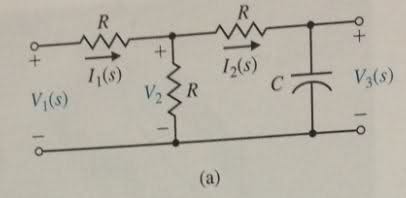
The current and voltage equations are:
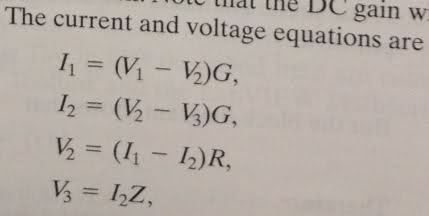
where G=1/R, Z(s)=1/Cs, and I1(s)=I1
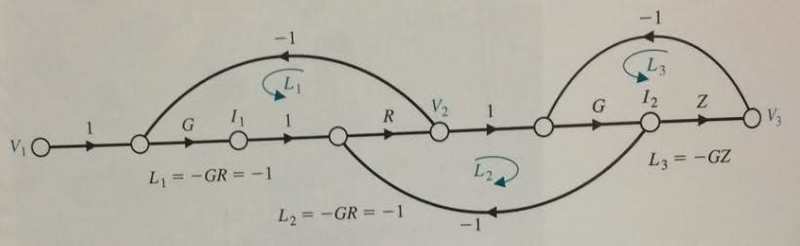
Then the text says the following signal flow graph can be obtained:
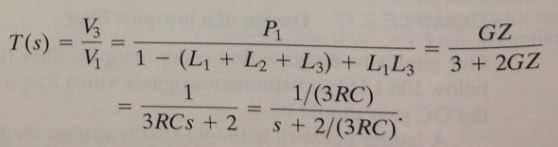
And finally we can somehow obtain the transfer function:
First question, why is it necessary to do the substitution for G, Z(s) and I1?
For the fourth equation, it says V3=I2Z, where Z(s)=1/Cs. Therefore, V3=I2/Cs (voltage=current/capacitance)? Where does this relationship comes from?
Lastly, how do I know how many equations do I need? And which circuit elements should I describe?
I might have more questions later, but I couldn't proceed without know the basics.
Thank you so much!
Hi, guys. This is my first post on this forum!
I'm trying to understand this example in my textbook.
The current and voltage equations are:
where G=1/R, Z(s)=1/Cs, and I1(s)=I1
Then the text says the following signal flow graph can be obtained:
And finally we can somehow obtain the transfer function:
First question, why is it necessary to do the substitution for G, Z(s) and I1?
For the fourth equation, it says V3=I2Z, where Z(s)=1/Cs. Therefore, V3=I2/Cs (voltage=current/capacitance)? Where does this relationship comes from?
Lastly, how do I know how many equations do I need? And which circuit elements should I describe?
I might have more questions later, but I couldn't proceed without know the basics.
Thank you so much!