How Do You Calculate the Force of a Solenoid to Lock a Neodymium Triangle?

Click For Summary
SUMMARY

The discussion focuses on calculating the force required for a solenoid to lock a neodymium triangle magnet in place. Key parameters include a 2 mm separation distance, a weight of 2 kg, and the use of a solenoid with specific coil characteristics such as thickness, turns, and current. The force equations provided include F=((N x I)^2 x k x A) / (2 x d^2) and considerations for resistance based on copper properties. The conversation also highlights the importance of controlling current and understanding the thermal limits of the coil.

PREREQUISITES
  • Understanding of solenoid physics and electromagnetic principles
  • Familiarity with force calculation formulas in electromagnetism
  • Knowledge of electrical resistance and material properties, specifically for copper
  • Basic concepts of thermal dynamics related to electrical components
NEXT STEPS
  • Research solenoid design parameters including coil thickness and number of turns
  • Learn about the thermal properties of copper and its impact on solenoid performance
  • Explore the effects of magnetic materials on solenoid efficiency and force generation
  • Investigate methods for calculating and controlling current in solenoids
USEFUL FOR

Engineers, hobbyists, and researchers involved in electromagnet design, solenoid applications, and those working with neodymium magnets in mechanical systems.

r_prieto5
Messages
18
Reaction score
0
Hello everyone,

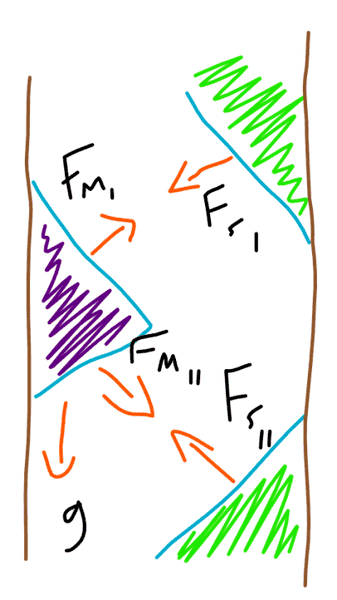
So for a personal project I want to calculate the force necessary for a solenoid (electromagnetic coil) to keep a permanent magnet triangle locked diagonally up and down at the same time so that it does not move in any direction. I need to know the values for coil thickness, amps, turns, and pretty much anything else necessary. The distance should be around 2 mm separation between faces and the weight of the triangle is around 2 kg. In the sketch, the green things are electromagnets attracting with forces Fsi and Fsii and purple is the triangle with forces Fmi and Fmii, all magnets are horizontally locked by the wall, it is just a vertical movement controlled by the magnets pulling on the triangle. This is not a homework or anything so feel free to give comments, formulas (hopefully with links to source), or any information I could use.
solenoid forces.png
 
Engineering news on Phys.org
In order to fix the magnet in space the solenoid forces should act in opposite sides. If the angle between forces is less than 180 degrees then a resultant force is present.
upload_2017-3-19_7-12-23.png
 
Ok wow thanks for the sketch and reply. Let's see if I understand though. Why does Fsi result vertically up only and Fsii result horizontally to the right only? Fsi is directly in front of Fmi and Fsii is with Fmi so that both Fs forces are pulling the triangle towards them, therefore balancing out vertically if we ignore weight. Horizontally, movement is locked since the solenoids and triangle magnet are locked to the brown walls by means of say rollers so that the don't rotate or get separated from the wall.
You can also assume there is an isolating wall between solenoids which can partially prevent the fields from affecting each other.
Finally, the degree between solenoids is 90 so that the resulting pull force would be right and a little bit down due to weight.
 
At first you have to control the currents so the resultant vertical force will be exact the 2 kg .
Second you can calculate the required force FsII*sin(a)=FsI*sin(b)+g where a and b are
the angles between force vectors and the horizontal line.
A general force eq. [in N-1kgf=9.8 N]:
F=((N x I)^2 x k x A) / (2 x d^2) where:
N=number of turns; A=solenoid cross section[m^2]; k=4*pi/10^7 H/m ; d=distance [m]
You have to choose the supply voltage and to calculate the resistance [according to conductor
material for copper ro=1/58 ohm*mm^2/m at 20oC] R=pi*diam*N*ro*kT/scu
kT=(234.5+Tc)/(234.5+20) where Tc actual temperature of the conductor[oC]
diam=solenoid diameter[m;] scu=cross section area of the conductor [mm^2]
scu=~I/3 mm^2 I[A]
If the supply voltage is a.c. you need also the reactance
X=2*pi*frq*k*N^2*A/hght
frq=50 or 60 Hz hght=solenoid height[m]
I=V/SQRT(R^2+X^2)
 
  • Like
Likes   Reactions: r_prieto5
Omg thanks a lot for this. I will get into it later on today if possible and get back if something in unclear, just ote thing, is the distance between magnets included in these formulas?
 
If do you mean if the distance between solenoids does matter, in my opinion, what does is the force direction only. It has to be against the magnet, of course. However, since the horizontal motion is not allowed so rotation also is not possible.
 
How do i select the current? I can't do trial and error as the point of this whole calculation is to buy the right type of coil diameter.
 
Sorry, I did not think about the practical part: coil building. Here are a lot of problems:
the total coil length limit, the number of layers, the air temperature, and the wire insulation rated
temperature, the wind velocity and many other problem.
For instance for 2000 turns and 0.245 A in single layer 21 V d.c. the coil length will be 55 cm the temperature of the wire 160oC [wind velocity 2m/sec air temperature 20oC –dry open air.]
 
Hmm ok this just got tougher. What formula did you use for that? Also, why would it get to 160°? I would need it to work at around 50-60° tops. I don't think eddy currents would have such a large effect here to heat it up that much if i use neodymium magnets
 
  • #10
First, I did not know the magnet is neodymium magnets. I considered it as ferromagnetic material[usual iron or steel].
I have no experience with neodymium magnets.
Second, I took air as coil core not magnetic material.
If you intend to use a magnetic core instead of air for the coil you have to know the material
properties-as saturation curve ,hysteresis and other magnetic losses and so on.
The temperature calculation of coil is based on convection and radiation heat evacuation compared with the losses-Plosses=R*I^2 [W].
See for instance:
https://farnam-custom.com/resources/engineer-talk/estimating-the-resistance-wire-temperature-for-an-open-coil-heating-element/
Nevertheless it is for an other application the theory is the same.
 

Similar threads

  • · Replies 37 ·
2
Replies
37
Views
4K
Replies
6
Views
8K
Replies
31
Views
4K
  • · Replies 1 ·
Replies
1
Views
2K
  • · Replies 4 ·
Replies
4
Views
2K
  • · Replies 1 ·
Replies
1
Views
1K
Replies
49
Views
6K
  • · Replies 12 ·
Replies
12
Views
5K
  • · Replies 4 ·
Replies
4
Views
3K
  • · Replies 3 ·
Replies
3
Views
2K