Vertex, Propagator and Loop counting

Click For Summary

Discussion Overview

The discussion revolves around the counting of loops, vertices, and propagators in vacuum diagrams as presented in lecture notes. Participants express confusion regarding the assigned factors related to these elements and their implications for the number of loops in various diagrams.

Discussion Character

  • Exploratory
  • Technical explanation
  • Debate/contested

Main Points Raised

  • One participant questions the counting of loops in a diagram with 6 vertices and 9 propagators, asserting that their count leads to 6 loops, while the paper states there should be 5.
  • Another participant agrees with the initial count of loops in the first diagram but expresses skepticism about the paper's assertion.
  • A different diagram with 2 vertices and 3 propagators is discussed, where one participant believes there are 3 loops, contradicting the paper's claim of 1 loop.
  • One participant notes that the first picture shows two loops moving in different directions, suggesting a different interpretation of loops.
  • Another participant acknowledges seeing 5 loops in the second diagram, including both interior and exterior loops, but questions how this relates to their original understanding of loops.

Areas of Agreement / Disagreement

Participants express differing views on the correct counting of loops in the diagrams, with no consensus reached on the interpretations presented in the paper.

Contextual Notes

Participants highlight potential ambiguities in the definitions of loops and how they may vary based on different interpretations of the diagrams.

ShayanJ
Science Advisor
Insights Author
Messages
2,802
Reaction score
605
I'm reading these lecture notes but there is something I don't understand. In page 15, it starts to consider vacuum diagrams of various orders and tries to associated a factor to them according to the rule:
## diagram \sim (\frac \lambda N)^p(\frac N \lambda)^v N^l=\lambda^{p-v} N^{l+v-p}##.
Where v is the number of vertices, p is the number of propagators and l is the number of loops.
But I have some problems with understanding a few of its countings.
a.jpg

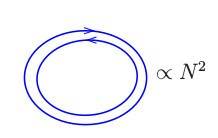
In this one, I think, you can consider any number of vertices you want and it doesn't matter because the number of propagators will be equal to it and they will cancel each other. But what does matter is the number of loops which, for me, is obviously equal to 1. But as you can see, the papers says its 2 and I have no idea how!
b.jpg

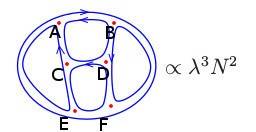
In this one, there are 6 vertices and 9 propagators. The factor that the paper assigns to it suggests that the number of loops should be 5. So let's count! I start from A:
AECA,AECDBA, AEFDCA, AEFDBA, AEFBA, AEFBDCA,...
I think there are still more A-containing loops but it doesn't matter. There are already 6 loops and I didn't even go to loops containing other vertices(like CDFEC). So how does the paper say the number of loops is 5?
c.jpg

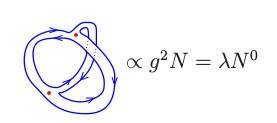
This one has 2 vertices and 3 propagators and so the number of loops should be 1, according to the factor given to it by the paper. But I see 3 loops! Let's call the top vertex F and the bottom one G. If I'm on each of the vertices, then I have three directions to go, let's call them east,west and north. So let's say I'm on F. Then I can go to north to reach G. Then I can either go to west or east to return to F. So we have 2 loops here. Another loop is going east(west) to reach G and then going west(east) to return to F. So there are 3 loops in this diagram, but the paper says its 1. How?

Thanks
 
Physics news on Phys.org
Shayan.J said:
I'm reading these lecture notes but there is something I don't understand. In page 15, it starts to consider vacuum diagrams of various orders and tries to associated a factor to them according to the rule:
## diagram \sim (\frac \lambda N)^p(\frac N \lambda)^v N^l=\lambda^{p-v} N^{l+v-p}##.
Where v is the number of vertices, p is the number of propagators and l is the number of loops.
But I have some problems with understanding a few of its countings.View attachment 104306
In this one, I think, you can consider any number of vertices you want and it doesn't matter because the number of propagators will be equal to it and they will cancel each other. But what does matter is the number of loops which, for me, is obviously equal to 1. But as you can see, the papers says its 2 and I have no idea how!View attachment 104308
In this one, there are 6 vertices and 9 propagators. The factor that the paper assigns to it suggests that the number of loops should be 5. So let's count! I start from A:
AECA,AECDBA, AEFDCA, AEFDBA, AEFBA, AEFBDCA,...
I think there are still more A-containing loops but it doesn't matter. There are already 6 loops and I didn't even go to loops containing other vertices(like CDFEC). So how does the paper say the number of loops is 5?View attachment 104309
This one has 2 vertices and 3 propagators and so the number of loops should be 1, according to the factor given to it by the paper. But I see 3 loops! Let's call the top vertex F and the bottom one G. If I'm on each of the vertices, then I have three directions to go, let's call them east,west and north. So let's say I'm on F. Then I can go to north to reach G. Then I can either go to west or east to return to F. So we have 2 loops here. Another loop is going east(west) to reach G and then going west(east) to return to F. So there are 3 loops in this diagram, but the paper says its 1. How?

Thanks
The first picture in your post show two loops that move in different directions.
Also in the second pic you gave I see 5 loops, the 4 interior loops and the one big loop around them.
 
MathematicalPhysicist said:
The first picture in your post show two loops that move in different directions.
Well...that may be true...and I considered that..., but seems really unlikely to me and I don't think that's how it works.
 
Did you send an email to the author of this paper just in case?
 
MathematicalPhysicist said:
Did you send an email to the author of this paper just in case?
Well...Let's first see if I can get something out of this thread! I don't think that's necessary.
 
MathematicalPhysicist said:
The first picture in your post show two loops that move in different directions.
Also in the second pic you gave I see 5 loops, the 4 interior loops and the one big loop around them.
Hey...looks like that's true! It explains all of them!
But...now I'm not sure how its related to the concept of loop I was thinking of...or why that concept of loop doesn't apply!
For now I just continue reading!
Thanks
 

Similar threads

  • · Replies 1 ·
Replies
1
Views
2K
  • · Replies 4 ·
Replies
4
Views
2K
  • · Replies 8 ·
Replies
8
Views
2K
  • · Replies 6 ·
Replies
6
Views
6K
  • · Replies 1 ·
Replies
1
Views
2K
  • · Replies 4 ·
Replies
4
Views
3K
  • · Replies 6 ·
Replies
6
Views
5K
  • · Replies 2 ·
Replies
2
Views
5K
  • · Replies 4 ·
Replies
4
Views
2K
  • · Replies 6 ·
Replies
6
Views
4K