nmnna
- 22
- 3
- Homework Statement
- Given a position vs time graph.
1)Find ##\frac{v_{2}}{v_{1}}##
2)At what time the objects will meet?
3)Find ##\frac{\Delta{x_2}}{\Delta{x_1}}##, if the second object started moving from the origin.
- Relevant Equations
- ##v = \frac{\Delta{x}}{t}##
The graph:
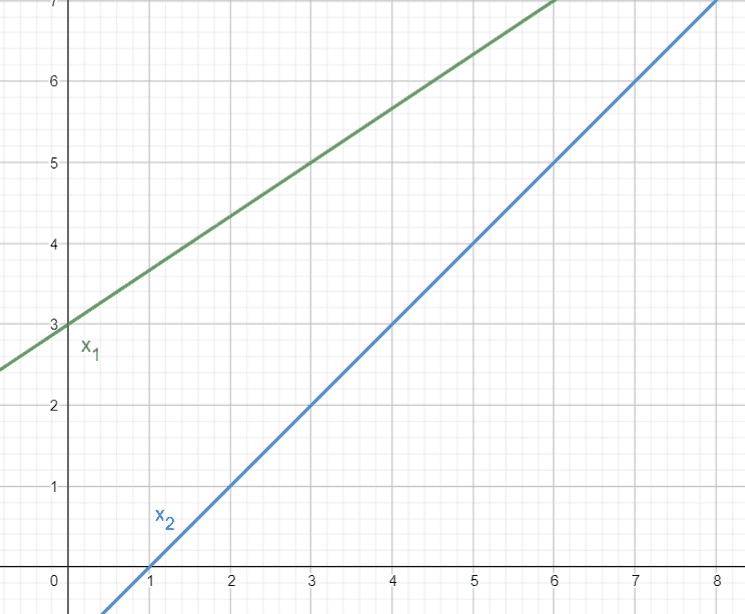
1) $$v_1 = \frac{\Delta{x}}{t} = \frac{5 - 3}{3} = \frac{2}{3}$$
$$2 = \frac{\Delta{x}}{t} = \frac{4 - 0}{5 - 1} = 1$$
$$\frac{v_2}{v_1} = \frac{1}{2/3} = \frac{3}{2} = 1.5$$
2)Points of intersection of the lines with the x-axis: ##I## (0; 3) and ##II## (0; -1), thus
$$\frac{2}{3}t + 3 = t - 1$$
$$t=\frac{-4}{(\frac{2}{3} - 1)} = 12 \ \text{seconds after starting motion}$$
I'm confused about the 3rd part.
If the second object starts moving from the origin then the graph should look something like this
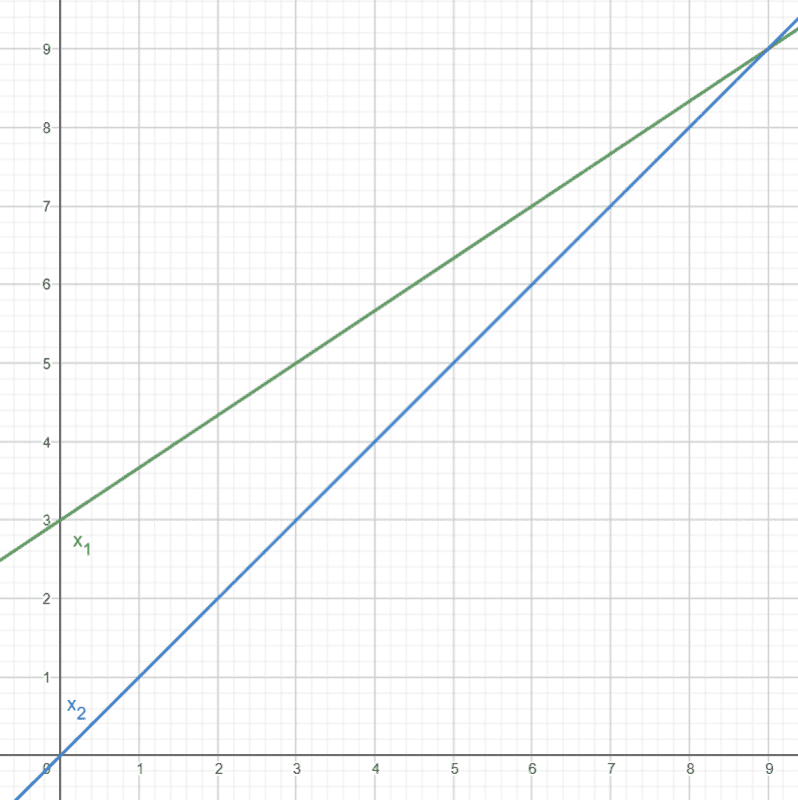
We can clearly see that the objects met when 9 seconds passed and calculations lead to the same value as well:
$$\frac{2}{3}t + 3 = t$$
We know that the velocity of the first one is ##\frac{2}{3} \frac{\text{m}}{\text{sec}}##, we can find the distance it passed in 9 seconds, which is ##6## meters, for the second one I got ##9## meters. So the ratio ##\frac{\Delta{x_2}}{\Delta{x_2}} = \frac{9}{6} = 1.5##.
But the answer in my textbook is 1.375
Where I went wrong?
This is a translation from another language so if something is not clear please tell me.
1) $$v_1 = \frac{\Delta{x}}{t} = \frac{5 - 3}{3} = \frac{2}{3}$$
$$2 = \frac{\Delta{x}}{t} = \frac{4 - 0}{5 - 1} = 1$$
$$\frac{v_2}{v_1} = \frac{1}{2/3} = \frac{3}{2} = 1.5$$
2)Points of intersection of the lines with the x-axis: ##I## (0; 3) and ##II## (0; -1), thus
$$\frac{2}{3}t + 3 = t - 1$$
$$t=\frac{-4}{(\frac{2}{3} - 1)} = 12 \ \text{seconds after starting motion}$$
I'm confused about the 3rd part.
If the second object starts moving from the origin then the graph should look something like this
We can clearly see that the objects met when 9 seconds passed and calculations lead to the same value as well:
$$\frac{2}{3}t + 3 = t$$
We know that the velocity of the first one is ##\frac{2}{3} \frac{\text{m}}{\text{sec}}##, we can find the distance it passed in 9 seconds, which is ##6## meters, for the second one I got ##9## meters. So the ratio ##\frac{\Delta{x_2}}{\Delta{x_2}} = \frac{9}{6} = 1.5##.
But the answer in my textbook is 1.375
Where I went wrong?
This is a translation from another language so if something is not clear please tell me.
Last edited: