Where is this term coming from?

  • Context: Undergrad 
  • Thread starter Thread starter bigmike94
  • Start date Start date
  • Tags Tags
    Term
Join the discussion
Ask a follow-up here, or get your own question answered by working scientists, mathematicians and engineers — people, not an autocomplete.
Real named experts · corrections over time · the nuance an AI answer skips
5 replies · 1K views
bigmike94
Messages
99
Reaction score
61
TL;DR
I am back again to ask for your mathematical help.
I got the same result apart from that extra x in the second term? I have boiled it down to that it must have come from maybe the x hat j hat and z hat part of the product rule? Any help would be grateful thank you!
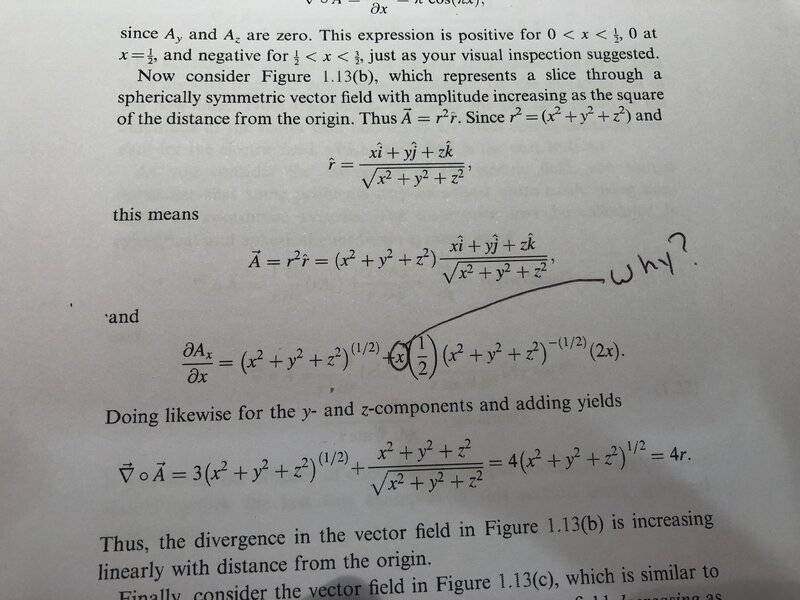
A46D6638-E602-4C43-BA7C-4DD92E3E44AE.jpeg
 
Physics news on Phys.org
It comes from numerator of the formula above, x i-hat.
 
Reply
  • Like
Likes   Reactions: bigmike94
anuttarasammyak said:
It comes from numerator of the formula above, x i-hat.
Yeah I had a guess what assumed that was it but why is it included and not y or z aswell? Maybe I am missing an i hat which will get rid of the j and z hat cos of the dot product?
 
PeroK said:
@bigmike94 can you write down what ##A_x## is?
I’m not sure how to type maths in here but I think you have just helped me crack it, because it’s in the x direction only we ignore y hat and z hat, then In the product rule you’re left with the extra x.

I’m not sure if that makes sense to you? But yeah I think I get it now thank you
 
bigmike94 said:
I’m not sure how to type maths in here but I think you have just helped me crack it, because it’s in the x direction only we ignore y hat and z hat, then In the product rule you’re left with the extra x.

I’m not sure if that makes sense to you? But yeah I think I get it now thank you
By definition $$\vec A = A_x \hat i + A_y \hat j + A_z \hat k$$This can also be expressed as:$$A_x = \vec A \cdot \hat i$$

You need to learn some LaTex:

https://www.physicsforums.com/help/latexhelp/
 
Reply
  • Like
Likes   Reactions: bigmike94