Why do you subtract different voltages in NodeVoltageMethod

  • Thread starter Thread starter AchillesWrathfulLove
  • Start date Start date
Click For Summary

Discussion Overview

The discussion revolves around the application of the Node Voltage Method in circuit analysis, specifically focusing on the reasoning behind subtracting different voltages when formulating equations for node voltages. Participants explore the definitions and conventions related to voltage and current in this context.

Discussion Character

  • Technical explanation
  • Debate/contested

Main Points Raised

  • One participant presents three equations derived from a circuit using the Node Voltage Method and questions the rationale behind subtracting voltages from each other.
  • Another participant suggests that the original poster should consult their textbook for foundational understanding, implying that they may be overcomplicating the method.
  • A participant explains that voltage is defined as a difference, thus necessitating subtraction to find the voltage across resistors.
  • Concerns are raised about the sign conventions used for current entering and leaving nodes, with differing perspectives on whether current entering a node should be treated as positive or negative.
  • Participants express the importance of consistency in sign conventions to avoid confusion in circuit analysis.

Areas of Agreement / Disagreement

Participants express differing views on the sign conventions for current at nodes, indicating a lack of consensus on this aspect of the Node Voltage Method. The discussion remains unresolved regarding the best practices for applying these conventions.

Contextual Notes

Participants reference different educational backgrounds and conventions, highlighting potential limitations in understanding due to varying definitions and teaching methods related to voltage and current.

AchillesWrathfulLove
Messages
30
Reaction score
6
Derived from this circuits 3 nodes are 3 equations using the NodeVoltageMethod

1. (V1--40)/12 + 5 + (V1-V2)/20 + V1/25 = 0
2. (V2-V1)/20 + (V2-V3)/40 - 7.5 - 5 = 0
3. V3/40 + (V3-V2)/40 + 7.5 = 0

The only pattern I can see here is that if it is at node 1 then it is always the node voltage belonging to node 1 (which is V1) minus something else. I know that "this" minus "this" gives you the voltage across the horizontal or sometimes vertical resistor but I don't know WHY. Why do you minus voltages from each other.
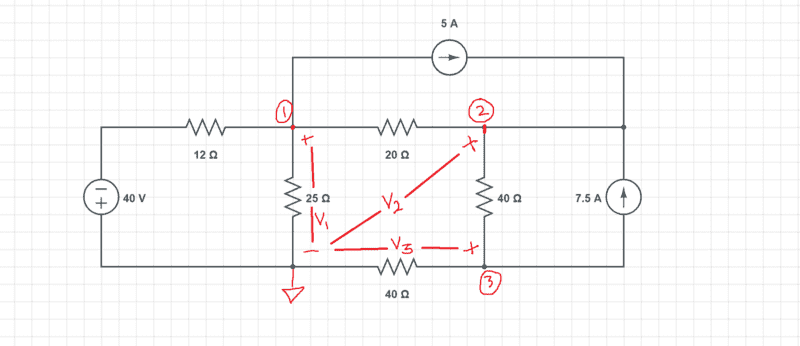
NodeVoltageMethod.png
 

Attachments

  • NodeVoltageMethod.png
    NodeVoltageMethod.png
    9.9 KB · Views: 941
Engineering news on Phys.org
What does you textbook says about the method? What sources have you tried to consult to answer the question and to learn how to apply the method?

Looks to me like you are searching for a pattern in worked out examples and reinventing the wheel instead of just learning the basics of the method, where it is all explained.
 
Did you derive those three equations or is that from an example problem out of your course material ?

AchillesWrathfulLove said:
Why do you minus voltages from each other.
Short answer is because voltage is a DIFFERENCE (remember definition of voltage, it's Potential Difference) and to get a difference you subtract. You're finding the voltage across those 12, 20 , and 40 ohm resistors.

I know that sounds like a wise-guy answer but it's not.

I don't want to start in on my long answer because i was taught to treat current entering a node as positive, current leaving as negative,
yet i notice your 5 and 7.5 amp current sources are assigned a + sign when leaving nodes 1 and 3 and a - sin when entering node 2.

So i'll wait and see if anybody clarifies that conundrum..
Might be as simple as in 1961 when i was taught, we still believed in "electron current" and our textbook was the RCA Receiving Tube Manual.

That's why i asked if those equations were yours or a textbook author's.
Each author is free to set his conventions provided he clearly defines them.
I don't want to mix different sets of conventions--- that's chaos.

old jim
 
jim hardy said:
I don't want to start in on my long answer because i was taught to treat current entering a node as positive, current leaving as negative,

Well i was taught that current into node is negative and current out of node is positive so that is why my equations are as such. Thank you for your answer.
 
AchillesWrathfulLove said:
Well i was taught that current into node is negative and current out of node is positive so that is why my equations are as such. Thank you for your answer.
Thank you !
So long as one is rigorous with whatever sign convention he uses he'll be okay.
 

Similar threads

  • · Replies 4 ·
Replies
4
Views
2K
Replies
20
Views
4K
Replies
15
Views
3K
  • · Replies 4 ·
Replies
4
Views
9K
  • · Replies 1 ·
Replies
1
Views
2K
  • · Replies 3 ·
Replies
3
Views
2K
  • · Replies 15 ·
Replies
15
Views
4K
Replies
4
Views
3K
  • · Replies 4 ·
Replies
4
Views
2K
Replies
55
Views
8K