Why Does a Second Order Opamp Circuit Show Contradictory Derivatives?

Click For Summary

Discussion Overview

The discussion revolves around a second order operational amplifier (op-amp) circuit, specifically addressing apparent contradictions in the derivatives of voltage at a certain point in the circuit. Participants are trying to clarify the solution process and the equations involved, with a focus on understanding the behavior of the circuit in both time and Laplace domains.

Discussion Character

  • Technical explanation
  • Debate/contested
  • Mathematical reasoning

Main Points Raised

  • One participant expresses confusion over two conflicting derivative values for dv(0+)/dt, questioning why one is 0 and the other is -1.
  • Another participant suggests that the confusion may stem from a possible typo in the equations presented.
  • Several participants provide higher resolution images of the circuit for better clarity, indicating that the original images were difficult to read.
  • A participant proposes using Laplace transforms to avoid dealing with derivative terms directly, suggesting it might simplify the analysis.
  • One participant reports an algebra mistake in their calculations related to the transfer function, specifically omitting a resistor in the denominator, which they later correct.
  • Another participant confirms that correcting the algebra leads to a valid expression for V_{out}(t) and advocates for the use of Laplace transforms as a more effective method for analyzing the circuit.
  • A later reply points out a potential mislabeling in the equations, suggesting that a derivative should refer to a different voltage variable.

Areas of Agreement / Disagreement

Participants do not reach a consensus on the source of the contradictions in the derivatives, and multiple competing views on the solution methods and interpretations of the equations remain present throughout the discussion.

Contextual Notes

There are unresolved issues regarding the clarity of the equations and potential typos, as well as the implications of using different analytical methods (time domain vs. Laplace domain) for solving the circuit behavior.

paulmdrdo
Messages
89
Reaction score
2
Homework Statement
Find the expression for vo(t)
Relevant Equations
See the attached photo
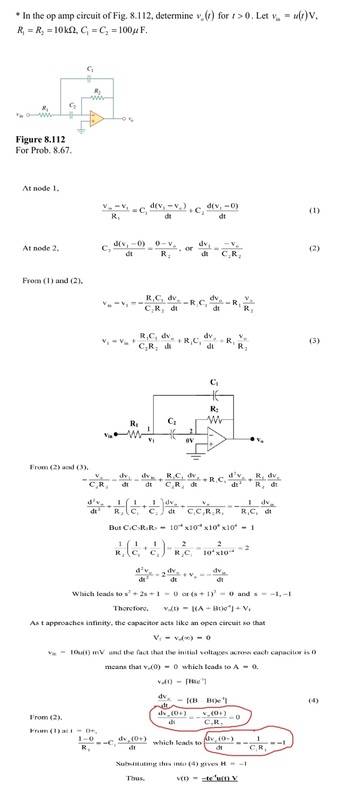
I was trying to understand the way this problem was solved and I got confused with the latter part of the solution. I encircled the part that confused me. They seem to contradict each other. If dv(0+)/dt = 0 why is it dv(0+)/dt = -1 in the other one? Please explain. TIA!
t6s31y.jpg

http://i67.tinypic.com/t6s31y.jpg
 
Last edited:
Physics news on Phys.org
the scan quality is too poor to be readable.
 
here's a readable version of the photos
 

Attachments

  • PROBLEM 8.67 SADIKU P1.png
    PROBLEM 8.67 SADIKU P1.png
    15.5 KB · Views: 430
  • PROBLEM 8.67 SADIKU P2.png
    PROBLEM 8.67 SADIKU P2.png
    20.3 KB · Views: 410
  • PROBLEM 8.67 SADIKU P3.png
    PROBLEM 8.67 SADIKU P3.png
    26.1 KB · Views: 398
paulmdrdo said:
here's a readable version of the photos
Thanks for the higher resolution images. I notice that the resolution is fine when I click on the tinypic URL in your first post -- do you have any idea why the image you Uploaded in post #1 is lower resolution?

I also find the equations confusing that you are pointing out. I'll try to spend more time later today looking at it.
 
paulmdrdo said:
I was trying to understand the way this problem was solved and I got confused with the latter part of the solution. I encircled the part that confused me. They seem to contradict each other. If dv(0+)/dt = 0 why is it dv(0+)/dt = -1 in the other one? Please explain. TIA!

Not a direct answer to your question, but have you thought of working through the problem in Laplace space? It saves you from working with all these derivative terms around and should give the same answer.

In direct answer to your question, an initial look leads me to believe that there might be a typo, but I will indeed have a proper look later on.
 
  • Like
Likes   Reactions: gneill and berkeman
I have made an attempt at the problem (apologies for length, but tried to make sure it was clear), here are the images below (I hope that they are legible...). However, when I put my transfer function into MATLAB, I didn't end up with [itex]V_{out}(t) = -t \exp(-t) u(t)[/itex] and I was hoping someone could help point out any errors I made. Thanks.

IMG_6276.jpg
IMG_6277.jpg
 
Master1022 said:
I have made an attempt at the problem (apologies for length, but tried to make sure it was clear), here are the images below (I hope that they are legible...). However, when I put my transfer function into MATLAB, I didn't end up with [itex]V_{out}(t) = -t \exp(-t) u(t)[/itex] and I was hoping someone could help point out any errors I made. Thanks.

You made an algebra mistake; you left out R1 in a denominator. I've shown where it belongs in red. Of course you need to redo all the calculations after that point.

IMG_6276.jpg
 
  • Like
Likes   Reactions: berkeman
The Electrician said:
You made an algebra mistake; you left out R1 in a denominator. I've shown where it belongs in red. Of course you need to redo all the calculations after that point.

Ah yes, thank you very much. How embarrassing...

For the interest of the OP (@paulmdrdo ), correcting my error yields [tex]V_{out}(s) = \frac{-1}{s^2 + 2s + 1}[/tex] taking the inverse Laplace transform of that does indeed yield [itex]V_{out}(t) = -t\exp(-t) u(t)[/itex]. I think this way is a much better way of dealing with these problems as you don't have to deal with all these derivative operators around and this allows you to find the response of the circuit to a wide range of inputs, rather than just specifically solving for one type.

Hope that is of some help.
 
  • Like
Likes   Reactions: berkeman
paulmdrdo said:
I was trying to understand the way this problem was solved and I got confused with the latter part of the solution. I encircled the part that confused me. They seem to contradict each other. If dv(0+)/dt = 0 why is it dv(0+)/dt = -1 in the other one? Please explain. TIA!
View attachment 241869
http://i67.tinypic.com/t6s31y.jpg
The first thing you have encircled in red says that it's "From (2)". If you go back to (2) you'll see that where the red circled part says first thing: dVo/dt (0+), it should actually be dV1/dt (0+)
 

Similar threads

  • · Replies 3 ·
Replies
3
Views
3K
Replies
1
Views
2K
Replies
15
Views
3K
  • · Replies 3 ·
Replies
3
Views
4K
Replies
1
Views
3K
  • · Replies 9 ·
Replies
9
Views
2K
  • · Replies 12 ·
Replies
12
Views
3K
  • · Replies 3 ·
Replies
3
Views
2K
  • · Replies 2 ·
Replies
2
Views
2K
  • · Replies 2 ·
Replies
2
Views
2K