Solving OPAMP Circuit Analysis Problem

Click For Summary

Discussion Overview

The discussion revolves around analyzing an operational amplifier (OPAMP) circuit, focusing on the output voltage behavior under different capacitor values. Participants explore the mathematical derivation of the output voltage, the characteristics of the resulting waveforms, and the implications of using different capacitor values in the circuit.

Discussion Character

  • Technical explanation
  • Mathematical reasoning
  • Debate/contested

Main Points Raised

  • One participant outlines their approach using superposition and integration to derive the output voltage for an ideal OPAMP circuit with a time-dependent input voltage.
  • Another participant suggests that the output should exhibit both a triangle wave and a slow ramp, questioning whether the mathematical derivation reflects these features.
  • A different participant presents a Fourier series approach to analyze the input voltage, expressing concern about the necessity of this method for the task at hand.
  • Some participants express confusion over the use of Fourier series, suggesting a more direct approach to express the input as a function of time for integration.
  • One participant reports discrepancies between their simulation results and expected output, indicating a difference in peak-to-peak values despite similar waveform shapes.
  • Another participant emphasizes the importance of demonstrating practical understanding of the circuit's behavior under the specified conditions rather than focusing solely on complex mathematics.
  • One participant claims to have solved the problem by analyzing the circuit for specific time intervals, providing derived equations for the output voltage.

Areas of Agreement / Disagreement

Participants express a range of views on the appropriate methods for analyzing the OPAMP circuit, with some advocating for Fourier series while others prefer simpler approaches. There is no consensus on the best method or the interpretation of the results, indicating ongoing debate and uncertainty.

Contextual Notes

Some participants note the need for DC analysis and the importance of capturing the waveform at specific junctions in the circuit to understand the output behavior fully. There are references to discrepancies in simulation results and the challenge of connecting derived equations to practical outputs.

Who May Find This Useful

This discussion may be useful for students and practitioners interested in OPAMP circuit analysis, waveform behavior, and the application of mathematical methods in electrical engineering contexts.

etf
Messages
179
Reaction score
2
Hi!
Here is my task:

OPAMP circuit and output voltag are shown in image below. Assuming that OPAMP is ideal, come up with a solution by hand.
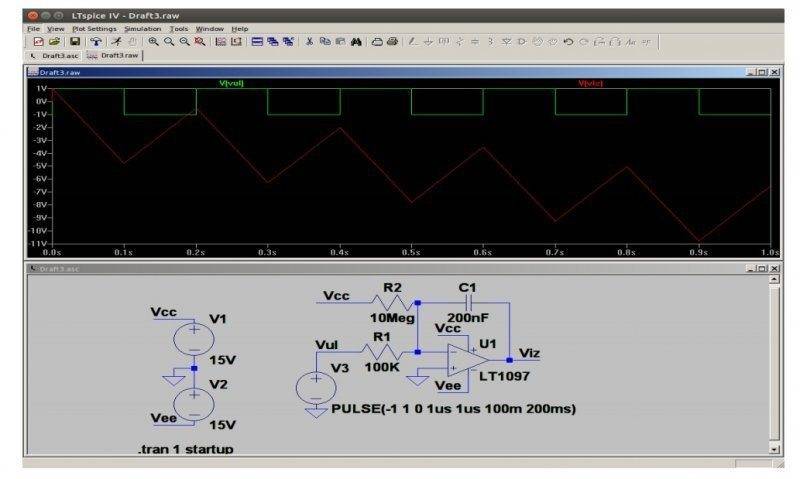
postavka.jpg


Then change capacitor's value from 200nF to 33nF and output voltage will be:
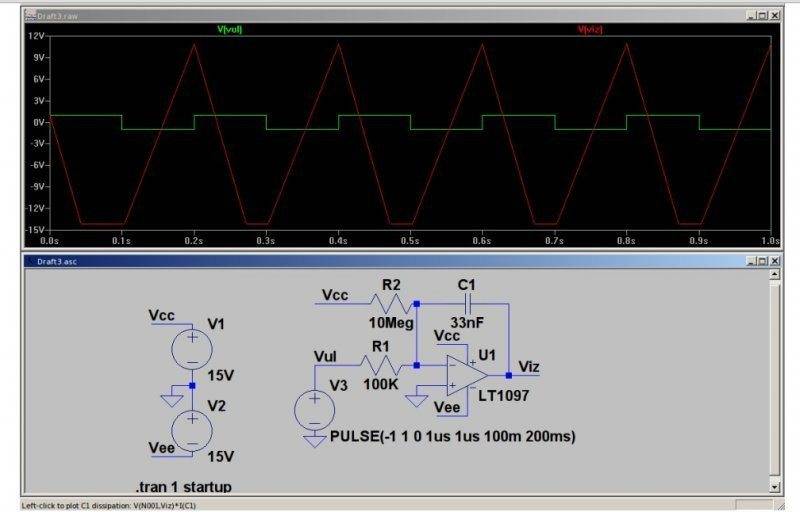
postavka2.jpg


Explain why output voltages are different ( first has triangle shape and gradually decreases and second has cut off bottom and doesn't decrease).

Here is what I have done:
Since there are two sources, one DC and one time dependent pulse waveform, I used superposition method. When time dependent source is active, our circuit is:
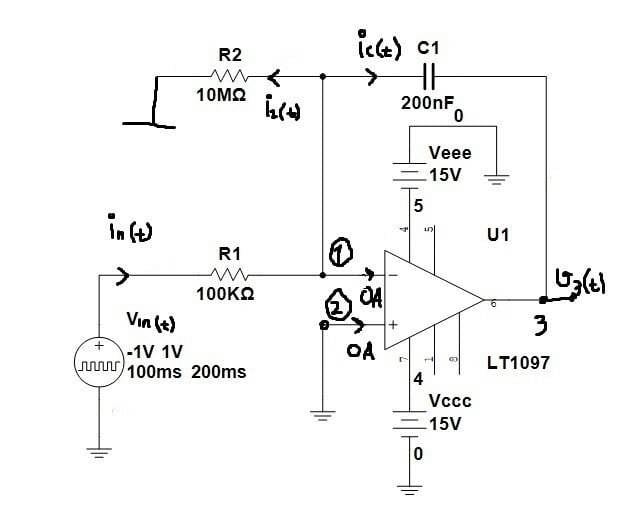
sema1.jpg

v2(t)=0\rightarrow v1(t)=0

i2(t)=0\rightarrow iin(t)=ic(t)

iin(t)=\frac{vin(t)}{R1}

v3(t)+\frac{1}{C}\int ic(t)dt+R1iin(t)-vin(t)=0

For positive input voltage vin(t)=1V we have:

v3(t)=-\frac{1}{RC1}\int vin(t)dt=-50\int 1dt=-50t,\,\, 0\leq t\leq 100*10^{-3}s

For negative input voltage vin(t)=-1V we have:
v3(t)=-\frac{1}{RC1}\int vin(t)dt=-50\int (-1)dt=50t,\,\,100*10^{-3}s\leq t\leq 200*10^{-3}s
But I don't know what to do next :(
 
Physics news on Phys.org
The output should comprise a triangle wave produced by integrating the squarewave, plus a slow ramp produced by integrating a small fixed current. Does your mathematical derivation exhibit these two features?

The waveform from your simulation is what I'd expect to see.
 
Here is how I have done it:
I found Fourier series of vin(t), vin(t)=\sum_{n=1}^{\infty}\frac{2(1-(-1)^{n})}{n\pi }\sin{(nw0t)}. Then I used superposition method to find viz(t). When vin(t) is active, our circuit is (I didn't show OPAMP power supply):
sema1.jpg

Using KVL I got:
viz(t)+\frac{1}{C}\int i(t)+Ri(t)=vin(t)

viz(t)+\frac{1}{C}\int\frac{vin(t)}{R1}dt+Ri(t)=vin(t)

viz(t)+\frac{1}{R1C}\int vin(t)+R1\frac{vin(t)}{R1}=vin(t)
viz(t)=\frac{-1}{R1C}\int (\sum_{1}^{\infty}2\frac{1-(-1)^{n}}{n\pi }\sin{(nw0t)})dt
viz(t)=\frac{-2}{R1C}\sum_{n=1}^{\infty}\frac{1-(-1)^{n}}{n\pi }\int \sin(nw0t)dt=\frac{2}{R1C}\sum_{n=1}^{\infty}\frac{1-(-1)^{n}}{n^{2}\pi w0 }\cos{(nw0t)}
 
Here is plot of viz(t)
111.jpg


Now it is necessary to do DC analysis and add viz(t) and Viz and (hopefully) we will get output as in simulator. I didn't do DC analysis yet.
 
Last edited:
With referece to your infinite series... Uh huh. That's all well and good, but what does but tell you? I think you are expected to come up with an analysis and explanation of what you see in the waveforms. Along the lines of what I outlined.

OPAMP circuit and output voltage are shown in image below. Assuming that OPAMP is ideal, come up with a solution by hand.

I don't see much call for Fourier here. Not explicitly, anyway.
 
Last edited:
Well, I thought I must have explicit expression of input voltage for analysis. How would I express output voltage (viz(t)) if I hadn't expression for input voltage?
 
etf said:
Well, I thought I must have explicit expression of input voltage for analysis. How would I express output voltage (viz(t)) if I hadn't expression for input voltage?
I think you should express each input as a function of time, then integrate and sum the result.

What I think you are doing is expressing the input as a Fourier series and integrating that, then using a computer program to convert that back to a function of time and plot it. That is a roundabout process I doubt you would have time to pursue in any exam.

Have you memorised the Fourier series of a triangle wave?
 
Now I'm completely lost. I did analysis in Multisim and I got same shape for output voltage but different peak to peak value of signal. I give up. Here is code in Matlab I used to plot viz(t) I got by hand:
clear
clc
R1=100000;
C=200*10^(-9);
t=linspace(0,1,10000);
w0=2.*pi./0.2;
suma=0;
for n=1:10000
suma = suma + ((1-(-1).^n).*(cos(n.*w0.*t))./(n.*n.*pi.*w0));
end
red=(2./(R1.*C)).*suma;
plot(t,red)
grid
 
Last edited:
In my view, you've shown all the mathematics that's needed back in your first post: the integral of a step. Now, apply that to one cycle and show how the squarewave input becomes a triangular wave at the output, and how the other input leads to a ramp at the output. Then combine them.

It might be instructive if you were to extend the duration of your simulation, so you capture some "interesting output" when non-linear things start to appear.

Before you dive into complicated maths you should look back at what you are specifically asked to explain, in post #1. I interpret it to be they want you to demonstrate a practical understanding of that circuit's behaviour under the two different conditions.
 
  • Like
Likes   Reactions: etf
  • #10
When using the 33nF capacitor, could you also please record the waveform at the junction of R1 and R2. It might contain some answers ...
 
  • #11
I think I solved it (without Fourier series :) )
Firstly I analysed circuit for t between 0 and 0.1s (VCC=15V, vin(t)=1V). I got vout(t)=-57.5t. Then I analysed circuit for t between 0.1s and 0.2s (VCC=15V, vin(t)=-1V). I got vout(t)=42.5t. On time interval between 0s and 0.2s our output voltage vout(t) is

graf.jpg


What do you think? I didn't plot it on some wider interval since it's a little bit tricky to connect those lines and plot :)
 
  • #12
Here is code I used for plot:
>> t1=linspace(0,0.1,100000);
>> t2=linspace(0.1,0.2,100000);
>> vout1=-57.5.*t1;
>> vout2=-5.75+42.5.*(t2-0.1);
>> plot(t1,vout1,t2,vout2)
>> grid
>>
It is necessary to plot decreasing line, then on it's end increasing one etc. :)
 
  • #13
That looks good, providing it agrees with your actual circuit. You don't need to do anymore computations in order to be able to sketch a dozen or more cycles, because each will drop by 5.75V and then rise by 4.25V --- so you can fill in the rest of the waveform by hand.
 

Similar threads

  • · Replies 3 ·
Replies
3
Views
2K
  • · Replies 9 ·
Replies
9
Views
2K
Replies
15
Views
3K
  • · Replies 6 ·
Replies
6
Views
3K
  • · Replies 2 ·
Replies
2
Views
2K
Replies
0
Views
2K
  • · Replies 1 ·
Replies
1
Views
2K
  • · Replies 28 ·
Replies
28
Views
4K
  • · Replies 1 ·
Replies
1
Views
2K
  • · Replies 3 ·
Replies
3
Views
3K