Balancing forces on a bicycle wheel

  • Context: Undergrad 
  • Thread starter Thread starter peanutaxis
  • Start date Start date
  • Tags Tags
    Bicycle Forces Wheel
Click For Summary

Discussion Overview

The discussion revolves around analyzing the forces acting on a bicycle wheel when the bicycle is stationary on an incline. Participants explore the implications of the center of mass (COM), the effects of friction, and the role of the brake in maintaining equilibrium.

Discussion Character

  • Technical explanation
  • Conceptual clarification
  • Debate/contested

Main Points Raised

  • One participant suggests that the weight of the bicycle acts through the center of the wheel, questioning how this would change if the COM were in a different position.
  • Another participant agrees that the friction force opposes the weight and acts at ground level, but emphasizes the importance of considering Newton's 3rd Law regarding the brake's force on the wheel.
  • A participant points out that the brake applies a force to the wheel, which in turn applies a reaction force back on the brake, potentially affecting the overall force balance.
  • Concerns are raised about balancing the tangential forces and the normal forces acting on the wheel, particularly in relation to the incline.
  • One participant highlights that the wheel's stationary state means that all forces must balance, including the torque from friction and weight being opposed by the torque from the brake.
  • Another participant notes that the component of the bike's weight perpendicular to the ground is balanced by the force of the Earth on the wheels, while the parallel component is balanced by the friction force transmitted to the brakes.

Areas of Agreement / Disagreement

Participants express differing views on the implications of the brake's force and the overall force balance on the wheel. The discussion remains unresolved, with multiple competing perspectives on how to analyze the forces involved.

Contextual Notes

Participants mention the need to consider various forces, including normal forces and torques, but do not resolve the mathematical relationships or assumptions involved in their analysis.

peanutaxis
Messages
26
Reaction score
3
Hi, (this is not a homework question)

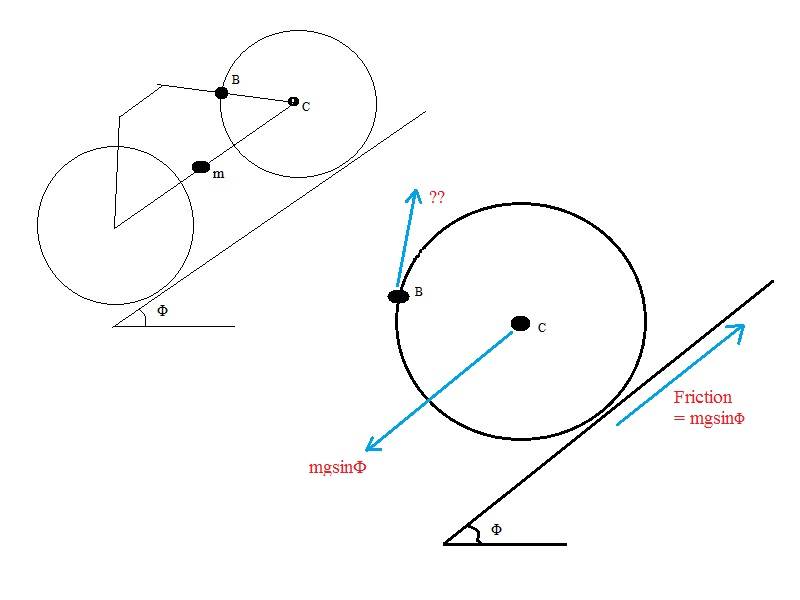
If I have a bicycle with COM, M (in line with the center of the wheels, C) on an incline, angle Φ, and the bicycle is NOT moving at all because the brake is on at B.

I am trying to put in the forces acting on the wheel. I figure that the weight of the bicycle is probably acting through the center of the wheel because the COM is at the same height (would this change if the COM was in a different place?). And because the wheel is not moving laterally I figure the friction force is opposing the weight, but acting at ground level.

The brake is preventing the wheel from turning CCW, and so I think the ?? force from the brake needs to also be mgsinΦ in a CW direction. But the problem is that if I put the brake/?? force in, the static/overall forces on the wheel won't balance and the wheel should move off in the direction of the ?? force.

Help!?
thanks
jfz0bp.jpg
 
Physics news on Phys.org
peanutaxis said:
I figure that the weight of the bicycle is probably acting through the center of the wheel because the COM is at the same height (would this change if the COM was in a different place?). And because the wheel is not moving laterally I figure the friction force is opposing the weight, but acting at ground level.
First of all, force from the frame is acting on center, right. That's property of the axis, so it will not change even if CoM is higher/lower.

You are also correct that the friction will be equal to weight's projection along the incline. No problem there.

What you are forgetting about is Newton's 3rd Law for the brake. If brake is applying force on wheel, wheel is applying force back on the brake. That force would accelerate the bike backwards if it weren't attached to the wheel. So rather than just bike's weight, front wheel experiences bike's weight plus the reaction force of the brake through it's center.

Now you can balance the tangential forces. Keep in mind that you also have normal forces on the wheel, and that normal force on the two wheels together adds up to component of weight perpendicular to the incline.
 
K^2 said:
What you are forgetting about is Newton's 3rd Law for the brake. If brake is applying force on wheel, wheel is applying force back on the brake.

But the whole thing is stationary, so Newton's 3rd applies to everything! So that doesn't help me: The wheel is pushing on the ground equally and opposite to the Friction force pushing on the wheel, and the wheel is pulling on the bicycle mass equally and opposite to the bicycle mass pulling on the wheel.

What I am trying to do is find the forces acting on the wheel.
The wheel is not moving laterally, so the friction force must be opposed equally by the bicycle weight.
The wheel is not rotating, so the torque due to the friction and the weight force must be opposed equally by the torque from the brake? How do you work these out?


thanks,
p
 
The component of the bike's weight perpendicular to the ground is balanced by force of the Earth on the wheels. Since the bike is on slanted ground there is also a component of weight parallel to the ground. That will be balanced by the friction force on the wheels which is transmitted to the brakes that prevent the wheels from turning.
 

Similar threads

  • · Replies 11 ·
Replies
11
Views
2K
  • · Replies 4 ·
Replies
4
Views
1K
  • · Replies 15 ·
Replies
15
Views
3K
Replies
2
Views
2K
  • · Replies 1 ·
Replies
1
Views
2K
  • · Replies 22 ·
Replies
22
Views
5K
  • · Replies 29 ·
Replies
29
Views
8K
  • · Replies 4 ·
Replies
4
Views
4K
  • · Replies 1 ·
Replies
1
Views
1K
  • · Replies 59 ·
2
Replies
59
Views
5K