Discussion Overview
The discussion revolves around the calculation of torque for wind turbines, specifically addressing discrepancies in calculated values compared to those presented in a referenced book. Participants are examining the moment of inertia values and the implications of different symbols used in the equations.
Discussion Character
- Technical explanation
- Debate/contested
- Mathematical reasoning
Main Points Raised
- One participant notes a mismatch in torque calculations compared to a book, questioning the moment of inertia value.
- Another participant expresses similar confusion regarding the torque value and suggests a potential error in the author's use of powers of ten.
- A participant introduces the concept of polar moment of inertia, indicating a need for further study on the topic.
- Calculations provided by one participant yield a net torque of 785.4 Nm, derived from converting RPM to rad/s and applying the torque formula.
- Concerns are raised about the dimensional consistency in the author's equations, particularly regarding the use of symbols for moment of inertia.
- Discussion includes a calculation of moment of inertia from other sources, suggesting a value of 113,000 kgm², which contrasts with the author's figure of 7500 kg/m².
- Another participant humorously points out the implications of the mass distribution for the blades based on the moment of inertia values discussed.
Areas of Agreement / Disagreement
Participants do not reach a consensus on the correct torque value or the moment of inertia. Multiple competing views and calculations are presented, indicating ongoing uncertainty and debate.
Contextual Notes
Participants highlight potential issues with the author's notation and dimensional analysis, suggesting that these may contribute to the discrepancies in calculations. The discussion remains focused on the interpretation of the provided data and formulas.
Who May Find This Useful
Individuals interested in wind turbine mechanics, torque calculations, and the application of moment of inertia in engineering contexts may find this discussion relevant.

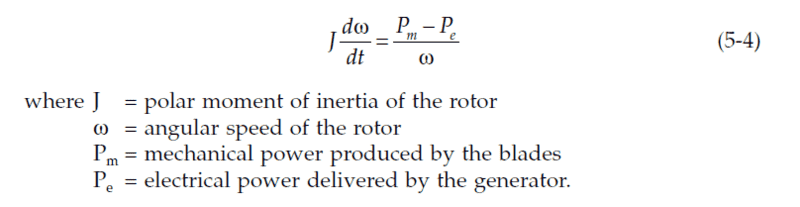
 if the total ##I## is 7500 kg m2