Can I Simplify a Block Diagram by Making Multiple G5 Blocks?

Click For Summary

Discussion Overview

The discussion revolves around the simplification of a block diagram involving transfer functions and the arrangement of blocks in series and parallel configurations. Participants explore the implications of manipulating these configurations and the effects on the overall system representation.

Discussion Character

  • Technical explanation
  • Debate/contested

Main Points Raised

  • One participant questions the validity of thinking of G5 in series with G3(G4+G6G7) and then in parallel with G2, suggesting a misunderstanding of series and parallel definitions.
  • Another participant raises concerns about the implications for G8 and C(s) if G5 is treated in this manner, questioning whether G5 should also be multiplied with C(s).
  • A participant suggests that G5 cannot be only in series with (G4 + G6G7) due to a common point with G8, proposing that G5 is in series with both components.
  • Some participants propose that while multiple G5 blocks can be created, it may not necessarily simplify the diagram, although one participant notes that it could help eliminate rational expressions for easier transfer function representation.

Areas of Agreement / Disagreement

Participants express differing views on the arrangement of G5 in relation to other blocks, with no consensus on whether the proposed simplifications are valid or beneficial.

Contextual Notes

There are unresolved questions regarding the definitions of series and parallel configurations, as well as the treatment of G8 and C(s) in the context of the proposed manipulations.

mech-eng
Messages
826
Reaction score
13
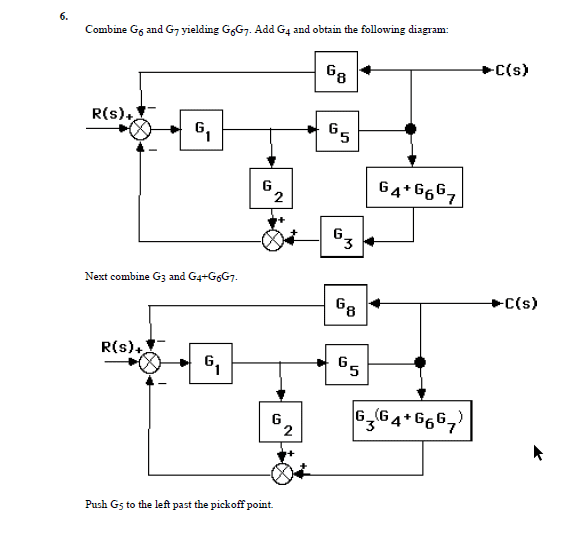
I would like to ask why cannot I think G5 in series with G3(G4+G6G7) and then after muliplying them why I cannot think of G5*G3(G4+G6G7) in parallel to G2 so sum G2 and G5*G3(G4+G6G7) ?
c.png

Thank you.
 
Last edited:
Engineering news on Phys.org
If you do that, what happens to G8 and C(s)?

G5 would be at the other side, by the way.
 
mech-eng said:
I would like to ask why cannot I think G5 in series with G3(G4+G6G7) and then after muliplying them why I cannot think of G5*G3(G4+G6G7) in parallel to G2 so sum G2 and G5*G3(G4+G6G7) ?
.
I suggest you review the definitions of serial and parallel and see how they apply in this case. It's completely clear from the definitions that what you want to be series isn't series.
 
mfb said:
If you do that, what happens to G8 and C(s)? G5 would be at the other side, by the way.

If you do that I would ignore the multiplication of G8 and G5 so the result would be incorrect. I cannot think of what happens to the C(s) ? Is that the same thing for G(8) i.e ignorance of multiplication? But problem is that is G5 also series with C(s) so when multiply G5 with G8 and (G4 +G6G7) should I also multiply G5 with C(s) ?

Thank you.
 
Last edited:
phinds said:
I suggest you review the definitions of serial and parallel and see how they apply in this case. It's completely clear from the definitions that what you want to be series isn't series.

I try to still understand. Because there is a common point between G5, G8 and (G4 + G6G7), G5 cannot be only series with (G4 + G6G7) and the signal G5 is going to both G8 and (G4 + G6G7) so G5 is both series with them. When I do this result is correct but I think simpler.

Thank you.
 
You can make multiple G5 blocks, but I don't think that makes it simpler.
 
mfb said:
You can make multiple G5 blocks, but I don't think that makes it simpler.

But if I do that, I can get rid of rational expressions so I can write transfer function easily.

Thank you.
 

Similar threads

  • · Replies 2 ·
Replies
2
Views
2K
  • · Replies 5 ·
Replies
5
Views
533
  • · Replies 13 ·
Replies
13
Views
4K
  • · Replies 4 ·
Replies
4
Views
3K
Replies
1
Views
6K
  • · Replies 4 ·
Replies
4
Views
5K
  • · Replies 7 ·
Replies
7
Views
2K
  • · Replies 31 ·
2
Replies
31
Views
5K
Replies
4
Views
2K
Replies
1
Views
4K