Density of Water at 1°C & 8°C | Homework Help

Click For Summary

Homework Help Overview

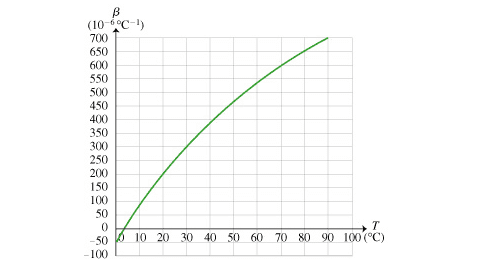
The discussion revolves around the density of water at specific temperatures, particularly focusing on the relationship between temperature changes and density variations. Participants are examining a graph that illustrates these changes and are trying to identify at what temperature water has the same density as at 1°C, as well as where the maximum density occurs.

Discussion Character

  • Exploratory, Conceptual clarification, Mathematical reasoning, Assumption checking

Approaches and Questions Raised

  • Participants are analyzing a graph to determine the temperature at which water's density is equal to that at 1°C and questioning the implications of the graph's behavior around 0°C and 4°C. There is also discussion about the significance of the slope and the concept of density changes with temperature.

Discussion Status

Some participants have provided insights into the graph's interpretation and the mathematical concepts involved, while others are seeking clarification on specific terms and the relationship between temperature and density. There appears to be a productive exploration of the topic, with various interpretations being discussed.

Contextual Notes

Participants mention the difficulty in reading the graph and the need for familiarity with calculus to fully understand the implications of the density changes. There is also a reference to the specific temperature at which water's density is highest, which is noted as 4°C.

nicky670
Messages
21
Reaction score
1
Homework Statement:: The relative density of water is determined by the rate at which it expands (and contracts) with changes in temperature. At approximately what other temperature T does water have the same density as at 1 ∘C ?
Relevant Equations:: Just looking at graphical and analyzing. But i can't seem to figure out why the answer is 8 degree celsius.

phy1.PNG
phy2.PNG
 
Physics news on Phys.org
Do you know at what temperature the water's density is highest? It's a bit difficult to read it from the graph.
 
Hi and welcome to PF
The relevant region of the graph is very tiny but look at what the graph is telling you. At 0°C it is contracting (negative sign for β) by about 50 per degree. Where is it expanding by 50 per degree? What does that say about where the maximum density is and what would the Density / temperature graph look like?
I think it would be perfectly in order for you to Search about the way the density of water changes with temperature, near freezing point and relate that to the graph.
I don't need to give you the actual answer to your question now, do I?
 
@nicky670 that could be seen as a tricky question to be presented with unless you are familiar with Calculus and the meanings of differentials. It was easy for me / PF because we knew the answer already and it was mainly a matter of reconciling the answer with the graph (reverse process of how you're supposed to do it :wink:)
 
kuruman said:
Do you know at what temperature the water's density is highest? It's a bit difficult to read it from the graph.
No it is not stated
 
sophiecentaur said:
Hi and welcome to PF
The relevant region of the graph is very tiny but look at what the graph is telling you. At 0°C it is contracting (negative sign for β) by about 50 per degree. Where is it expanding by 50 per degree? What does that say about where the maximum density is and what would the Density / temperature graph look like?
I think it would be perfectly in order for you to Search about the way the density of water changes with temperature, near freezing point and relate that to the graph.
I don't need to give you the actual answer to your question now, do I?
will do so and get back to you shortly. Thank you
 
nicky670 said:
No it is not stated
You can look it up or read it off the graph that @berkeman provided, it's 4 oC. That's where the graph you provided crosses the temperature axis. So if the density is highest at 4 oC, what happens to the density if you increase the temperature from 4 oC by 1 degree? What happens to the density if you decrease the temperature from 4 oC by 1 degree?
 
nicky670 said:
No it is not stated
It is implied, though, which is what the question is about. at a maximum or minimum (a turning value) the slope / differential is zero. Where is your graph zero? That is your answer, followed by where the value is similar to the value at 0°C (but opposite sign).
As I hinted previously, it's a matter of understanding the maths / logic of it rather than the Physics.
 
Last edited:

Similar threads

  • · Replies 1 ·
Replies
1
Views
2K
  • · Replies 6 ·
Replies
6
Views
1K
Replies
7
Views
2K
  • · Replies 1 ·
Replies
1
Views
2K
  • · Replies 5 ·
Replies
5
Views
2K
Replies
24
Views
3K
  • · Replies 7 ·
Replies
7
Views
10K
Replies
4
Views
2K
Replies
3
Views
1K
  • · Replies 4 ·
Replies
4
Views
4K