Designing NFA & DFA for (1001 + 110 + 11)* Language

Click For Summary

Discussion Overview

The discussion revolves around designing a non-deterministic finite automaton (NFA) and converting it into a deterministic finite automaton (DFA) for the language defined by the regular expression (1001 + 110 + 11)*. Participants explore the construction of the automaton, the implications of epsilon transitions, and the requirements for a DFA.

Discussion Character

  • Exploratory
  • Technical explanation
  • Debate/contested
  • Mathematical reasoning

Main Points Raised

  • The original NFA design incorrectly accepts strings like 111 and 10, which are not part of the specified language.
  • Participants discuss the role of epsilon transitions in NFAs and how they differentiate from DFAs.
  • There is a clarification that epsilon transitions allow returning to the initial state, which is common in automata accepting languages defined by the Kleene star.
  • It is noted that a DFA requires a total transition function, meaning every state must have defined transitions for all input symbols.
  • A suggestion is made to include a sink state (or dead state) to handle missing transitions in the DFA conversion process.
  • Participants express a growing understanding of the concepts involved, particularly regarding the acceptance of specific strings and the structure of the automata.

Areas of Agreement / Disagreement

Participants generally agree on the definitions and roles of NFAs and DFAs, but there are differing interpretations regarding the specific designs and transitions of the automata being discussed. The discussion remains unresolved as participants continue to refine their understanding and designs.

Contextual Notes

Some assumptions about the transition functions and the handling of specific strings remain unaddressed, and the discussion includes various interpretations of how to properly implement the automata based on the given regular expression.

Who May Find This Useful

This discussion may be useful for students and practitioners interested in automata theory, particularly those learning about NFAs, DFAs, and the conversion processes between them.

Lolligirl
Messages
22
Reaction score
0
Hello everyone! I'm trying to design an NFA and then turn it into a DFA, and I'm not sure if I've done it correctly so far. Here is the question:

"Present a transition diagram for an NFA for the language associated with the regular expression (1001 + 110 + 11)*. Your NFA must have no more than five states. Then, use the standard conversion technique (subsets of states) to convert the NFA to an equivalent DFA. Be sure to not include unreachable states. Hint: This DFA should have no more than six states."

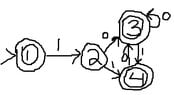
And here is my attempt at an answer:

View attachment 3147

Would this work as the NFA or DFA? I feel like I'm missing something here, but I am not sure what. Any help is appreciated! :D
 

Attachments

  • Assignment3PossibleNFA.jpg
    Assignment3PossibleNFA.jpg
    11.8 KB · Views: 180
Technology news on Phys.org
Hi, and welcome to the forum!

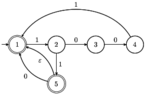
Your automaton accepts 111 and 10, which are not in the original language. How about the following NFA?

View attachment 3151
 

Attachments

  • automaton1.png
    automaton1.png
    2.9 KB · Views: 182
Oh, I see! Thank you so much for pointing that out, Evgeny: I indeed included the string 10!

Okay, so now I understand the NFA, but I guess I really don't understand what's going on with the epsilon there. Why, from state 5 in the diagram, are we going back to state 1 on epsilon? Also, is that the only thing making this an NFA and not a DFA? As far as I can tell, state 2, for instance, indeed can branch two different ways, but there's only one character per arrow. So I guess my question is basically, what makes this not a DFA already besides the epsilon?

Sorry if this is dead simple! >.<
 
Just to avoid confusion: $\varepsilon$ denotes the empty word, which is also sometimes denoted by $\lambda$. Going from an accepting state back to the initial one on $\varepsilon$ is a usual thing in an automaton accepting $L^*$ for some $L$. This is how we show that the set of languages accepted by NFAs is closed under the Kleene star. In this case, both 11 and 110 should lead to the initial state, which is the reason for the two arrows from 5 to 1.

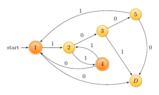
Yes, $\varepsilon$ makes it an NFA, but also not all states have outgoing arrows for both 0 and 1. In a DFA, the transition function has to be total, i.e., defined on all pairs from $Q\times\Sigma$. If it were not for the $\varepsilon$ arrow, to turn this automaton into a DFA one needs to add a sink state with all the missing arrows going there. By the way, I did not draw a 1-arrow from 2 to 1 because then it's not clear what to do with the word 110 since 0 should be accepted only after two 1's.
 
Ohh! By a sink state, do you mean like a dead state? So would it be kind of like this (D for dead)?

https://dl.dropboxusercontent.com/u/5778771/Assignment3Number1.jpg

Either way, thank you so much, Evgeny; I really feel like I'm starting to get it! :D
 
Let's make that:

View attachment 3161

Since $11$ should be accepted.
And since after $11$ we can get something that starts with a $1$.
 

Attachments

  • deterministic_finitestate_automaton.png
    deterministic_finitestate_automaton.png
    6.7 KB · Views: 151
Right, right, of course! That makes much more sense now; thank you very much for helping me understand, Evgeny, en hartelijk bedankt, I like Serena! :D
 
Last edited:

Similar threads

  • · Replies 1 ·
Replies
1
Views
1K
  • · Replies 6 ·
Replies
6
Views
13K
  • · Replies 1 ·
Replies
1
Views
2K
  • · Replies 3 ·
Replies
3
Views
2K
  • · Replies 4 ·
Replies
4
Views
2K
  • · Replies 9 ·
Replies
9
Views
8K
Replies
1
Views
2K
  • · Replies 1 ·
Replies
1
Views
2K
  • · Replies 52 ·
2
Replies
52
Views
8K
Replies
29
Views
5K