Differential Cartesian Coordinates Into Cylindrical Coordinates

Click For Summary
SUMMARY

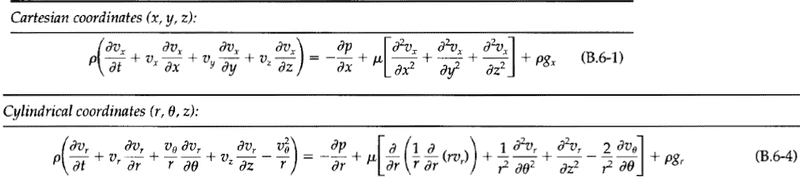
The discussion focuses on converting differential Cartesian coordinates into cylindrical coordinates, specifically in the context of the transport phenomenon as outlined in "Source Transport Phenomenon 2nd ed." The user seeks assistance in transforming the velocity components from Cartesian (Vx, Vy, Vz) to cylindrical coordinates (Vr, Vθ, Vz). The key relationships established include Vx = Vr * Cos(θ) and Vy = Vr * Sin(θ), but the user requires further guidance on deriving the angular component Vθ.

PREREQUISITES
  • Understanding of differential equations in fluid dynamics
  • Familiarity with coordinate transformations
  • Knowledge of cylindrical coordinate systems
  • Basic grasp of vector components in physics
NEXT STEPS
  • Study the derivation of velocity components in cylindrical coordinates
  • Learn about the application of the transport equation in fluid mechanics
  • Research the mathematical principles behind coordinate transformations
  • Explore examples of converting between Cartesian and cylindrical coordinates
USEFUL FOR

Students and professionals in engineering, particularly those specializing in fluid dynamics, as well as anyone involved in solving transport phenomena problems.

sorter
Messages
47
Reaction score
0
Has to convert B6-1 into B6-2 Source Transport Phenomenon 2nd ed -

sxgd39.jpg
 
Physics news on Phys.org
I can't even start solution
No idea how to convert subscipt from vx to vr and or to vtheta?
 
You are to find the radial component of the transport equation.

Set up the relevant quantities and relationships, then we'll help you.
 
In the first equation: substitute Vx = Vr * Cos (theta) Vy = Vr * Sin (theta) Vz = Vz

but how do I get V(theta)
 
Question: A clock's minute hand has length 4 and its hour hand has length 3. What is the distance between the tips at the moment when it is increasing most rapidly?(Putnam Exam Question) Answer: Making assumption that both the hands moves at constant angular velocities, the answer is ## \sqrt{7} .## But don't you think this assumption is somewhat doubtful and wrong?

Similar threads

  • · Replies 4 ·
Replies
4
Views
2K
  • · Replies 6 ·
Replies
6
Views
3K
Replies
1
Views
2K
  • · Replies 4 ·
Replies
4
Views
2K
  • · Replies 6 ·
Replies
6
Views
3K
  • · Replies 17 ·
Replies
17
Views
4K
  • · Replies 6 ·
Replies
6
Views
3K
  • · Replies 4 ·
Replies
4
Views
2K
  • · Replies 24 ·
Replies
24
Views
3K
  • · Replies 1 ·
Replies
1
Views
2K