Dipole problem with electric fields

Join the discussion
Ask a follow-up here, or get your own question answered by working scientists, mathematicians and engineers — people, not an autocomplete.
Real named experts · corrections over time · the nuance an AI answer skips
1 reply · 2K views
bubblewrap
Messages
134
Reaction score
2
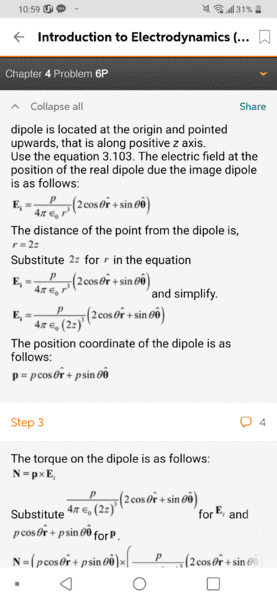
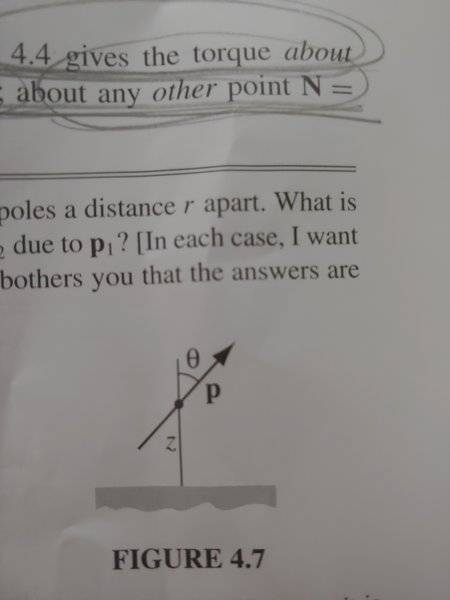
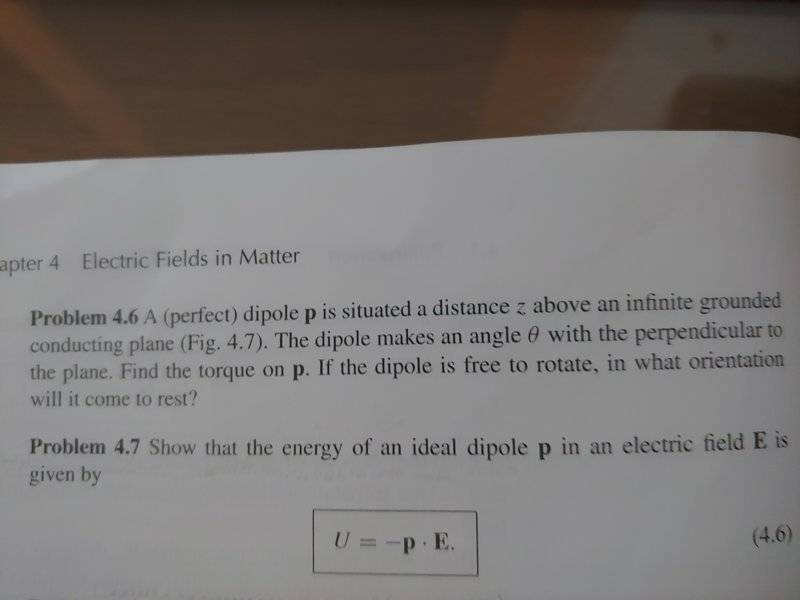
Dipole problem (which is solved through mirror imaging) has been troubling me with its solution. I understand everything except how the dipole moment's coordinates came to be, since when converted into x-y axis, its doesn't make sense. (problem 4.6)

The screenshot contains the solution which says that dipole moment p can be expressed into the terms shown (at the end of step 2, right before step 3
20181031_230650.jpg
Screenshot_2018-10-31-22-59-45.png
20181031_230933.jpg
)
 

Attachments

  • 20181031_230650.jpg
    20181031_230650.jpg
    26.4 KB · Views: 519
  • Screenshot_2018-10-31-22-59-45.png
    Screenshot_2018-10-31-22-59-45.png
    23.4 KB · Views: 425
  • 20181031_230933.jpg
    20181031_230933.jpg
    16.9 KB · Views: 430
Physics news on Phys.org
It helps to start with a good source. Try: http://phys.columbia.edu/~nicolis/Dipole_electric_field.pdf ## \\ ## Meanwhile ## \vec{p}_{image}=-p \cos{\theta} \, \hat{z} +p \sin{\theta} \, \hat{x} ## where we will assume the dipole has ## \phi=0 ## for the angle which it points.## \\ ## Using ## \vec{r}=2 z \, \hat{z}##, ##\vec{ E} ## (at location ##(0,0, 2z) ## from ## \vec{p}_{image} ##), can be computed from ## \vec{p}_{image} ##. ## \\ ## Meanwhile, ## \vec{p}=p \cos{\theta} \, \hat{z}+ \sin{\theta} \, \hat{x} ## should make it an easy algebraic exercise to compute the torque.## \\ ## I do think your book made a mistake in computing ## \vec{p} ##. ## \\ ## I got an expression for electric field ## E ## and torque ## \vec{N}=\vec{p} \times \vec{E} ##. I'd be happy to see how your result compares to mine.
 
Last edited:
  • Like
Likes   Reactions: berkeman