Do current sources stack with current?

  • Thread starter Thread starter ainster31
  • Start date Start date
  • Tags Tags
    Current Sources
AI Thread Summary
The discussion centers on the implications of adding a 3A current source to a circuit and whether current sources can be stacked in series. It is clarified that ideal current sources cannot be placed in series without causing contradictions, as they are defined to provide a specific current. In real-world applications, current sources have a compliance range; exceeding this range results in non-ideal behavior, where the current output may drop to the lower rating of any stacked sources. The conversation also touches on the analogy of voltage sources, comparing them to gravitational potentials, but this analogy is met with confusion. Ultimately, real current sources behave differently than ideal ones, and stacking them can lead to unexpected results.
ainster31
Messages
158
Reaction score
1
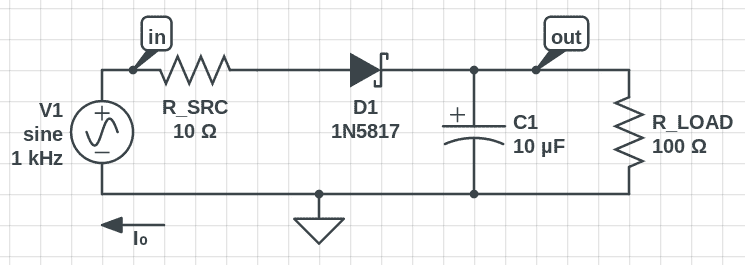
Consider the following circuit:

h_1390408792_3749447_6c069ce658.png


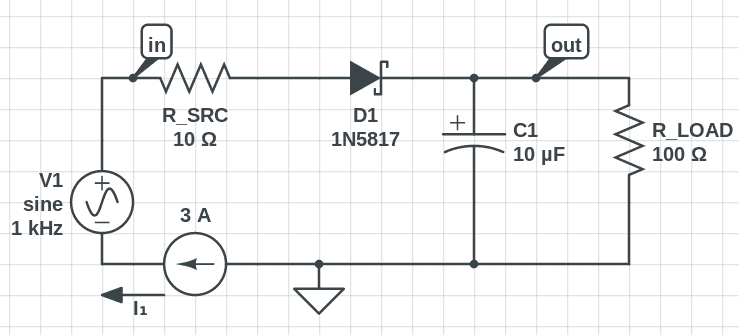
Now imagine that I add a 3A current source:

h_1390408821_1096865_026c3809ba.png


Is the following equation correct? $$I_1=I_0+3$$
 
Engineering news on Phys.org
No, I1 is by definition 3 amps. You cannot put ideal current sources in series just as you cannot put ideal voltage sources in parallel. Doing either one causes a contradiction.
 
phinds said:
No, I1 is by definition 3 amps. You cannot put ideal current sources in series just as you cannot put ideal voltage sources in parallel. Doing either one causes a contradiction.

What would happen in real life if I did add the current source? Will the circuit explode? Or will it just become non-ideal? Will it convert from current source to voltage source? How do voltage sources and current sources even work?

If we use the analogy of comparing electric potentials to gravitational potentials, are voltage sources like ladders or slides?
 
ainster31 said:
What would happen in real life if I did add the current source? Will the circuit explode? Or will it just become non-ideal? Will it convert from current source to voltage source? How do voltage sources and current sources even work?

Real current sources have a range of voltage that can be applied across them and still work. This voltage range is often called the "compliance" range. If you try to operate a real current source outside of this range, it no longer is a constant current source, and usually will put out less than the intended current.

If you stack 2 current sources that have different current ratings, generally the higher current one will go out of compliance, and will output only the current that the lower current source is rated at. Thus, both current sources in series are passing the same (lower) current.

You can see this for youself -- look up common circuits for a current sink and a current source. Then stack the two schematics and figure out what will happen... (fun exercise) :smile:

If we use the analogy of comparing electric potentials to gravitational potentials, are voltage sources like ladders or slides?

Sorry, I have no idea what that means.
 
ainster31 said:
What would happen in real life if I did add the current source? Will the circuit explode? Or will it just become non-ideal?

In real life, current sources are NEVER ideal so the question you seem to be asking (what would happen if I put ideal current source in series) doesn't make sense. Berkeman has explained what will likely happen if you put real current sources in series.
 
I see the circuit posted as a current source in series with a voltage source. There is no reason that cannot be done.
 
Very basic question. Consider a 3-terminal device with terminals say A,B,C. Kirchhoff Current Law (KCL) and Kirchhoff Voltage Law (KVL) establish two relationships between the 3 currents entering the terminals and the 3 terminal's voltage pairs respectively. So we have 2 equations in 6 unknowns. To proceed further we need two more (independent) equations in order to solve the circuit the 3-terminal device is connected to (basically one treats such a device as an unbalanced two-port...
Thread 'Weird near-field phenomenon I get in my EM simulation'
I recently made a basic simulation of wire antennas and I am not sure if the near field in my simulation is modeled correctly. One of the things that worry me is the fact that sometimes I see in my simulation "movements" in the near field that seems to be faster than the speed of wave propagation I defined (the speed of light in the simulation). Specifically I see "nodes" of low amplitude in the E field that are quickly "emitted" from the antenna and then slow down as they approach the far...
Back
Top