Find the Thevenin Equivalent circuit

Click For Summary
SUMMARY

The discussion focuses on calculating the Thevenin equivalent circuit external to a load resistor (RL) using a series of resistors and a current source. The key calculations include determining the Thevenin resistance (Rth) as 7Ω and the Thevenin voltage (Vth) as 25V. Participants clarify the distinction between Thevenin and Norton equivalents and emphasize the importance of calculating the open-circuit voltage across terminals A and B when RL is absent. The final consensus confirms that the correct Thevenin equivalent is achieved through systematic calculations and source transformations.

PREREQUISITES
  • Thevenin's Theorem
  • Norton’s Theorem
  • Circuit analysis techniques
  • Basic understanding of resistors in series and parallel
NEXT STEPS
  • Learn about Thevenin and Norton equivalent circuits in-depth
  • Study source transformation techniques in circuit analysis
  • Explore simulation tools for circuit analysis, such as LTspice or Multisim
  • Review voltage divider and current divider rules
USEFUL FOR

Electrical engineering students, circuit designers, and professionals involved in circuit analysis and design who seek to understand Thevenin and Norton equivalents for simplifying complex circuits.

Fatima Hasan
Messages
315
Reaction score
14
Thread moved from the technical forums, so no Homework Template is shown
Find Thevenins Equivalent circuit external to RL, then find I.
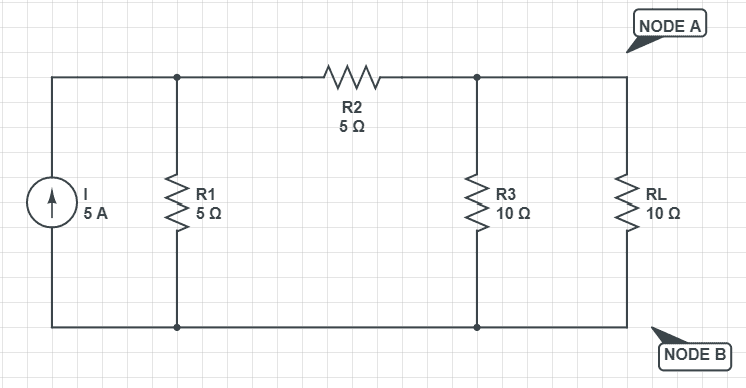
screenshot_17.png


Here's my work :
5Ω & 5Ω series → R(1) = 5+5 = 10 Ω
10Ω & R(1) parallel→ R(2) = (10*10)/(10+10) = 5 Ω
2Ω & R(2) series → R(3) = R Th = 5+2 = 7Ω
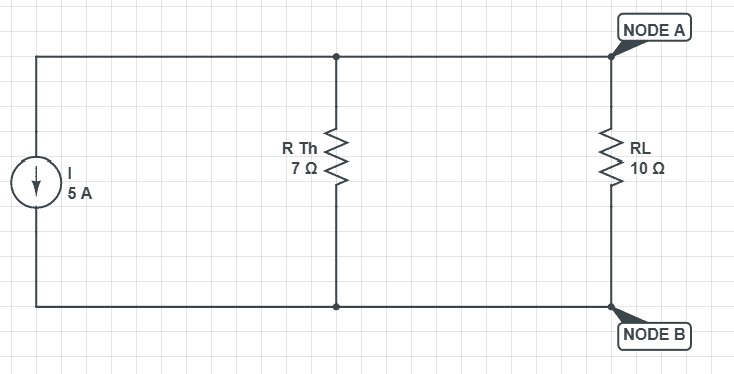
screenshot_19.png

V = I R
R = (R Th * RL)/(R Th + RL)
R = 70/17 Ω
V = 5 * (70/17) = 350 / 17 V = 20.6 V

Could somebody check my answer please ?
 

Attachments

  • screenshot_17.png
    screenshot_17.png
    4.3 KB · Views: 1,299
  • screenshot_19.png
    screenshot_19.png
    3.6 KB · Views: 1,379
Physics news on Phys.org
Fatima Hasan said:
. . .
2Ω & R(2) series → R(3) = R Th = 5+2 = 7Ω
. . .

Hi ! Will you please explain what is 2Ω here?
 
AlexCaledin said:
Hi ! Will you please explain what is 2Ω here?
I forgot to put it ...
screenshot_21.png
 

Attachments

  • screenshot_21.png
    screenshot_21.png
    10.6 KB · Views: 852
  • Like
Likes   Reactions: AlexCaledin
These are the currents at RL=0 as calculated by a simulation program;
the "Thevenin current" is 1.786A ( to be then multiplied by 70/17 Ω).

Currents1.PNG


( 357.143m = 0.357143A )
 

Attachments

  • Currents1.PNG
    Currents1.PNG
    6.8 KB · Views: 1,317
Last edited:
AlexCaledin said:
These are the currents at RL=0 as calculated by a simulation program; the Thevenin current is 1.786A, to be multiplied by 70/17 Ω.

View attachment 221969
The current in a series circuit is everywhere the same , why I2 doesn't equal to I1 ?
 
Why is it series?
5 amperes are rather applied to parallel resistors:
one is the R1 = 5ohm and the other is {R2 + R3-and-R4} = 5 + 20/12 = 40/6 = 6.66666etc ohm;
so in the R2 there is less current.

____________

Thanks to the Electrician, now I know about the "Norton", as opposed to "Thevenin". I have been taught about "The Equivalent Source Theorem", combining both of them.
 
Last edited:
  • Like
Likes   Reactions: Fatima Hasan
  • Like
Likes   Reactions: AlexCaledin
The Electrician said:
See the section on this page: https://en.wikipedia.org/wiki/Thévenin's_theorem

with the heading "Calculating the Thevenin equivalent".

What do you get if you follow that method?
RNo = RTh = 7 Ω
INo * RNo = VTh
VTh=5*7 = 35 V
VNo = 1.786*70/17 =7.354 V
ITh = VNo / RNo =7.354/7 = 1.051 A
 
  • #10
Fatima Hasan said:
VTh=5*7 = 35 V
That is incorrect.
You need to remove RL and calculate the open circuit voltage VAB.
Fatima Hasan said:
RNo = RTh =
Right.
 
  • #11
cnh1995 said:
You need to remove RL and calculate the open circuit voltage VAB.
VAB = V3 (parallel)
VAB= I3 * R3
= 0.357143 * 10 = 3.57 V
 
  • #12
Fatima Hasan said:
VAB = V3 (parallel)
VAB= I3 * R3
= 0.357143 * 10 = 3.57 V
No. You get I3*R3=3.57V when you 'short circuit' the terminals A and B and VAB=0 in that çase.

Do you know the steps for finding the Thevenin equivalent of a network? It looks like you are mixing Thevenin and Norton without knowing the fundamental differences between them.
 
  • #13
cnh1995 said:
. . . you are mixing Thevenin and Norton . . .

- the thing is, they may be mixed in the textbooks. In our Russian textbooks, there is typically one "Equivalent Source Theorem" mixing Thevenin and Norton straight away, never mentioning any of them, like here:

http://energ2010.ru/Toe/Toe_lekcii_VUZ/Toe_lekcii_belarus/2_11_Teorema_ekvivalentnom_generatore.html

- and in some textbooks that same mixed theorem is called also "Thevenin theorem", as its second name. And of course lots of people - including teachers - from many countries have studied here in Russia so this confusion may well be typical.
 
  • #14
The link you have provided shows in Fig 27 two circuits. The one on the left, designated а) is known on this forum as the Thevenin equivalent. The one on the right, designated б) is known on this forum as the Norton equivalent. They are shown as two different circuits. Are they not given different names in that Russian text?

At any rate, I pointed out the two different circuits and their names used here in posts #7 and #8.
 
  • #15
- they are called equivalent voltage and equivalent current sources - making the point that you can always use this or that, whatever is better for your problem.
 
  • #16
So far Fatima Hasan hasn't calculated either one correctly. Let's hope he (or she) is still with us and tells us which one is needed.
 
  • #17
The Electrician said:
So far Fatima Hasan hasn't calculated either one correctly. Let's hope he (or she) is still with us and tells us which one is needed.
I want to calculate the Thevenin's Equivalent .
 
  • #18
Fatima Hasan said:
I want to calculate the Thevenin's Equivalent .

OK. You have already correctly calculated Rth. Next you need to respond to post #12. You must calculate the voltage across terminals A & B when RL is not present. That will be Vth.
 
  • #19
The Electrician said:
OK. You have already correctly calculated Rth. Next you need to respond to post #12. You must calculate the voltage across terminals A & B when RL is not present. That will be Vth.
R = R1 + R2 = 5 + 5 = 10 Ω
Is = 5 A
Vs = Is * R = 5*10 = 50 V
V3= Vs /(R+R3) * R3
V3 = 50/(10+10) * 10 = 25 V
V3 = VTh = 25 V
Isc = RTh * Voc
=7 *25 = 175 A
 
  • #20
The resistance R should be the resistance seen by the current source, but it's not just R1+R2. There is some current also in R3, so R2+R3 is in parallel with R1; that equivalent resistance is the load on the source.

Also, the next to last thing in your calculations is Isc = RTh * Voc. That can't be right because the units are wrong.
 
  • #21
The Electrician said:
Isc = RTh * Voc
I sc = Voc / RTh
 
  • #22
Fatima Hasan said:
I sc = Voc / RTh

That's good. Now calculate V5 with the R1, R2, R3 combination load.
 
  • #23
The Electrician said:
That's good. Now calculate V5 with the R1, R2, R3 combination load.
screenshot_22.png
 

Attachments

  • screenshot_22.png
    screenshot_22.png
    6.5 KB · Views: 1,123
  • #24
Fatima Hasan said:
You have correctly calculated the voltage V5 across the current source, which is also the voltage across R1. Your last calculation is wrong. You should be calculating the voltage V3 across the resistor R3. You have labeled the left side of that equation V5, but it should be V3, which is also Vth.

If you know the voltage at the left end of R2, which is V5, then what would be the voltage at the right end of R2 considering that R2 and R3 form a voltage divider?
 
  • #25
The Electrician said:
You have correctly calculated the voltage V5 across the current source, which is also the voltage across R1. Your last calculation is wrong. You should be calculating the voltage V3 across the resistor R3. You have labeled the left side of that equation V5, but it should be V3, which is also Vth.

If you know the voltage at the left end of R2, which is V5, then what would be the voltage at the right end of R2 considering that R2 and R3 form a voltage divider?
V2 = R2 /(R1+R2)*Vs
= 5/(10+5) * 18.75
= 6.25 V
 
  • #26
Fatima Hasan said:
V2 = R2 /(R1+R2)*Vs
= 5/(10+5) * 18.75
= 6.25 V
I'm not sure why you would want the voltage across R2 (which we would call V2). Vth is the same as V3 which is the voltage across R3.

If you replace the current source and R1 with an 18.75 volt battery, could you calculate the voltage across R3? If all you had was a circuit with an 18.75 volt battery on the left side, with R2 and R3 forming a voltage divider, what would be the voltage across R3?
 
  • #27
The Electrician said:
I'm not sure why you would want the voltage across R2 (which we would call V2). Vth is the same as V3 which is the voltage across R3.

If you replace the current source and R1 with an 18.75 volt battery, could you calculate the voltage across R3? If all you had was a circuit with an 18.75 volt battery on the left side, with R2 and R3 forming a voltage divider, what would be the voltage across R3?
V3 = 10/15*18.75 = 12.5 V
 
  • #28
Congratulations! This is correct. You now have Rth and Vth. Do you understand all the steps now?
 
  • Like
Likes   Reactions: Fatima Hasan
  • #29
The Electrician said:
Congratulations! This is correct. You now have Rth and Vth. Do you understand all the steps now?
The voltage across R2 is 6.25 V
V2= I2 * R2 --> = 5 *2.173 = 10.865
Why I didn't get the same answer ?
 
Last edited:
  • #30
Fatima Hasan said:
The voltage across R2 is 6.25 V
V2= I2 * R2 --> = 5 *2.173 = 10.865
Why I didn't get the same answer ?

I don't know where that value of 2.173 came from, so I can't explain. You'll have to tell me how you calculated I2.
 

Similar threads

  • · Replies 5 ·
Replies
5
Views
2K
  • · Replies 1 ·
Replies
1
Views
2K
  • · Replies 42 ·
2
Replies
42
Views
6K
Replies
9
Views
2K
  • · Replies 4 ·
Replies
4
Views
2K
  • · Replies 12 ·
Replies
12
Views
3K
  • · Replies 10 ·
Replies
10
Views
3K
  • · Replies 1 ·
Replies
1
Views
1K
  • · Replies 13 ·
Replies
13
Views
3K
  • · Replies 3 ·
Replies
3
Views
2K