Help Me Find Thevenin's Equivallent for the Circuit Impaired

Click For Summary

Discussion Overview

The discussion revolves around finding the Thevenin equivalent of a given electrical circuit between two points, A and B. Participants explore various methods and approaches to analyze the circuit, including voltage and resistance calculations, while addressing the challenges faced by the original poster in understanding the concepts involved.

Discussion Character

  • Homework-related
  • Technical explanation
  • Debate/contested

Main Points Raised

  • Some participants emphasize the need for the original poster to demonstrate effort and understanding before seeking help, suggesting that they review simpler problems first.
  • One participant proposes starting with the upper left loop of the circuit to find the Thevenin equivalent, suggesting a step-by-step approach to simplify the analysis.
  • Another participant calculates Rth and Vth for the upper left loop, but questions arise about the accuracy of these values and the understanding of the Thevenin equivalent concept.
  • There is a discussion about the definition of Vth and whether it should equal E5, with some participants expressing confusion about the relationship between voltage across nodes and the Thevenin voltage.
  • Some participants suggest that the original poster may have a fundamental misunderstanding of the concepts involved, recommending a review of basic circuit analysis principles.
  • Clarifications are made regarding reference points in the circuit and how they affect voltage calculations, with some participants advising the original poster to establish a clear reference point for analysis.
  • There is a back-and-forth regarding the correct identification of voltages at points A and B, with some participants correcting earlier claims about these values.

Areas of Agreement / Disagreement

Participants express differing views on the original poster's understanding of Thevenin's theorem and circuit analysis. While some provide guidance and corrections, there is no consensus on the original poster's calculations or the best approach to take in solving the problem.

Contextual Notes

Participants note that the original poster's confusion may stem from a lack of familiarity with basic circuit analysis concepts, such as voltage division and reference points, which are crucial for understanding Thevenin equivalents.

magnetpedro
Messages
39
Reaction score
0
Hello guys,

Can someone guide me through this problems solution?
I need to find the Thevenin's Equivallent for this circuit, between A and B.
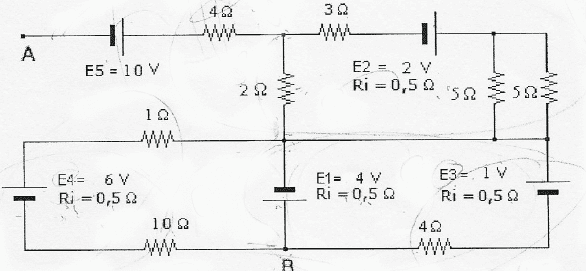
upload_2016-9-14_17-17-26.png


I'm terrible at Circuits and I'm eager for some motivation and help.
Thanks a lot in advance.
 
Engineering news on Phys.org
You HAVE to show some effort. That's the rule here. We don't spoon feed answers. If you don't even know how to get started, best to go back to your text and work on simpler problems before attacking this more complex one.

For example, start with just the upper left loop from A back around through the 4, 2, 1ohm resistors to the point above E4. Ignoring the rest of the circuit, find the Thevinin equivalent for just that circuit. Then maybe add the upper right loop. Just adding that will make for a fairly complex analysis.

Also, I'm not seeing any "B" node.
 
phinds said:
You HAVE to show some effort. That's the rule here. We don't spoon feed answers. If you don't even know how to get started, best to go back to your text and work on simpler problems before attacking this more complex one.

For example, start with just the upper left loop from A back around through the 4, 2, 1ohm resistors to the point above E4. Ignoring the rest of the circuit, find the Thevinin equivalent for just that circuit. Then maybe add the upper right loop. Just adding that will make for a fairly complex analysis.

Also, I'm not seeing any "B" node.

Thanks a lot for your guidance.
For the upper left loop wouldn't it be:

Rth = 7 ohm
Vth = 10* (2/(2+4+1) ) V

?

(Unfortunately the "B" node got cutted from the print. It's the "R" (a B without the lower leg) under E1)
 
phinds said:
You HAVE to show some effort. That's the rule here. We don't spoon feed answers. If you don't even know how to get started, best to go back to your text and work on simpler problems before attacking this more complex one.

For example, start with just the upper left loop from A back around through the 4, 2, 1ohm resistors to the point above E4. Ignoring the rest of the circuit, find the Thevinin equivalent for just that circuit. Then maybe add the upper right loop. Just adding that will make for a fairly complex analysis.

Also, I'm not seeing any "B" node.

Adding the other right loop:

Rth = 7,4 ohm

Vth = [ 10 * ( 2 / ( 2+ 4 + 1) ) ] + [ 2 * ( 2 / ( 2,5 + 0,5 + 3 + 2 ) ] V

?

Thanks once again for your awesome support.
 
magnetpedro said:
Rth = 7 ohm
yes
Vth = 10* (2/(2+4+1) ) V
I think you need to go back to your textbook, as this shows a fundamental misunderstanding about how these things work.
 
phinds said:
yesI think you need to go back to your textbook, as this shows a fundamental misunderstanding about how these things work.

Hum, let's see.
In that isolated upper left loop, Vth is equal to VAB = VB - VA , right? ( B being the node above E4)
I thought VAB would be the V of the 2 ohm resistor, but I'm clearly confused.

I believe it's a matter of not being able to visualize it correctly.

Sorry for the trouble, do you have any texts or guides I can study?
Can you point me in the right direction, without giving me the final answer?

Thanks again.
 
Last edited:
magnetpedro said:
Hum, let's see.
In that isolated upper left loop, Vth is equal to VAB = VB - VA , right? ( B being the node above E4)
I thought VAB would be the V of the 2 ohm resistor, but I'm clearly confused.

I believe it's a matter of not being able to visualize it correctly.

Sorry for the trouble, do you have any texts or guides I can study?
Can you point me in the right direction, without giving me the final answer?

Thanks again.
It's not the value that you are coming up with, it's the fact that you do not instantly recognize that Vth = E5 that leads me to say you have a fundamental misunderstanding. You need to study the DEFINITION of Thevinin equivalent. I'm sure there must be simple examples and tutorials online if your text doesn't help you.
 
How can Vth be equal to E5? Am I missing something?
 
magnetpedro said:
Can someone guide me through this problems solution?
I need to find the Thevenin's Equivallent for this circuit, between A and B.

upload_2016-9-14_17-17-26-png.105915.png


.

I was taught to find Thevenin in two steps:
1) Find open circuit voltage between the two points. That is VThevenin
2) Replace every internal voltage and current source with its internal impedance, then solve for impedance between the two points. That is ZThevenin .

First thing i'd do is redraw the circuit combining whatever resistances i could. That'll make it look less intimidating.
Example : in top right i see resistances of 3Ω , 0.5Ω, and two fiveΩs that can be replaced by a single 6Ω.

Then i'd use either loop current or mesh current method to solve for VBA with Kirchoff's laws.

It is not apparent to me that Vth is E5, though the algebra might turn out that way - i haven't solved it.
oops - see posts 10 & 11 jh
 
Last edited:
  • #10
jim hardy said:
s:
1) Find open circuit voltage between the two points. That is VThevenin
Exactly. In this case, Vth = E5 (the reduced case I had him working on. The entire circuit in that case is a voltage source in series with some resistors. What kind of math do you need to figure out the Vth = the voltage source?
 
  • #11
phinds said:
Vth = E5 (the reduced case I had him working on. What kind of math do you need to figure out the Vth = the voltage source?
Ahhh, you were working on just one leg of the circuit,,,, from A to the middle node . Now i see what you meant. ...

old jim
 
  • #12
phinds said:
Exactly. In this case, Vth = E5 (the reduced case I had him working on. The entire circuit in that case is a voltage source in series with some resistors. What kind of math do you need to figure out the Vth = the voltage source?
I believe see it now, thanks a lot!
Like this?

upload_2016-9-15_9-21-33.png


The VBA equals the VTh and VB = 10 V and VA = 0 V, right?

Now, I'll try to add the upper right loop.
 
  • #13
Yep, you have the right idea, but you were to find the Vth from A to B so you have the sign wrong.
 
  • #14
phinds said:
Yep, you have the right idea, but you were to find the Vth from A to B so you have the sign wrong.

What do you mean?
Thanks!
 
  • #15
Exactly what I said. I once again advise you to go back and study some basics. You were asked to find Vth as Vab
 
  • #16
phinds said:
Exactly what I said. I once again advise you to go back and study some basics.

Sorry to bother but let me clarify something. In the picture I've posted (#12), isn't VA suppose to be zero since it's a point before the source?
And in point B, if I follow the current's path from A to B, we first have a voltage rise of 10 V (the source) and then a voltage drop of 10 V (in the resistor) so shouldn't VB also equal to zero?

I'm mixing everything up.

Thanks again.
 
  • #17
I see NO reference point ("zero") in your diagram, but traditionally, if there is one, it is at the bottom of the circuit. I once again advise you to go back and study some basics.

Look, I know my harping on this is perhaps not "motivating" for you but it really is what you need to do. This asking semi-random questions on an internet forum and trying to learn that way is not a good idea. It may give you some short-term satisfaction in solving one particular problem but it the important thing is that it won't tell you what you don't know. You need to get systematic about this.
 
  • #18
phinds said:
I see NO reference point ("zero") in your diagram, but traditionally, if there is one, it is at the bottom of the circuit. I once again advise you to go back and study some basics.

Look, I know my harping on this is perhaps not "motivating" for you but it really is what you need to do. This asking semi-random questions on an internet forum and trying to learn that way is not a good idea.

Nevermind, you're probably right.
Thank you very much for your time!
 
  • #19
Thevenin voltage comes down to removing the load and looking back into the where the load was connected and determining the voltage. That really isn't part of Thevenin. It is part of understanding basic circuit analysis. You know, voltage division, current division, all that dandy good stuff.
 
  • #20
Averagesupernova said:
Thevenin voltage comes down to removing the load and looking back into the where the load was connected and determining the voltage. That really isn't part of Thevenin. It is part of understanding basic circuit analysis. You know, voltage division, current division, all that dandy good stuff.
Exactly, which is why I keep harping on his need to get back to the basics in a systematic way.
 
  • #21
When I was in school and we were shown thevenin I had mixed feelings. I could see it was a powerful tool but not so sure how often a person would need to reach for that tool. Nonetheless, it adds for more practice in circuit analysis. I am glad I had hard-nosed teachers that drilled and drilled and drilled.
 
  • #22
magnetpedro said:
Hello guys,

Can someone guide me through this problems solution?
I need to find the Thevenin's Equivallent for this circuit, between A and B.

View attachment 105915

I'm terrible at Circuits and I'm eager for some motivation and help.
Thanks a lot in advance.

Don't give up yet. What circuit analysis techniques have you learned? Do you know superposition, nodal analysis, mesh and loop analysis?
 
  • #23
Averagesupernova said:
When I was in school and we were shown thevenin I had mixed feelings. I could see it was a powerful tool but not so sure how often a person would need to reach for that tool. Nonetheless, it adds for more practice in circuit analysis. I am glad I had hard-nosed teachers that drilled and drilled and drilled.
In my early days as a working EE when it was most likely to be called for I had little occasion to "reach for that tool" (but not quite never). I, like you, came to see it as just an exercise that helped me learn circuit analysis which was of course very useful.
 

Similar threads

  • · Replies 1 ·
Replies
1
Views
2K
  • · Replies 2 ·
Replies
2
Views
1K
  • · Replies 1 ·
Replies
1
Views
2K
  • · Replies 6 ·
Replies
6
Views
6K
  • · Replies 8 ·
Replies
8
Views
3K
  • · Replies 5 ·
Replies
5
Views
2K
  • · Replies 7 ·
Replies
7
Views
4K
  • · Replies 2 ·
Replies
2
Views
2K
Replies
15
Views
2K
  • · Replies 10 ·
Replies
10
Views
4K