Homopolar motor rotation in Vacuum

Join the discussion
Ask a follow-up here, or get your own question answered by working scientists, mathematicians and engineers — people, not an autocomplete.
Real named experts · corrections over time · the nuance an AI answer skips
18 replies · 2K views
StoyanNikolov
Messages
50
Reaction score
0
TL;DR
Homopolar motor rotation in Vacuum
Hi again,
I've found interesting video.
Roller homopolar motor :
Roller Motor
Do you think the motor from 1:08 min Will self rotate in Vacuum/Space
(No other forces : Gravitational or Other type.)
Thank you in advance.
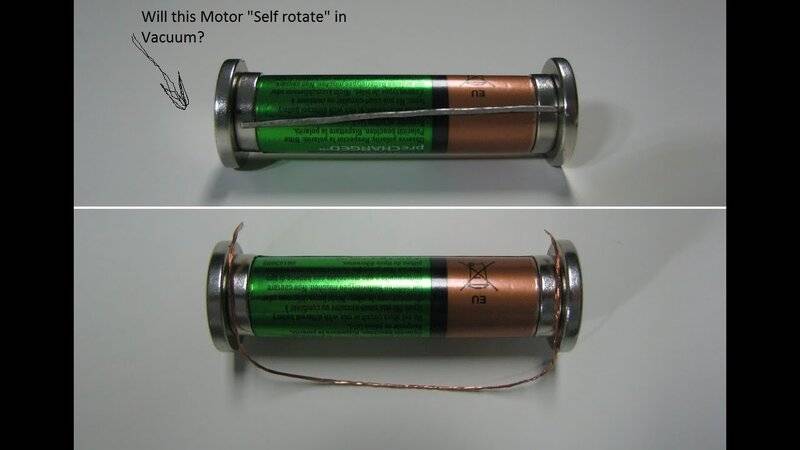
Roller motor.jpg
 
on Phys.org
StoyanNikolov said:
[Do you think the motor from 1:08 min Will self rotate in Vacuum/Space
(No other forces : Gravitational or Other type.)

After a Mentor discussion, the thread is approved for now. It may be closed if it veers into discussion of Reactionless Drives or other subjects that are not allowed at PF.
 
Reply
  • Like
Likes   Reactions: russ_watters and Dale
StoyanNikolov said:
TL;DR Summary: Homopolar motor rotation in Vacuum

Do you think the motor from 1:08 min Will self rotate in Vacuum/Space
(No other forces : Gravitational or Other type.)
No. Angular momentum is conserved in vacuum/space too.
 
Reply
  • Like
Likes   Reactions: russ_watters
Note that the bottom motor may rotate in free space, as it is composed of two pieces that counterrotate: the wire and the battery with attached disk magnets. The wire rotates one way, the battery and magnets the other. The top motor will rotate and align itself with an external magnetic field (by virtue of becoming an electromagnet placed in a magnetic field), but in the absence of an external magnetic field I can't see any rotation happening.

For those interested in homopolar motors and rollers, more information can be found at the following link: https://www.scielo.br/j/rbef/a/5WgC4T8ygH9kxRcTqjV34bN/?lang=en#
 
Reply
  • Like
Likes   Reactions: Ibix
To clarify, I assumed “self rotate” meant to get a net angular momentum. Not merely to counter rotate different parts
 
Reply
  • Like
Likes   Reactions: russ_watters
Yes. The motor from 1:08 . In the video there is
Rolling Motion (Rotation+Translation)
Will there be Rotation in Vacuum/Space.
Thank you.
 
StoyanNikolov said:
Yes. The motor from 1:08 . In the video there is
Rolling Motion (Rotation+Translation)
Will there be Rotation in Vacuum/Space.
Thank you.
No, the motor will not rotate around like it appears to be doing on the table in that video.
 
StoyanNikolov said:
Hi again. Found this image (Please see the motor on the right side)
It it relevant ?
Relevant to what? Please elaborate.
 
StoyanNikolov said:
Will there be Rotation in Vacuum/Space.
Thank you.
This has already been answered: NO. You are welcome (again).
 
Reply
  • Like
Likes   Reactions: russ_watters
Drakkith said:
No, the motor will not rotate around like it appears to be doing on the table in that video.
But can it work on the table like shown at 1:00?
 
A.T. said:
But can it work on the table like shown at 1:00?
When you have a buddy tilting the table, yes. :wink:

ADD -- the 1st configuration at 1:00 has fixed conductor, so in the Earth's magnetic field it can experience a torque to align with that field, but it will not cause continuous rotation (no commutation). For the 2nd configuration with the slip-ring setup, it seems possible to get continuous torque on the table in the Earth's gravitational field, which sort of provides continuous commutation.
 
Reply
  • Like
Likes   Reactions: Dale
berkeman said:
ADD -- the 1st configuration at 1:00 has fixed conductor, so in the Earth's magnetic field it can experience a torque to align with that field, but it will not cause continuous rotation (no commutation).
There will be no continuous rotation when floating in zero g.

But can there be continuous rolling on a level table? Let's say there is a constant external magnetic field that has a component vertical to the table.
 
A.T. said:
But can there be continuous rolling on a level table? Let's say there is a constant external magnetic field that has a component vertical to the table.
For the fixed conductor configuration (config #1), the coil will experience a torque to align its magnetic field with the external field. That should result in damped harmonic rotation that eventually leaves the coil horizontal with respect to the vertical external B-field. No?
 
berkeman said:
For the fixed conductor configuration (config #1), the coil will experience a torque to align its magnetic field with the external field. That should result in damped harmonic rotation that eventually leaves the coil horizontal with respect to the vertical external B-field. No?
Not sure what you mean by "coil" and "horizontal with respect to the vertical".

In the top case (shown at 1:00) we have a straight wire with a current in a B-field. This wire will experience a force perpendicular to both: the B-field and the current. If the B-field and current have constant direction then so will the force on the wire. Why shouldn't that force propel it along the table?
 
A.T. said:
If the B-field and current have constant direction then so will the force on the wire. Why shouldn't that force propel it along the table?
There is also the return current through the battery. The 1-turn coil is formed by the wire and the battery. A commutator is needed to get continuous rotation of a current-carrying coil in a magnetic field.
 
Reply
  • Like
Likes   Reactions: A.T.
berkeman said:
There is also the return current through the battery.
But isn't that current in a different B-field than the wire current, due to the permanent magnets at the ends and how their fields combine with the external B-field?
 
I hadn't considered the magnets holding the metal end caps on. Those fields are parallel to the battery, so parallel to the plane of the coil, which it would seem wouldn't affect the forces on the coil carrying the current.