How can I find this formula for the magnetic flux density? (EMagn)

Click For Summary

Discussion Overview

The discussion revolves around deriving the formula for magnetic flux density H using the Biot-Savart law. Participants explore the mathematical steps involved in the derivation, including the relationships between variables and integration techniques. The focus is on theoretical aspects of electromagnetism.

Discussion Character

  • Exploratory
  • Mathematical reasoning

Main Points Raised

  • One participant presents an illustration and applies the Biot-Savart formula to find the magnetic flux density H at a specific point.
  • Another participant suggests expressing variables in terms of angles and integrating over those angles to facilitate the calculation.
  • A later reply indicates a derived expression for H, noting that it applies to a semi-infinite line of current.
  • Another participant mentions that the result for an infinite wire can be derived and is double the semi-infinite case, referencing Ampere's law.

Areas of Agreement / Disagreement

Participants generally agree on the mathematical approach and the application of the Biot-Savart law, but there are different considerations regarding the limits of integration and the implications for different configurations of current-carrying wires.

Contextual Notes

There are unresolved aspects regarding the assumptions made in the derivation, particularly concerning the limits of integration and the specific configurations of the current. The discussion does not resolve these uncertainties.

Boltzman Oscillation
Messages
233
Reaction score
26
Homework Statement
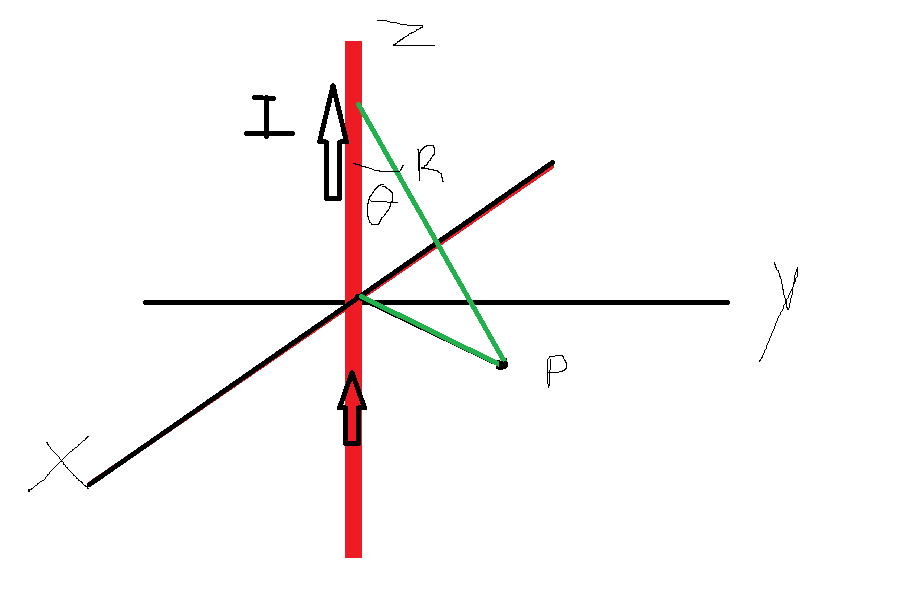
A semi-infinite linear conductor extends between z = 0 and z = inf. along the z- axis. If the current in the inductor flows along the positive z-direction find H(vector) at a point in the x-y plane at a distance r from the conductor.
Relevant Equations
H = I/(4*pi) Integral[( dl x R)/R^2]
I drew an illustration to make this easier:
1571355836024.png

Point P is where I wish to find the magnetic flux density H.
Given the Biot-Savart formula:
$$d\textbf{H} = \frac{I}{4\pi}\frac{d\textbf{l}\times\textbf{R}}{R^2}$$
I can let
$$d\textbf{l} = \hat{z}dz$$
and
$$\hat{z}dz\times\textbf{R} = \hat{\phi}sin(\theta_{Rdl})dz$$
Have I done this correctly so far? If so, what should I let R^2 in the Biot-Savart equation be?
 
Physics news on Phys.org
Looks ok. I'll give you a hint: What is ## \frac{r}{R} ##? One other hint is you would do well to also express ## z ## in terms of ## \theta ## and ## r ##, and write ## dz ## as a ## d \theta ## expression, and integrate over ## \theta ##.
 
  • Like
Likes   Reactions: Boltzman Oscillation
Charles Link said:
Looks ok. I'll give you a hint: What is ## \frac{r}{R} ##? One other hint is you would do well to also express ## z ## in terms of ## \theta ## and ## r ##, and write ## dz ## as a ## d \theta ## expression, and integrate over ## \theta ##.
Ah, I think I see what you mean.
$$R = rcsc(\theta)$$
$$z = rcsc^2(\theta)d\theta$$
$$dz = rcsc^2(\theta)d\theta$$
Thus Biot-Savart's law becomes:
Then doing all the integration from 0 to limiting angle will eventually lead me to:
$$H = \hat{\phi}\frac{I}{4\pi r}$$
Of course this is taking into account that this is a semi-infinite line.
thank you for that clarification.
 
  • Like
Likes   Reactions: Charles Link
Very good. :smile:The result for a whole wire running from ## -\infty ## to ## +\infty ## is twice this answer, and can readily be found from Ampere's law. You will likely see that soon also in your coursework.
 

Similar threads

  • · Replies 2 ·
Replies
2
Views
2K
  • · Replies 1 ·
Replies
1
Views
2K
  • · Replies 13 ·
Replies
13
Views
4K
  • · Replies 3 ·
Replies
3
Views
9K
  • · Replies 3 ·
Replies
3
Views
2K
  • · Replies 7 ·
Replies
7
Views
3K
  • · Replies 1 ·
Replies
1
Views
2K
  • · Replies 19 ·
Replies
19
Views
12K
  • · Replies 2 ·
Replies
2
Views
3K
Replies
5
Views
2K