Isotopic exchange and SIMS diffusion profile measurement

  • Thread starter Thread starter Dario56
  • Start date Start date
  • Tags Tags
    Diffusion
Join the discussion
Ask a follow-up here, or get your own question answered by working scientists, mathematicians and engineers — people, not an autocomplete.
Real named experts · corrections over time · the nuance an AI answer skips
2 replies · 3K views
Dario56
Messages
289
Reaction score
48
Suppose there is a cylindrical (pellet) sample in the oxygen atmosphere as shown on the photo attached. Oxygen diffuses from the outside to the sample interior everywhere on the outer surface of the sample. From the photo, it can be seen that diffusion profile of oxygen is measured in the axial direction of the cylinder. In another words, diffusion is regarded as one-dimensional even though the sample is three-dimensional. I'm not sure how is it possible that one-dimensional solution of the diffusion equation can be applied here?

Oxygen can move in all three dimensions and will do so if partial derivative of concentration is non-zero in the other two Cartesian coordinates (cylindrical coordinates are more appropriate here, but that's not super important for the question).
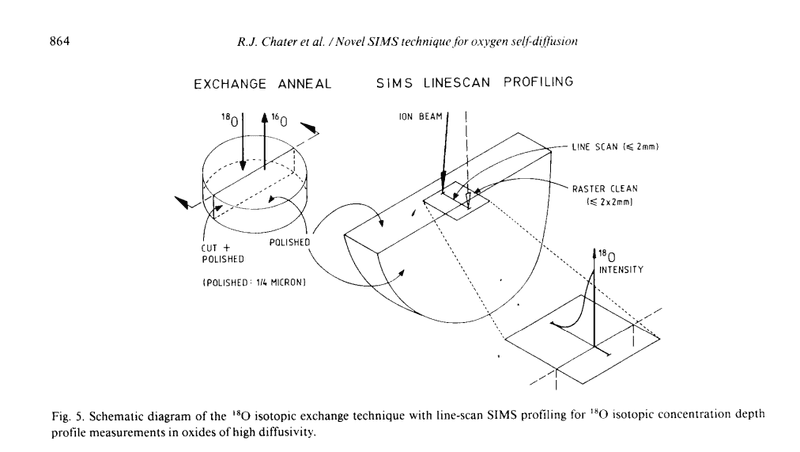
annealphoto.png
 
Engineering news on Phys.org
Dario56 said:
I'm not sure how is it possible that one-dimensional solution of the diffusion equation can be applied here?
IF the sample thickness is small compared to the diameter, the one-dimensional solution applies to all but the outer perimeter. The region around the outer perimeter to a depth of about one sample thickness would require a two-dimensional solution, but a one-dimensional solution will be accurate farther toward the center.

A three-dimensional solution would be necessary if the sample diameter is of similar dimension to the sample thickness.
 
Reply
  • Like
Likes   Reactions: Astronuc, Chestermiller and Lord Jestocost
Dario56 said:
Suppose there is a cylindrical (pellet) sample in the oxygen atmosphere as shown on the photo attached. Oxygen diffuses from the outside to the sample interior everywhere on the outer surface of the sample. From the photo, it can be seen that diffusion profile of oxygen is measured in the axial direction of the cylinder. In another words, diffusion is regarded as one-dimensional even though the sample is three-dimensional. I'm not sure how is it possible that one-dimensional solution of the diffusion equation can be applied here?

Oxygen can move in all three dimensions and will do so if partial derivative of concentration is non-zero in the other two Cartesian coordinates (cylindrical coordinates are more appropriate here, but that's not super important for the question).
So this is about isotopic exchange (18O for 16O) in a metal oxide pellet? As in ZrO2, Al2O3 or MgO?

It will also depend in whether the oxide is an n-type vs p-type oxide, and how the specimen is mounted, e.g., precluding diffusion from the circumference.

But, as jrmichler indicated, the problem can be treated in 1-D if the t << D.