Gary7 said:
They do not speculate that fuel caused the hole (at least, not in this video). The red mark is just a graphical representation of the hole, not of fuel.
I wonder who's idea was it to use the exact same hot orange blob colour to represent the fuel mass and the suspected hole in the Torus? That's just poor graphic design.
I said at the time I couldn't understand how a mass of fuel would make it into the torus so this clarification makes sense. What else would have caused this damage to the suppression pool while leaving the plumbing strong enough for concrete injection I still don't know.
Rive said:
Now, this part. That stuff outside the pedestal definitely looks like a secondary deposit, carried there through the pedestal opening by water. [...] by the look of it I would not expect many fuel outside the pedestal (in case of U1).
Molten fuel is already viscous. Why would you need a separate process to account for its transportation through the pedestal doorway? It is said there was approximately
125 metric tons of fuel and fuel related materials loaded into Unit 1 at the time of meltdown. With the muon scans and other visual/reading data indicating that this mass melted out of the reactor, the melted liquid metal/corium pool had to flow somewhere from there. Down into the basemat or out through the pedestal are pretty much the only viable options. I don't think transportation by water is necessary. As for not expecting fuel outside of the Unit 1 pedestal, I think this is pretty much exactly what happened and Tepco themselves depicted this in their
March 27 handout:
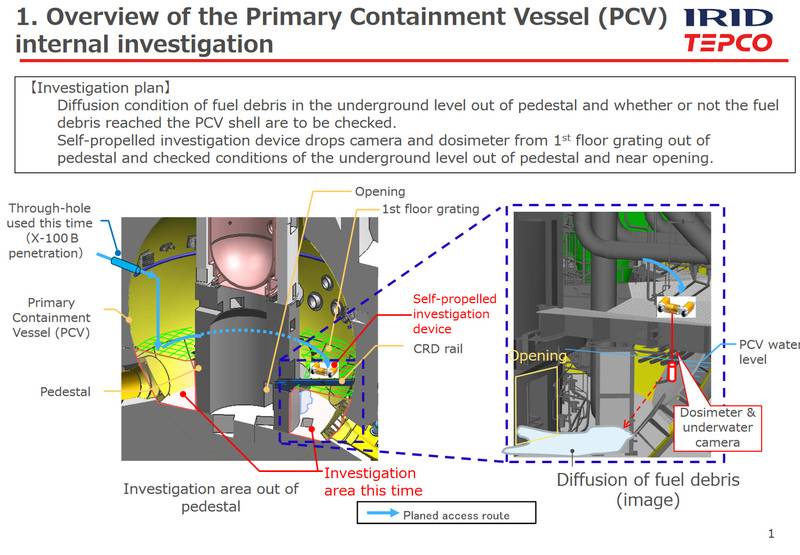
Note the grey blob representing a molten melt fuel mass pooling out of the pedestal doorway into the PVC. With gravity and normal fluid behaviour, once the molten fuel falls from the reactor, flowing outside the pedestal into the PVC is pretty much the only logical next step. The fact that there is an openly communicable doorway from the pedestal to the PVC just makes it easier. One thing you see on page 4 of this handout and a later release with the eventual sample results, was that they actually sampled two areas in the PVC specifically with this in mind. One called D2 right outside the pedestal doorway where they expected the fuel mass to travel causing high radiological readings along the way, and another sample site called D0 on the opposite side of the PVC well away from the pedestal doorway. The idea being that a reading at D0 far from the likely fuel exit point could be sampled to provide a 'background' measurement and then compared to the D2 readings taken outside the doorway to see how radiologically 'hot' that area of the PVC was by comparison.
Rive said:
About the linked papers and experiments: interesting stuff, but as being an engineer who likes to think with his hands (and being good with it), I would not take them into my heart
This is just a personal view but I'm surprised to read that. I don't know if there is a technical or scientific field that benefits or depends on practical investigations and assessments more than engineering. If you want to know how much steel is needed to support a bridge or how a given structure will behave in high wind situations or whatever, you don't build it first and figure out what happens after, you model and test. University studies, thesis papers, research groups, material evaluations... everything is modeled and tested. It's no coincidence that many of the more relevant 'Severe Nuclear accident' studies and investigations were published during the 1980's and 90's. After the Chernobyl disaster, knowing exactly happens during a Nuclear power plant disaster became extremely important work our and was tested very heavily. What happens to the reactor pressure vessel when the fuel can't be cooled, what gases are produced if the fuel catches fire, how long does it take a given amount of molten fuel to burn through a given amount of steel or concrete, what withstand the longest, how viscous is the fuel-corium mix, what structures does it have, what happens when it meets water, what happens when you add Boric acid... Pretty much the entire civilian atomic power operation and plant construction industry is based on the result of these outcomes and studies. Los Alamos, Oak Ridge, the IAEA, many of these studies are carried out or commissioned by the actual operators and providers of the technology using the actual components. The entire industry is practically built and sustained on the outcomes of these studies. Wanting to understanding a nuclear accident but not putting much stock in these studies would be like trying to understand a murder without believing in forensics. Not to over do the point but except for the few unfortunate cases of actual disasters that have accidentally happened, the models and studies are all the data we have about nuclear plant mishaps. I will try to find the one you asked for though.
@Sotan, is there anything that you can share about 02:10 into the video where they show the hot fuel leaving the RV via the central drain pipe? Is that said to be Tepcos actual working assumption on the fuel exit or just from NHKs understanding of the events?