Sotan
- 331
- 256
I'm sorry, my bad. The first link should have been simply http://www.ndf-forum.com/program_en.html
I wonder if they looked at the Ellingham diagrams and thermodynamic stability, of which Zr to ZrN and Zr to ZrO2 are among the most energetic in their class, with the exception of Y/Yb to Y/Yb2O3 (and other lanthanides/actinides), if the passive oxide/nitride breaks down. Pyrophoricity is a tricky subject to those who don't understand the physics.Hiddencamper said:A single hot bundle can ignite the entire fuel pool. This was provided to the NRC and is what led to heightened emotions about unit 4. Sandia told us that even when they tried to inert the test chamber with nitrogen or argon it didn't stop the fire. The zirconium was reacting with the nitrogen. The argon couldn't purge it enough. They tried putting sand on it, and it melted then the zirconium sucked the oxygen molecules out of the sand to keep burning. With no water injection It took several days before the Reaction rate lowered so that they could open the test chamber back up.
It is NUREG-2161 (internal to NRC, i.e., not a contractor report (CR))Hiddencamper said:This is in NUREG-2161 (might be CR/2161)
Hiddencamper said:This was provided to the NRC and is what led to heightened emotions about unit 4.
Hiddencamper said:Another interesting thing I learned: if fuel overheats, its recommended to not try to quench unless you have a lot of injection. If injection is too low you just feed the zirconium reaction and can't cool enough to beat it.
MadderDoc said:According to the recent report which was posted here, Tepco think that a zirconium water reaction occurred in the core of unit 3,with a heat output that maxed at 177 MW,
jim hardy said:That's 604 million BTU/hour , quite a fire .
Help me find that report ? I don't remember seeing it - but i miss a lot. Ones immediately above seem to be printed in Japanese.
MadderDoc said:According to the recent report which was posted here, Tepco think that a zirconium water reaction occurred in the core of unit 3, with a heat output that maxed at 177 MW, during the morning of March 13 in 2011. BOE, that is an impressive burn rate, consuming about 1.6 tons of zirconium/minute. Makes me wonder how much Zr was present in total in the core.
jim hardy said:That's 604 million BTU/hour , quite a fire .
Help me find that report ?
Hiddencamper said:Of course the core is still mostly or all in place you want to inject with whatever you have but if it's not you want to avoid a big pressure spike.
the HPCI stopped at 2:42 on March 13. The reason for that appears to be a drop of pressure in
the reactor. The other probable cause could be water-vapor outflow from the HPCI system.
∙ (Status of the reactor core) The operation for injection of water containing boric acid
commenced using a fire extinguishing line at around 9:25 on March 13. However, the water
could not be injected sufficiently due to the high pressure in the reactor, and the water level in
the reactor lowered. As a result, water injection was halted at least for 6 hours and 43 minutes
after the HPCI stopped at 02:42 on March 13 until water injection using the fire extinguishing
line started at 09:25 on the same day.
jim hardy said:Adding energy to gas usually raises its pressure...
THEN the time of heat production (purple in the NDF chart, first image in this post ) should correlate with the pressure rise around 3:30 AM, beginning of "without water injection" interval, not the pressure drop around 9 am at end of that interval ?
jim hardy said:i've only added two lines to your picture to help me visualize the time frame
wetwell vent(purple) and explosion(red)
MadderDoc said:The RPV pressure drop around 9 am Tepco have thought might have been caused by the Automatic Decompression System's being (unintendedly) triggered. IOW, the abrupt RPV pressure drop at 9 am would then be explained by the ADS forcing the opening of several (6-8) SRVs, adding further to the loss of RPV water inventory at that time.
jim hardy said:Your ADS seems a better fit with Occam.
Fair question.MadderDoc said:At the least one is allowed to ask: if the RPV didn't fail in a major way at 9 am on March 13 -- such as to produce the mess that can be observed there now -- when did it?
jim hardy said:are these broken tubes of some sort ?
.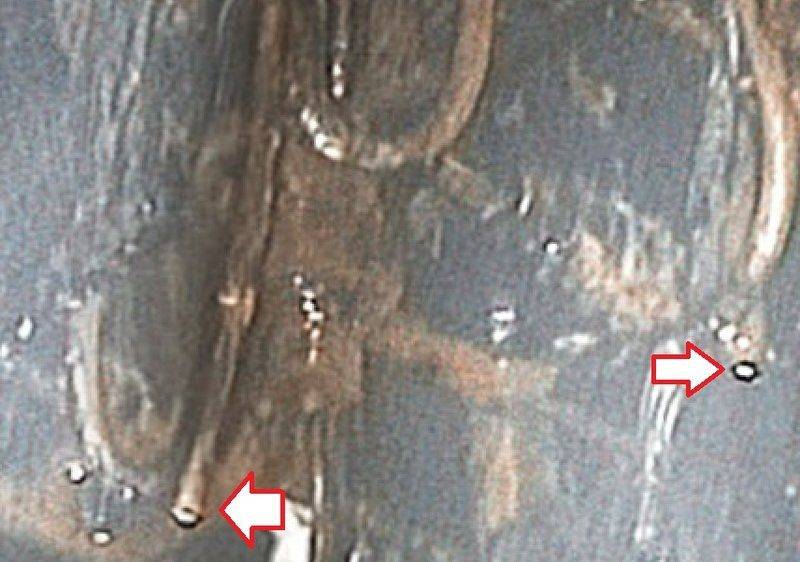
2X snip from Sotan's picture , http://photo.tepco.co.jp/library/170330_01/170330_07.jpg
jim hardy said:I see lots of 'stuff' that appears to have run down from above. No clue whether it came through vessel bottom or down outside of vessel from above, running along underneath the insulation.
No clue what it is.
Looks a lot like sea salt , maybe some boric acid too, but that's just a visual interpretation of course prejudiced because i know they injected both.
Hiddencamper said:How automatic depressurization system works
MadderDoc said:Thank you for explaining this, Hiddencamper. Do you know, once an ADS blow-down has been initiated, how or when is it triggered to end, meaning, is there some automatic to release the SRVs to come back closed again dependent on changing signals of water level/pressure? They would by design, I believe, come back closed passively, when/if power has run out to open/keep them actuated in the open position -- but besides that, assuming there is enough power, I wonder if there is some logic to actively trigger them to come back closed.
Hiddencamper said:The ADS logic seals in once it activates and remains sealed in.
MadderDoc said:Now I wonder when Tepco think the vessel eventually was breached.
MadderDoc said:Tepco would think, it seems, that the vessel was breached already by about noon
jim hardy said:i haven't yet learned which goes with which unit.