Lattice systems and group symmetries

Click For Summary
SUMMARY

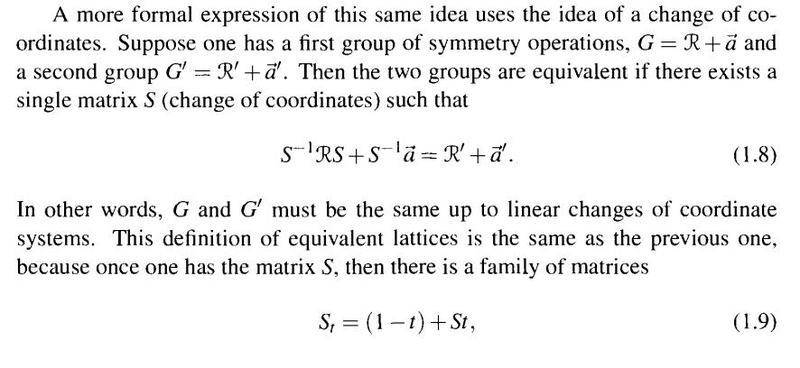
The discussion centers on the equivalence of two lattice systems as explained in Marder's "Condensed Matter Physics." The key assertion is that if a single matrix S exists such that S-1RS-1 + S-1a = R' + a', then the two groups are equivalent. This equivalence is established through a similarity transformation involving the matrix S and its inverse, which applies to both the rotation (R) and translation (a) components of the lattice systems. Marder emphasizes that the existence of one linear transformation implies a family of transformations, reinforcing the power of group theory in crystallography.

PREREQUISITES
  • Understanding of matrix operations and transformations
  • Familiarity with concepts of group theory in physics
  • Knowledge of crystallography principles
  • Basic comprehension of linear maps and their applications
NEXT STEPS
  • Study Marder's "Condensed Matter Physics" for detailed explanations of lattice systems
  • Explore the concept of similarity transformations in linear algebra
  • Research group theory applications in crystallography
  • Learn about the mathematical foundations of linear maps and their implications
USEFUL FOR

Physicists, mathematicians, and students in condensed matter physics or crystallography who seek to understand the relationship between lattice systems and group symmetries.

fyw
Messages
3
Reaction score
0
Dear all,

In Marder's Condensed matter physics, it uses matrix operations to explain how to justify two different lattice systems as listed in attachment.
marder.jpg


However, I cannot understand why the two groups are equivalent if there exists a single matrix S satisfying S-1RS-1+S-1a=R'+a'.

Can someone help me to understand it? Thank you.
 
Physics news on Phys.org
I'm sorry you are not generating any responses at the moment. Is there any additional information you can share with us? Any new findings?
 
Marder is saying that if there is a linear map between the two lattice systems, then they are equivalent. The original system is defined by a Rotation (R) and a translation (a).

The matrix S and its inverse are performing a similarity transformation (coordinate system change) on R, and also apply it to the translation.

Marder then notes if there exists one such linear transform, then there exists a family of them.

Personally I found Marder too abstract for my taste, though the group theoretical approach to crystallography is very powerful. But most of the math is not very difficult - it just appears dense because of the writing style.
 

Similar threads

  • · Replies 5 ·
Replies
5
Views
3K
  • · Replies 4 ·
Replies
4
Views
2K
  • · Replies 3 ·
Replies
3
Views
5K
  • · Replies 4 ·
Replies
4
Views
3K
  • · Replies 2 ·
Replies
2
Views
2K
  • · Replies 1 ·
Replies
1
Views
2K
  • · Replies 8 ·
Replies
8
Views
1K
  • · Replies 2 ·
Replies
2
Views
3K
  • · Replies 2 ·
Replies
2
Views
2K
  • · Replies 17 ·
Replies
17
Views
10K