Load and Stress; 3 angles with different shapes corners

Click For Summary

Discussion Overview

The discussion revolves around the strength of three different angles with distinct corner shapes—rectangular, circular, and triangular—when subjected to the same downward force. Participants explore the implications of geometry on structural integrity, material properties, and fabrication processes.

Discussion Character

  • Debate/contested
  • Technical explanation
  • Conceptual clarification

Main Points Raised

  • One participant suggests that the circular angle may be the strongest due to having the most surface area to support the force.
  • Another participant proposes that the triangular angle could also have significant surface area to support the force.
  • A different viewpoint indicates that the triangular angle is typically the strongest because it lacks a concave notch that could concentrate stress, but acknowledges that in this specific scenario, the circular angle might be stronger due to a straight line of force transmission.
  • It is noted that all angles connect to the ground through the same section, which has the maximum moment, implying that they share the same static limit regardless of shape.
  • Participants discuss material costs and fabrication ease, with the triangular angle having the lowest material costs, the rectangular angle being easiest to fabricate, and the circular angle potentially adding the most structural weight.

Areas of Agreement / Disagreement

Participants express differing opinions on which angle is the strongest, with no consensus reached. Multiple competing views remain regarding the influence of geometry and material properties on strength.

Contextual Notes

Some participants question the absence of an original diagram, which may limit the clarity of the discussion. The analysis appears to depend on assumptions about material properties and structural behavior that are not fully detailed.

Who May Find This Useful

Individuals interested in structural engineering, material science, and design considerations in mechanical applications may find this discussion relevant.
adamkhalid02
Messages
2
Reaction score
0
Post moved from the technical forums to the Schoolwork forums
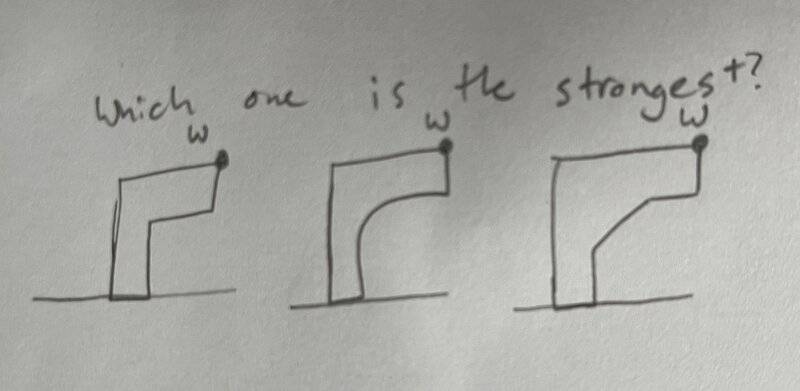
Summary: Each angle has a different type of corner, rectangular, circular, and triangular. Which one is the strongest?

D7FFC1C0-7A18-4A1E-8E56-33258F9BB4CC.jpeg

All three angles are mounted in the ground and made of the same material. The same force ‘w’ towards the ground is acting on all angles, which one is the strongest?
Please explain why it is the strongest, I believe it is the circular one but can’t give a reason other than it has the most surface area to support the ‘w’.
 
Physics news on Phys.org
Welcome!
The triangular one could also have "the most surface area to support the ‘w’."
What have you studied about the subject?
 
adamkhalid02 said:
The same force ‘w’ towards the ground is acting on all angles, which one is the strongest?
Normally I would say #2 is the strongest, because it has no concave notch that will focus energy to one point.
But in this special case, where the concave face is always under compression, I believe the answer would probably be #3, since the line between w and the foundation is straightest, which puts the least tension on the convex face.

But it is so easy to be distracted by an ellegant style.
Fundamentally, they all connect to the ground through the same section, which is also the section with maximum moment, so all structures have the same static limit. The answer will come down to material and fabrication process.

#2 has the lowest material costs,
#1 is easiest to fabricate from stock materials, while
#3 has the greatest additional structural weight, so it comes last.
 
  • Like
Likes   Reactions: adamkhalid02
Baluncore said:
Normally I would say #2 is the strongest, because it has no concave notch that will focus energy to one point.
But in this special case, where the concave face is always under compression, I believe the answer would probably be #3, since the line between w and the foundation is straightest, which puts the least tension on the convex face.

But it is so easy to be distracted by an ellegant style.
Fundamentally, they all connect to the ground through the same section, which is also the section with maximum moment, so all structures have the same static limit. The answer will come down to material and fabrication process.

#2 has the lowest material costs,
#1 is easiest to fabricate from stock materials, while
#3 has the greatest additional structural weight, so it comes last.
Thank you so much!
 
adamkhalid02 said:
Thank you so much!
So was this question for schoolwork? What was the answer you found in your grading? What class was this for, and did it involve any FEA analysis?
 
If this was schoolwork, why did the OP not post the original diagram?
 
Baluncore said:
If this was schoolwork, why did the OP not post the original diagram?
Beats me, let's ask Adam...
 

Similar threads

  • · Replies 3 ·
Replies
3
Views
2K
  • · Replies 10 ·
Replies
10
Views
2K
  • · Replies 1 ·
Replies
1
Views
2K
  • · Replies 2 ·
Replies
2
Views
3K
  • · Replies 6 ·
Replies
6
Views
4K
  • · Replies 5 ·
Replies
5
Views
16K
Replies
39
Views
7K
  • · Replies 9 ·
Replies
9
Views
7K
  • · Replies 2 ·
Replies
2
Views
9K
  • · Replies 17 ·
Replies
17
Views
5K