Mass going up an inclined plane with initial velocity Vo

Click For Summary

Homework Help Overview

The discussion revolves around a mass moving up an inclined plane with an initial velocity, Vo. Participants are exploring the dynamics of the motion, particularly the time it takes for the mass to stop moving up the incline.

Discussion Character

  • Mixed

Approaches and Questions Raised

  • Participants discuss two different approaches to the problem: one involving the y component of the initial velocity and the other focusing on the weight component parallel to the incline. There are conflicting results from these approaches, leading to questions about the correct interpretation and application of forces.

Discussion Status

The discussion is ongoing, with participants requesting more clarity on the original poster's attempts and the specific question being addressed. Some participants emphasize the need for a detailed mathematical translation of the approaches taken, while others critique the initial setup and assumptions regarding forces acting on the mass.

Contextual Notes

There are reminders about forum rules regarding the presentation of work, with a focus on the importance of typing out problem statements and attempts rather than relying on images. Participants also note that the weight is not the only force acting on the mass, suggesting a need for a more comprehensive analysis of the forces involved.

herardo
Messages
4
Reaction score
0
1. Vo
Mass=m


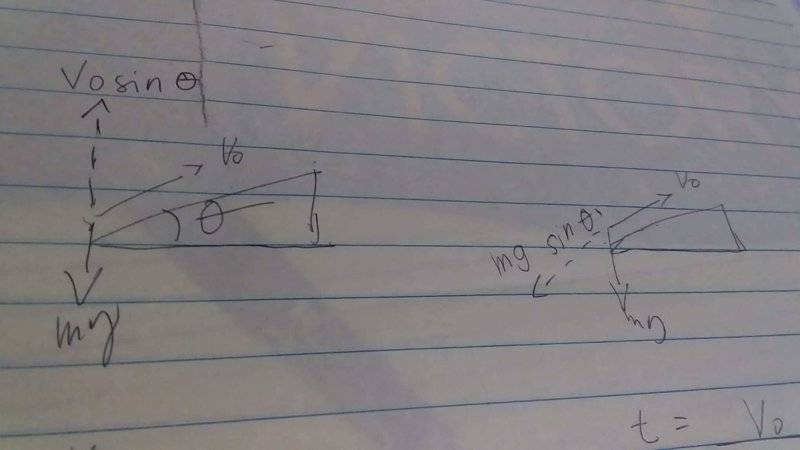
2.So we tried two ways of doing this, one is by taking the y component of the i itial velocity and using that and the other by using the component of its weight parallel to the initial velocity.They give conflicting answers.

For the left one it turns out to be t=Vosinθ/g

But for the right its t=Vo/gsinθ
received_463357710740654.jpeg
mVo/gsinθ
Any thoughts?
 

Attachments

  • received_463357710740654.jpeg
    received_463357710740654.jpeg
    27 KB · Views: 579
Physics news on Phys.org
You have not actually shown your ways translated into maths or how you translate your sketches to an equation to solve. You also have not stated what the actual question is.
 
Orodruin said:
You have not actually shown your ways translated into maths or how you translate your sketches to an equation to solve. You also have not stated what the actual question is.
The question was how much time will it take for the box to stop up the incline
 
You still have not shown your actual attempt. Please note that this is required by forum rules.
 
Orodruin said:
You still have not shown your actual attempt. Please note that this is required by forum rules.
Here
20180829_204200.jpeg
 

Attachments

  • 20180829_204200.jpeg
    20180829_204200.jpeg
    19.2 KB · Views: 799

Attachments

  • 1535546677391.jpeg
    1535546677391.jpeg
    34.5 KB · Views: 409
Please read the homework guidelines.
Do not simply post images of the problem statement or your work.
Please make the effort to type up the problem statement and your work. Ask yourself "If I can't be bothered to spend my time typing it, why should they be bothered to spend their time reading it, much less responding to it?" Use images for supporting figures. You may, of course, attach an electronic copy of the problem statement in addition to the typed version. Indeed, if it's a complicated or long problem, you probably should, but you should always provide a typed version as well.

While posting images may be convenient for you, it's actually one of the most effective ways of getting your request for help ignored. Images are often too big, too small, rotated, upside down, out of focus, dimly lit, or of otherwise poor quality. Your handwriting may not be as easy to read as you think it is. Even when images are readable, they often make viewing and responding to a thread very inconvenient, particularly on a mobile device. Moreover, they're a hindrance to the helpers as portions of the problem statement or your work can't easily be quoted. Using images alone doesn't qualify as filling out the homework template, so your post may be deleted.

Also, the weight is not the only force that acts on the mass in the vertical direction.
 
The force mg is not going to act on the object as depicted by you in the first case, the whole mg will not cause retardation in the object. Acceleration takes place because of a force, here, you have not correctly determined the force which will act on the object.
 

Similar threads

  • · Replies 7 ·
Replies
7
Views
2K
  • · Replies 18 ·
Replies
18
Views
6K
  • · Replies 2 ·
Replies
2
Views
3K
  • · Replies 46 ·
2
Replies
46
Views
4K
  • · Replies 5 ·
Replies
5
Views
2K
Replies
3
Views
2K
Replies
1
Views
1K
  • · Replies 6 ·
Replies
6
Views
3K
Replies
13
Views
2K
  • · Replies 3 ·
Replies
3
Views
2K